
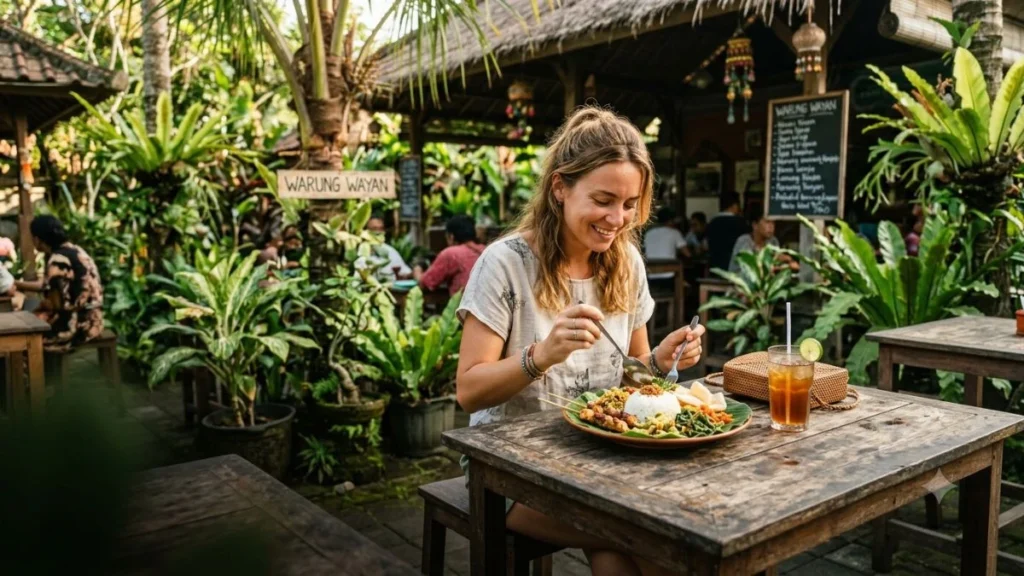
Bali has a reputation as a cheap destination that isn’t entirely accurate anymore — and a reputation as an expensive one that isn’t accurate either. The honest picture is that Bali operates at almost any budget, with the gap between a IDR 150,000 warung lunch and a IDR 600,000 restaurant lunch being the same plate of food in a different chair.
This bali on a budget guide covers what things actually cost in 2026, where the genuine savings are, what’s worth spending on versus what isn’t, and how to build a daily budget that matches what you’re actually trying to do rather than what the most optimistic travel blogs suggest.
Quick Facts — Bali Budget Benchmarks 2026
- Budget daily spend: IDR 300,000–500,000 (USD 18–30) — hostel, local food, scooter
- Mid-range daily spend: IDR 700,000–1,500,000 (USD 42–90) — guesthouse/villa, mix of warungs and restaurants, private driver
- Comfortable daily spend: IDR 2,000,000–4,000,000 (USD 120–240) — private villa, restaurant dining, driver
- Tourist levy: IDR 150,000 per arrival (one-off)
- Visa on Arrival: IDR 500,000 (one-off)
- Currency: IDR — ATMs widely available, no-fee card saves significantly
Where the Money Actually Goes in Bali
Before getting into line items, it’s worth being clear about the structure of spending in Bali — because the categories where most travellers overspend are not the obvious ones.
Accommodation is where the biggest range exists and where the biggest savings are available. A bed in a hostel dorm in Canggu costs IDR 100,000–200,000. A private room in a family guesthouse in Ubud costs IDR 250,000–450,000. A private villa with pool costs IDR 700,000–2,000,000 for a one-bedroom. The difference in experience between a clean guesthouse and a mid-range villa is real but not as large as the price gap suggests — Bali’s guesthouses are genuinely comfortable and the common areas are often where you meet other travellers.
Food is where Bali remains genuinely cheap if you eat where Balinese people eat. A nasi campur plate at a warung costs IDR 20,000–35,000. A smoothie bowl at a tourist café in Canggu costs IDR 65,000–90,000. Both are available everywhere. The choice between them across three meals a day produces a very different monthly spend — not because one is better value, but because they serve different functions.
Transport is the category most budget travellers get wrong. Hiring a scooter at IDR 70,000–100,000 per day is the cheapest option per kilometre. But Gojek and Grab for short in-town rides (IDR 15,000–35,000 per trip) are cheaper than a full-day scooter hire for travellers who aren’t covering significant ground every day. A private driver for a full-day itinerary at IDR 500,000–700,000 is expensive relative to a scooter but excellent value relative to an organised tour covering the same ground.
Activities are where Bali is most negotiable. The majority of Bali’s most rewarding experiences — the Campuhan Ridge Walk, the morning market, watching Galungan celebrations, walking village lanes, attending a temple ceremony — are free or cost under IDR 50,000. The expensive activities (white water rafting, ATV tours, elaborate cooking classes with market visits) are good but not necessary for a rich experience.
Accommodation: The Budget Options That Actually Work
Hostels (IDR 100,000–250,000/night)
Bali’s hostel scene is concentrated in Canggu and Seminyak, with a smaller offering in Ubud and Kuta. Female-only dorms are standard at most properties. The better hostels have pools, co-working spaces, and social programs — some are genuinely excellent for solo travellers who want community.
Recommended areas for hostel stays: Canggu for the surf and nightlife community, Ubud for the cultural immersion crowd. Kuta hostels are cheaper but the location’s character is the trade-off.
Family Guesthouses / Losmen (IDR 200,000–500,000/night)
The best budget accommodation in Bali — particularly for travellers who want a sense of place rather than a social hostel environment. A losmen (family guesthouse) in Ubud typically means staying in or adjacent to a Balinese family’s compound: a clean room, a small garden or rice field view, breakfast included, a family who knows the area well and will tell you things no guidebook covers.
This is the accommodation format that consistently produces the most positive memories for budget travellers in Bali. The price point is low, the experience is high, and the conversations over breakfast are often the highlight of the day.
Budget Villas (IDR 400,000–700,000/night)
Bali has a genuine market for budget villa accommodation — particularly in Ubud, Canggu, and rural East Bali — where a private room with a small pool or garden costs barely more than a mid-range hotel room. These are often family-owned properties where the villa format is the accommodation model rather than a luxury positioning.
Booking direct (via WhatsApp or the property’s own site) often produces better rates than through aggregators. Calling a property and asking for their direct booking rate is worth doing for stays of 3 nights or more.
Food: Eating Well on a Budget in Bali
The most important thing to understand about eating on a budget in Bali: the food at the cheap end is not a lesser version of the food at the expensive end. A nasi campur warung and a tourist café are producing different cuisines for different markets. The warung version is often better.
Warung Eating (IDR 15,000–40,000 per meal)
The baseline of eating in Bali — rice with rotating side dishes, freshly cooked, served fast. Nasi campur (rice with mixed sides), mie goreng (fried noodles), bakso (meatball soup), soto ayam (chicken soup) — all IDR 15,000–35,000 at a local warung. Add fresh fruit juice for IDR 10,000–15,000.
The warungs with the highest turnover and the most local customers are the reliable ones. Look for plastic chairs, hand-written menus, rice served from a bain-marie — these are signs of a warung operating for a local clientele rather than performing for tourists.
Market Food (IDR 5,000–20,000 per item)
The morning markets in Ubud, Gianyar, and surrounding villages sell cooked food alongside the fresh produce. Jaja (Balinese rice cakes), lawar (minced meat with vegetables and coconut), grilled corn, pisang goreng (fried banana) — all available at market prices that are meaningfully below even warung prices.
The Gianyar Night Market (about 12km from Ubud, open from 6pm) is one of the better food markets in Bali’s interior — a long covered space with dozens of stalls selling local dishes at IDR 10,000–25,000 per plate. Worth the trip for a budget dinner and a strong contrast to the tourist restaurant scene.
Budget Restaurants (IDR 40,000–100,000 per meal)
The mid-tier — tourist-facing restaurants that still maintain reasonable prices. Most coffee shops in Ubud and Canggu fall here: a smoothie bowl and coffee for IDR 60,000–90,000, a rice or noodle dish for IDR 45,000–75,000. Not cheap by warung standards but significantly below the full tourist restaurant pricing of IDR 150,000+ per main.
Transport: Getting Around Without Overspending
Scooter Hire (IDR 70,000–100,000/day)
The cheapest per-kilometre option for travellers covering significant ground daily. Fuel costs IDR 10,000–15,000 per litre (petrol sold in labelled bottles at small shops along most roads). A full day of riding costs IDR 70,000–120,000 all-in.
The trade-off: requires an international driving permit for the correct vehicle class, carries the traffic safety risk detailed in the Bali travel advisory 2026, and may affect travel insurance coverage if you’re riding without a valid licence.
Gojek and Grab (IDR 15,000–50,000 per ride)
For in-town movement and short distances, app-based rides are often cheaper than a scooter hire. Ubud town centre to Campuhan Ridge: IDR 15,000–20,000. Seminyak to Canggu: IDR 25,000–35,000. Sanur to Denpasar airport: IDR 60,000–80,000.
The Gojek food delivery function (GoFood) also enables ordering from warungs that don’t deliver independently — useful for budget eating from your accommodation.
Bemo (Local Minibus) (IDR 5,000–20,000)
The traditional public transport of Bali — small minibuses running fixed routes at fixed prices. Declining in frequency as Gojek has replaced much of the short-distance function. Still operating on some routes in the Denpasar area and between Ubud and Gianyar. For travellers with time and patience, the cheapest way to move between towns.
Perama Tourist Shuttle (IDR 50,000–150,000)
Fixed-route tourist shuttles connecting the main tourist areas: Kuta, Sanur, Ubud, Lovina, Amed, Padang Bai. Not the cheapest option but significantly cheaper than a private driver for inter-city movement and more convenient than the bemo system. Book through Perama’s offices in each area or online.
Free and Low-Cost Activities
This is where the Bali budget picture looks most different from the standard travel blog version — because many of Bali’s best experiences cost nothing or very little.
Free:
The Campuhan Ridge Walk from Ubud. Watching the sunset from any of the Bukit cliff viewpoints. The morning local market in Ubud before 8am. Walking the village lanes of Penestanan, Nyuh Kuning, or Mas. Watching the herons return to Petulu at dusk. Attending a temple ceremony (from a respectful distance). The beach at Sanur at dawn. The rice fields east of Nyuh Kuning on foot.
Under IDR 50,000:
Most temple entrance fees (IDR 30,000–50,000). The Ubud market browsing (free to walk through, buy only what you want). Tegallalang rice terraces informal entry (IDR 10,000–20,000 at the access points). Gunung Kawi (IDR 50,000). Goa Gajah (IDR 50,000).
IDR 50,000–150,000:
Tirta Empul including sarong rental. Evening Kecak performance at Ubud Palace (IDR 100,000–150,000 — one of the best value experiences available in Bali at any budget). Monkey Forest (IDR 80,000).
Where to spend if you’re going to: A cooking class (IDR 350,000–500,000) delivers more genuine cultural engagement than most organised tours. A single good dive or snorkelling trip to Tulamben or Amed (IDR 300,000–500,000 including equipment) is better value than multiple mediocre beach clubs.
The Hidden Costs That Catch Budget Travellers
Visa on Arrival: IDR 500,000 — paid on arrival or in advance via e-VoA. Not optional.
Tourist levy: IDR 150,000 per arrival — paid via Love Bali platform. See the Bali travel advisory 2026 for current payment process.
ATM fees: Using a standard bank card at Bali ATMs incurs fees at both the ATM (IDR 25,000–50,000 per withdrawal) and your home bank. A Wise or Revolut card eliminates the home bank fee and reduces the total cost significantly. Worth setting up before travel.
Travel insurance: Non-negotiable, not a place to save. A policy covering medical evacuation, which can cost USD 50,000+ if required, costs a fraction of that. Budget it as a fixed cost of the trip.
Baggage fees: Budget airlines serving Bali (AirAsia, Scoot, Jetstar) have strict baggage limits with high excess fees. Pack within your allowance or buy baggage in advance online.
Alcohol: Beer is cheap (Bintang IDR 25,000–45,000 at a warung, IDR 60,000–80,000 at a bar). Imported spirits and wine at tourist bars are not cheap and add up quickly on a budget itinerary.
A Realistic Daily Budget Breakdown
Strict budget (IDR 350,000–500,000/day):
Hostel dorm IDR 150,000 + warung breakfast IDR 20,000 + warung lunch IDR 25,000 + warung dinner IDR 30,000 + 2 Gojek rides IDR 40,000 + 1 temple entry IDR 50,000 + water and snacks IDR 30,000 = approximately IDR 345,000. Achievable but requires consistent warung eating and free or low-cost activities.
Comfortable budget (IDR 700,000–1,200,000/day):
Guesthouse private room IDR 350,000 + warung breakfast IDR 25,000 + mid-range lunch IDR 75,000 + warung dinner IDR 35,000 + scooter hire IDR 85,000 + fuel IDR 20,000 + 1–2 activities IDR 100,000 + water and snacks IDR 40,000 = approximately IDR 730,000. Comfortable, flexible, and representative of how most independent travellers experience Bali.
Mid-range (IDR 1,500,000–2,500,000/day):
Small villa IDR 800,000 + restaurant breakfast IDR 75,000 + restaurant lunch IDR 150,000 + warung or restaurant dinner IDR 120,000 + private driver IDR 600,000 + activities IDR 200,000 = approximately IDR 1,945,000. This is the budget that produces the Bali most people envision — private pool, good food, private transport — without the luxury hotel price tag.
FAQ
Is Bali cheap to travel in 2026?
Compared to Europe, Australia, and North America — yes, significantly. Compared to other Southeast Asian destinations like Cambodia or Vietnam — less so than it used to be. The honest answer is that Bali is excellent value at the mid-range level and very cheap at the budget level. The luxury end of the market is competitive with anywhere in the region.
How much money do I need per day in Bali?
A realistic comfortable budget is IDR 700,000–1,200,000 (USD 42–72) per day including accommodation, food, transport, and activities. This can be reduced to IDR 350,000–500,000 with hostel accommodation and consistent warung eating, or extended to IDR 2,000,000+ for villa accommodation and restaurant dining.
Is Bali cheaper than Thailand?
Broadly similar at the mid-range level, with Bali offering better value on accommodation (private villas are more accessible price-wise than equivalent Thai options) and Thailand offering better value on food at the street food level. Transport in Thailand is more developed for budget travellers. Both are excellent value relative to Western home countries.
What is the cheapest way to get around Bali?
A scooter hire (IDR 70,000–100,000/day) is the cheapest option for travellers covering significant ground. Gojek and Grab are cheaper for short in-town trips. The bemo (local minibus) is the cheapest inter-town option but limited in routes and frequency.
Can you do Bali on USD 50 a day?
Yes. USD 50 is approximately IDR 800,000 — enough for a clean private guesthouse room, warung meals three times a day, a scooter hire, one activity, and still have change. It requires eating predominantly at warungs rather than tourist restaurants and choosing guesthouses over villas, but neither of those things diminishes the quality of the Bali experience.
The bali on a budget picture in 2026 is good news for travellers who are willing to eat at warungs, stay at family guesthouses, and organise their own transport. The experiences that cost nothing — the ridge walk at dawn, the village lanes, the evening herons, the morning market — are among the best available. The things that cost money at the budget end (temple entries, a cooking class, an evening performance) are priced at a level that makes them accessible across almost any travel budget.
The version of Bali that requires significant daily spend is the resort-and-beach-club version. The version that costs very little is the one most people describe as the trip they keep thinking about.
For building the itinerary that makes the most of a budget trip, the things to do in Ubud Bali guide and Ubud hidden villages guide cover the territory. For what to eat and where, the honest guide to the best warungs in Ubud is the practical starting point.