
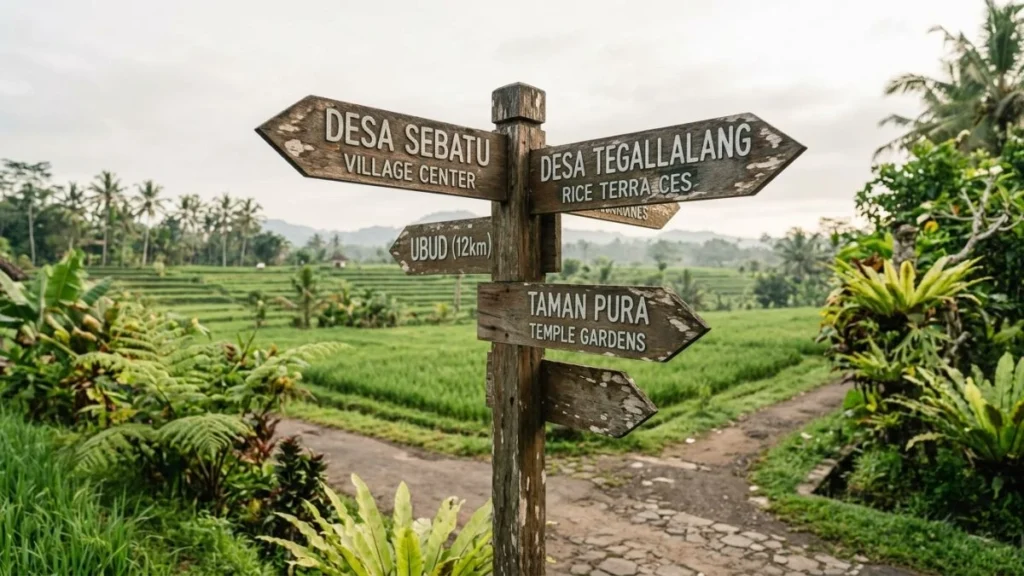
Most Bali itineraries are built around coverage — how many temples, how many beaches, how many rice terraces can be fitted into ten days before the flight home. The result is a trip that moves too fast to land anywhere, a series of photographs of places you were in for forty minutes.
This bali slow travel itinerary is built on a different premise: fewer places, longer in each one, and enough space in the days for something unplanned to happen. It covers two weeks — the minimum time that slow travel in Bali actually requires — with three bases, each chosen for what it offers over several days rather than several hours.
Quick Facts
- Duration: 14 days
- Bases: Ubud (5 nights), East Bali — Amed or Sidemen (4 nights), South Bali — Sanur or Seminyak (4 nights)
- Transport: Private driver for inter-base transfers; scooter or Gojek within each base
- Budget: IDR 700,000–1,500,000/day depending on accommodation choices
- Best season: April–October (dry season)
- What this itinerary is not: A checklist. Some days have nothing scheduled on purpose.
The Philosophy Behind Slow Travel in Bali
Slow travel is not a pace — it’s a relationship with a place. It means staying long enough in one location to have a favourite warung, to recognise the family in the compound across the lane, to know which café has the best light in the morning and which temple is quietest after 4pm.
Bali is particularly well-suited to this approach because the island operates at multiple speeds simultaneously. The tourist circuit — Tegallalang at 10am, Tirta Empul at noon, Kecak at sunset — is one speed. The Balinese daily rhythm — offerings at dawn, market at 6am, temple ceremony in the late afternoon — is another. Slow travel in Bali means spending enough time in one place to encounter the second one.
The itinerary below builds in rest days not as recovery from travel but as the days when the best things happen: the conversation that goes longer than expected, the ceremony you stumble into on a lane you walked down without a plan, the dawn that turns out to be different from all the others because you were there to see it.
Base One: Ubud — Days 1 to 5
Five nights in Ubud is enough to move past the tourist surface and into something more like residence. By day three you have a coffee order, a preferred walking route, and an opinion about which warung serves the better nasi campur. By day five you’re giving directions to other travellers.
Where to Stay
A family compound guesthouse (losmen) on the quiet lanes of Penestanan, Nyuh Kuning, or the roads north of the central market. Not a hotel — the guesthouse format places you inside a residential neighbourhood rather than adjacent to it. Budget IDR 250,000–450,000 per night for a clean private room with breakfast. Book direct where possible; most Ubud guesthouses have WhatsApp contacts.
Day 1 — Arrive and Do Nothing Ambitious
Arrive in Ubud by early afternoon. Walk the central market area without buying anything — just orient. Eat dinner at the first warung that looks busy with local customers. Sleep early. This is not wasted time. Arriving anywhere and immediately attempting to see everything is the fastest way to see nothing.
Day 2 — The Ridge and the Market
The Campuhan Ridge Walk at 6:30am — before the heat and before the other tourists. Return to central Ubud by 8:30am when the local morning market is still in transition, the tourist stalls just setting up alongside the last of the produce vendors. For a full guide to navigating the market, the Ubud market guide covers timing and what’s worth buying. Afternoon: find somewhere to sit for two hours. A café with a rice field view. Read. Write. Nothing particular.
Day 3 — Tampaksiring Loop
Early departure for Gunung Kawi (7am, before the groups arrive) — the carved cliff shrines in the Pakerisan river gorge are at their best in the morning light and with few people in them. Continue to Tirta Empul for the purification pools. Return via Pejeng and the Moon of Pejeng bronze drum at Pura Penataran Sasih. Back in Ubud by early afternoon. Evening Kecak or Legong performance at Ubud Palace — IDR 100,000–150,000, check the gate for the current program.
Day 4 — Village Day
No temples, no major sites. Rent a scooter and ride south through Mas (woodcarving), Batuan (painting tradition), and Sukawati (the larger market with wholesale prices) — not to buy but to understand the supply chain behind the craft objects in the Ubud market. Lunch at a warung in Batuan. Return via the back roads through Peliatan. This is the day that contextualises everything else.
Day 5 — Slow Morning, Petulu at Dusk
A morning with no plan. Breakfast at the guesthouse, a walk through whichever lane you haven’t explored yet, a second coffee somewhere that isn’t the café you’ve already been to twice. Afternoon rest. Drive or Gojek to Petulu village for 5:30pm — watch the herons arrive for thirty minutes. Return to Ubud for a last dinner at the warung that became yours over five days.
Transfer Day: Ubud to East Bali
Private driver from Ubud to Amed or Sidemen — 1.5 to 2 hours depending on destination and traffic. Book through your guesthouse the evening before. The road east from Ubud through the Sidemen valley is one of Bali’s better drives: rice terraces on both sides, Mount Agung appearing and disappearing through cloud, the traffic thinning as you move away from the tourist corridor. Ask the driver to take the Sidemen valley road rather than the coastal highway — it takes slightly longer and is significantly more interesting.
Base Two: East Bali — Days 6 to 9
East Bali operates at a different pace from Ubud. The infrastructure for tourism is present but less dense. The landscapes — black sand beaches, the slopes of Agung, the coastal villages of the Karangasem regency — are quieter and less curated. This is the part of the itinerary where Bali stops feeling like a tourist destination and starts feeling like a place.
Where to Stay
Sidemen valley — if quiet and rice terrace landscape is the priority. Several small guesthouses and villas set in working rice fields, far fewer visitors than Ubud, excellent morning light on Agung. IDR 200,000–500,000 for a clean room with views.
Amed — if the sea is the priority. Shore-entry snorkelling at Jemeluk bay, the USS Liberty wreck at Tulamben 15 minutes west, diving infrastructure well-developed. Quieter than south Bali dive sites. Small cluster of guesthouses along the bay from IDR 200,000.
Day 6 — Arrive and Adjust
The pace in East Bali is genuinely slower. Arrive by noon, swim or snorkel if you’re in Amed, walk the rice field paths if you’re in Sidemen, eat dinner locally. Let the change of scene settle.
Day 7 — The Water Temple and the Drive
Tirta Gangga water palace — 15 minutes north of Amed along the coast road, about 30 minutes from Sidemen. Pools fed by natural springs, tiered gardens, stone carvings. Entry IDR 50,000. Early morning is best — by 9am tour groups arrive. Continue north toward Tulamben for snorkelling at the USS Liberty wreck bow section (starts at 5 metres, accessible without certification, walk in from the beach). Back along the coastal road in the afternoon with the sea on one side and the lower slopes of Agung on the other.
Day 8 — Slow Day
For Sidemen: walk the rice field irrigation paths that run between the terraces — not a formal trail, just the earthen banks between the fields that local farmers use. Ask your guesthouse where to start; they’ll send you in the right direction. Two hours, no guide needed, no entrance fee. For Amed: morning snorkel at Jemeluk before 8am when the water is calmest and the light is best. Afternoon: nothing. This is one of the days the itinerary specifically holds open.
Day 9 — Besakih
Pura Besakih — Bali’s mother temple, on the southwestern slopes of Mount Agung at 950 metres elevation. The largest and most sacred Hindu temple complex in Bali, with over 80 individual temples spread across the slope. About 1 hour from Amed, 45 minutes from Sidemen. Go early. The mist that sits on the complex in the morning, burning off by 10am, is part of the experience. The views from the upper terraces on a clear day extend south across the whole of Bali. Entry IDR 60,000; sarong and sash required.
Transfer Day: East Bali to South Bali
Private driver from East Bali to Sanur or Seminyak — 1.5 to 2 hours. The route west along the coast through Candidasa and Padang Bai is one option; the inland route through Gianyar and past Ubud is another. If you haven’t yet seen the south coast of Bali, the coastal road via Klungkung and Gianyar is the more varied route.
Base Three: South Bali — Days 10 to 13
South Bali is where the itinerary shifts register deliberately. After nine days in Ubud and East Bali, the beach, the wider restaurant choice, and the different social energy of the south are a natural counterbalance. Slow travel doesn’t mean avoiding comfort — it means choosing it intentionally rather than by default.
Where to Stay
Sanur — the strongest recommendation for this itinerary’s south Bali base. Calm beach, flat and walkable, quieter evenings than Seminyak or Canggu, good restaurant variety. The pace in Sanur is slower than the rest of south Bali and sits naturally after East Bali rather than as a jarring transition. IDR 350,000–1,000,000 for a clean guesthouse or small villa.
Seminyak — for those who want more evening atmosphere and restaurant variety. Stronger nightlife, busier beach, higher prices.
Day 10 — Beach and Recovery
A morning on the beach with nowhere to be. Breakfast at a café near the water. Swimming, reading, sitting. Lunch at a warung rather than a beach club. Afternoon nap. This is a rest day in the proper sense — not a wasted day but a day that the itinerary specifically protects.
Day 11 — Nusa Lembongan Day Trip
Fast boat from Sanur harbour (20–30 minutes, IDR 100,000–150,000 each way). A quieter island with good snorkelling at Mushroom Bay, mangrove forests accessible by small boat, and a character noticeably different from the mainland. Day trip works well — return by late afternoon, dinner in Sanur. For a comparison of Lembongan with Nusa Penida, the Nusa Penida vs Nusa Lembongan day trip guide covers the decision.
Day 12 — Tanah Lot and the West
Tanah Lot — the sea temple on a coastal rock formation about 20km west of Seminyak — is Bali’s most photographed temple for good reason: the late afternoon light on the rock, with the surf breaking around it, is genuinely extraordinary. Go at 4pm, not at noon. The tourist infrastructure around it (enormous car park, rows of souvenir stalls) is easier to tolerate when the light pays you back. Continue west to Medewi for a quieter coastal stretch, or north through the rice country of Tabanan toward Jatiluwih if the landscape has more draw than the temple.
Day 13 — Final Ubud Return (Optional)
A one-day return to Ubud for anyone who wants a final morning at the market, a last bowl of jamu at the café that became a habit, or a specific thing left undone from the first five days. By now the return is easy — you know the roads, you know where to park, you know which stalls to go to. This optional day is the itinerary’s acknowledgement that slow travel in one place produces the desire to return before you’ve even left.
Day 14 — Departure
If flying from Ngurah Rai, Sanur is 30–40 minutes from the airport by Gojek or private driver — one of the more convenient departure points in Bali. An early morning walk along the Sanur beachfront before the airport transfer is a reasonable last hour in Bali: the sea at dawn, the fishing boats going out, the offerings placed outside the warungs that are just opening for the day.
FAQ
What is slow travel and how does it work in Bali?
Slow travel means spending more time in fewer places — long enough in each location to develop a routine, recognise faces, and encounter daily life rather than tourist infrastructure. In Bali it means three or four bases rather than a different hotel every night, and enough days in each to move past the obvious things into the quieter ones.
How many days do you need for a slow travel itinerary in Bali?
Two weeks is the practical minimum. Less than that and the bases feel rushed in a different way. Three weeks allows for even longer stays in each base and the option of a fourth area — North Bali or West Bali National Park.
Is slow travel in Bali expensive?
Not inherently. A family guesthouse in Ubud at IDR 300,000 per night with breakfast, warung meals, and a scooter for inter-village exploration produces a daily spend well below what most travellers budget. The per-day cost of slow travel is often lower than fast travel because you’re not paying for transfers, entrance fees, and restaurant meals at every new location every day.
Can you do slow travel in Bali without a scooter?
Yes — Gojek and Grab cover central Ubud and Sanur well. Private drivers are the practical solution for inter-base transfers and full-day excursions. For East Bali specifically, a scooter or private driver is helpful for the coastal road; Gojek coverage is thinner there.
What’s the best base for slow travel in Bali?
Ubud is the most consistent answer — the cultural density, the walking infrastructure, the range of activities at different paces, and the guesthouse accommodation format all suit the slow travel approach particularly well. For those who want the sea as their constant, Amed in East Bali or Sanur in the south both work as primary bases for a slower itinerary.
The bali slow travel itinerary that actually delivers is the one with space in it. The days that end up mattering most are rarely the ones with the most planned — the morning you stayed at the guesthouse too long talking to the family over breakfast, the afternoon you found a temple ceremony on a lane you walked down by accident, the evening the food at the warung was exactly right and you ordered the same thing again.
Bali is a place that reveals itself at a pace most itineraries don’t allow for. This one does.
For the detailed Ubud coverage, the things to do in Ubud Bali guide and Ubud hidden villages guide go deeper on the first base. For the east coast decision between Amed and Sidemen, the Amed vs Candidasa snorkeling guide covers the coastal options. For what to pack, the Bali packing list covers the two-week dry season specifics.