
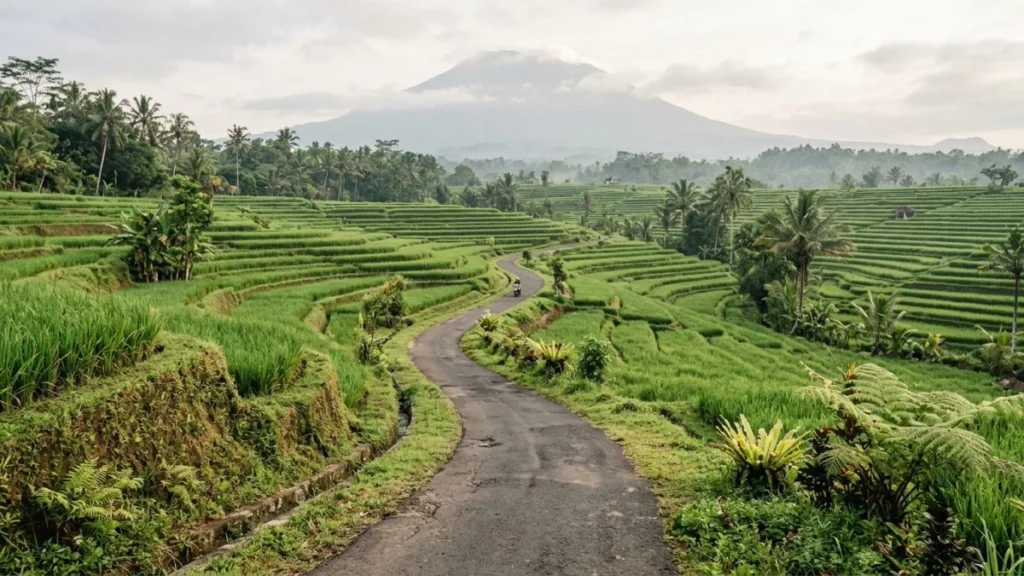
East Bali is the part of the island most visitors see from the window of a shuttle bus going somewhere else. The road from Ubud to Amed passes through some of the most varied landscape in Bali — the Sidemen valley, the lower slopes of Agung, the coastal villages of Karangasem — and most of it disappears in the background of a transfer.
A self-drive road trip through East Bali is a different proposition. The same distance that takes 1.5 hours on a direct transfer becomes a full day or two when you stop where the road warrants stopping. This bali road trip guide covers the East Bali route specifically — the most rewarding road trip circuit available from Ubud — with practical detail on what to see, where to eat, where to stop overnight, and how to do it without a tour operator in the middle.
Quick Facts
- Starting point: Ubud
- Route: Ubud → Sidemen → Tirta Gangga → Amed → Tulamben → Kintamani → Ubud
- Distance: ~180km loop
- Duration: 2 days minimum, 3 days comfortable
- Transport: Scooter (IDR 70,000–100,000/day) or private driver (IDR 600,000–800,000/day)
- Road condition: Good on main roads; narrow and steep on some village routes
- Best season: Dry season April–October
Why East Bali by Road
The case for doing this by road rather than by organised tour is simple: the things worth seeing in East Bali are not evenly distributed along the main road. They’re down the lane that branches left at the unmarked junction, at the village that appears between two larger towns, at the water temple nobody put on the itinerary because it’s not in any guidebook.
A scooter or a private driver gives you the option to stop when something warrants stopping. An organised tour does not. The difference between the two experiences of East Bali is the difference between a photograph of a place and actually being in it.
The route below is a loop — starting and ending in Ubud — that takes the inland valley road south to east, drops to the coast, follows the coastline north to Tulamben, then climbs back through the Kintamani caldera. It can be done in two full days with an overnight in Amed, or stretched to three days with a second night in Sidemen or Kintamani.
Day 1: Ubud to Amed via Sidemen
Ubud Departure: Early
Leave Ubud before 8am. Traffic through the Ubud town centre and south toward Gianyar builds quickly after 8:30. The road east from the Ubud area takes you through Gianyar town — worth a brief stop at the Gianyar Night Market location if you’re passing in the evening, but in the morning a through-road — and continues toward Klungkung.
Klungkung (Semarapura) — First Stop
About 30km east of Ubud, Klungkung is the former seat of the Klungkung Kingdom — once the most powerful royal house in Bali. The Kertha Gosa pavilion in the town centre is worth 30 minutes: an 18th-century open-air hall of justice with ceiling paintings depicting Hindu cosmology and the consequences of moral conduct. The style is a variant of the Kamasan painting tradition — flat, narrative, intricate. Entry IDR 15,000.
The market adjacent to the Kertha Gosa complex sells local produce and textiles at prices noticeably below Ubud market levels — the tourist premium hasn’t reached Klungkung in the same way.
The Sidemen Valley Turn
About 5km east of Klungkung, a road branches north into the Sidemen valley. Take it. This is the decision that defines the road trip.
The Sidemen valley is a 15km corridor of rice terraces rising toward the southwestern face of Mount Agung. The road follows the Unda River north through the valley, with terraced hillsides on both sides and the mountain appearing and disappearing through cloud above. The valley is farmed — this is working agricultural land, not a scenic attraction — and the rhythm of the farming activity (irrigation channels, farmers on the paths between terraces, the sound of water moving through the subak system) is visible from the road.
Several small guesthouses in Sidemen have rice field views and charge IDR 200,000–400,000 for a private room. If the itinerary allows a third night, Sidemen is where to spend it.
Tirta Gangga
Back on the main road heading northeast, Tirta Gangga water palace is 20km north of the Sidemen junction. Built in 1948 by the last Raja of Karangasem, the complex is built around a natural spring — tiered pools, carved stone, water everywhere. The 11-tiered fountain in the main pool is the centrepiece. You can swim in the upper pools (IDR 10,000 extra). The gardens are genuinely beautiful in the morning before the tour groups arrive. Entry IDR 50,000.
The warung directly beside the Tirta Gangga gate does a reasonable breakfast — nasi goreng and fresh juice while the mist is still on the water. One of the better breakfast spots on this route.
Abang and the Road to Amed
From Tirta Gangga, the road northeast climbs through the village of Abang before dropping toward the coast at Culik, where the road to Amed begins. The descent from Abang to the coast is one of the better road sections on this route — narrow, winding, with the sea appearing below and Mount Agung behind. Drive slowly. The views warrant it and the road doesn’t always permit speed anyway.
Amed — Overnight
Arrive in Amed by early afternoon. The bay at Jemeluk — the first main bay after Culik — has the best snorkelling on the Amed coast: reef starting in 2–3 metres of water, shore entry, no boat required. Get in the water before 4pm when the light is still good.
Guesthouses along the Amed coast from IDR 200,000 for a simple room to IDR 600,000 for something with a sea view. Most have restaurants attached serving grilled fish, local rice dishes, and the inevitable smoothie bowl. Dinner at the guesthouse or at one of the small warungs along the beach road — ikan bakar (grilled fish) with rice and sambal, ordered simply and eaten outside while it’s still warm.
Day 2: Amed North to Tulamben, then Kintamani
Morning Snorkel First
Before loading the scooter, a morning snorkel at Jemeluk — the water is calmest before 9am and the light from the east gives the best visibility. If you haven’t snorkelled here yet, this is the reason you drove to Amed. Equipment rental IDR 50,000–75,000 at any bay along the coast.
Tulamben — The Liberty Wreck
15km west of Amed along the coast road, Tulamben is home to the USAT Liberty — a US Army cargo ship torpedoed in 1942 and now sitting in 5–30 metres of water just offshore. The bow section starts at 5 metres and is snorkellable without certification. Walk directly from the black sand beach into the water — no boat, no operator required beyond equipment rental.
The wreck is busiest between 10am and 2pm when day-trip divers arrive from south Bali. Arrive before 9am or after 3pm for significantly fewer people in the water. The marine life around the wreck — schools of reef fish, occasional turtles, coral covering the rusted superstructure — is at its best in the early morning light.
Tulamben has a small warung cluster on the beach road. Lunch here before the inland climb.
The Road to Kintamani
From Tulamben, the route turns inland and climbs. The road north from Tulamben through Kubu and up toward Kintamani gains significant elevation quickly — from sea level to over 1,500 metres in roughly 30km. The landscape transitions from coastal dry forest to cool highland vegetation. The air temperature drops noticeably.
The road is in reasonable condition but narrow in sections. On a scooter, the climb takes 45–60 minutes. In a car it’s faster but the views from a scooter — open on both sides, no window between you and the landscape — are the better experience.
Kintamani and Lake Batur
The Kintamani caldera — a collapsed ancient volcanic crater now containing Lake Batur and the active cone of Mount Batur — is one of Bali’s most dramatic landscapes. The road along the crater rim runs through the town of Kintamani, where a long line of restaurants with caldera views has operated for decades. The views are real; the restaurants are overpriced and tourist-oriented. Stop for the view, eat somewhere else.
Mount Batur (1,717m) is hikeable from the village of Toya Bungkah on the lake shore below. The standard sunrise trek leaves at 3am and takes 2 hours to the rim. If the itinerary has a third day, spending the night in Kintamani for a sunrise Batur trek is one of the stronger optional additions. Simple guesthouses in Toya Bungkah from IDR 150,000.
Return to Ubud
The road south from Kintamani descends through Penelokan and Bangli toward Gianyar, rejoining the main road back to Ubud. Allow 1.5 hours from Kintamani to Ubud in good traffic. The descent through Bangli passes Pura Kehen — one of Bali’s finest state temples, worth a stop if the light is still good — before the road flattens back into the Gianyar plain.
Arrive in Ubud in the late afternoon. The circuit is complete.
Practical Notes for the Road Trip
Scooter vs Private Driver
Both work for this route. A scooter gives you the ability to stop anywhere, move at your own pace, and reach the smaller lanes that a car can’t easily navigate. The trade-off is the physical exposure — the Kintamani climb in particular is cold at elevation on a scooter — and the safety considerations detailed in the Bali travel advisory 2026.
A private driver for two days (IDR 600,000–800,000/day) removes the navigation burden and the physical exposure and allows two people to share the cost. The driver will know the roads, know where to stop, and know the warung in Klungkung that does the best lunch. The loss is spontaneity — a driver will follow a general route but isn’t a scooter in the ability to turn right on impulse.
Navigation
Google Maps works reliably on this route with a local Telkomsel SIM for data. Download the offline map of East Bali before departure as a backup — mobile coverage on the Kintamani climb and some inland sections is intermittent. The main route is straightforward; the village detours benefit from satellite navigation.
Fuel
Petrol is sold in labelled bottles from small roadside stalls across East Bali — IDR 10,000–15,000 per litre. Fill before leaving Ubud and again in Amed. The climb from Tulamben to Kintamani uses more fuel than flat riding. Don’t start the climb on less than half a tank.
Money
ATMs are available in Klungkung, Amlapura (near Tirta Gangga), and Kintamani town. The small villages between these points are cash-only and the denominations in circulation are small. Carry IDR 200,000–300,000 in small notes at all times on this route.
Where to Eat on the Road
Klungkung — warungs around the Kertha Gosa market area for breakfast. IDR 20,000–35,000 for rice or noodle dishes.
Tirta Gangga — the warung at the palace gate for breakfast or early lunch.
Amed — the guesthouse restaurants along the bay road for dinner. Ikan bakar (grilled fish) is the local standard and consistently good. IDR 40,000–70,000 for fish, rice and vegetables.
Tulamben — basic warungs on the beach road. Functional, inexpensive, no pretension. Eat here for the location not the food.
Kintamani — avoid the crater-rim restaurants and eat in one of the small warungs in Kintamani town or in Toya Bungkah village on the lake shore where prices are lower and the food is better.
FAQ
Can you do a Bali road trip without a motorbike licence?
Technically you need a valid international driving permit for the appropriate vehicle class to legally ride a scooter in Bali. This is enforced inconsistently but the legal and insurance implications are real — riding without a valid licence may void travel insurance coverage for accidents. For this route, a private driver is the legally simpler option.
How long does the East Bali road trip loop take?
The full loop from Ubud — Sidemen, Tirta Gangga, Amed, Tulamben, Kintamani, back to Ubud — is most comfortably done in 2 days with an overnight in Amed. It can be compressed into a very long single day but this defeats the purpose of a road trip and misses the morning water time in Amed and Tulamben.
What is the best time of year for a Bali road trip?
The dry season (April–October) is the clear recommendation. The roads on this route are manageable in the wet season but the Kintamani section and the Sidemen valley are frequently clouded over from November through March, which removes one of the main reasons to be on them. Dry season mornings on the caldera rim are reliably clear.
Is East Bali safe for self-drive road trips?
Yes. The roads are in reasonable condition, traffic outside the main Denpasar–Ubud corridor is light, and the route is straightforward to navigate with Google Maps. The main practical concern is the scooter traffic safety considerations that apply across Bali — particularly on the descent from Abang to the coast and the Kintamani climb, where road conditions require attention.
What should I bring for the East Bali road trip?
A light jacket for the Kintamani elevation (temperature drops to 15–18°C at the crater rim). Snorkelling gear or rental money for Amed and Tulamben. Small-denomination cash. A full phone charge and offline maps downloaded before departure. Sunscreen for the coastal sections. Sarong and sash for temple visits.
The bali road trip through East Bali is the itinerary that produces the most consistent answer to the question of what the best thing about Bali was. Not a specific temple or a specific view — the day on the road, the descent to the coast, the morning in the water at Jemeluk, the climb to the caldera in the late afternoon. The accumulation of things that happened because you were moving through the landscape at a pace that allowed them to happen.
For the Ubud base before or after the road trip, the things to do in Ubud Bali guide and the Ubud hidden villages guide cover the territory. For the snorkelling decision between Amed and Candidasa, the Amed vs Candidasa snorkeling guide has the coastal comparison. For packing the road trip kit, the Bali packing list covers the dry season specifics.