
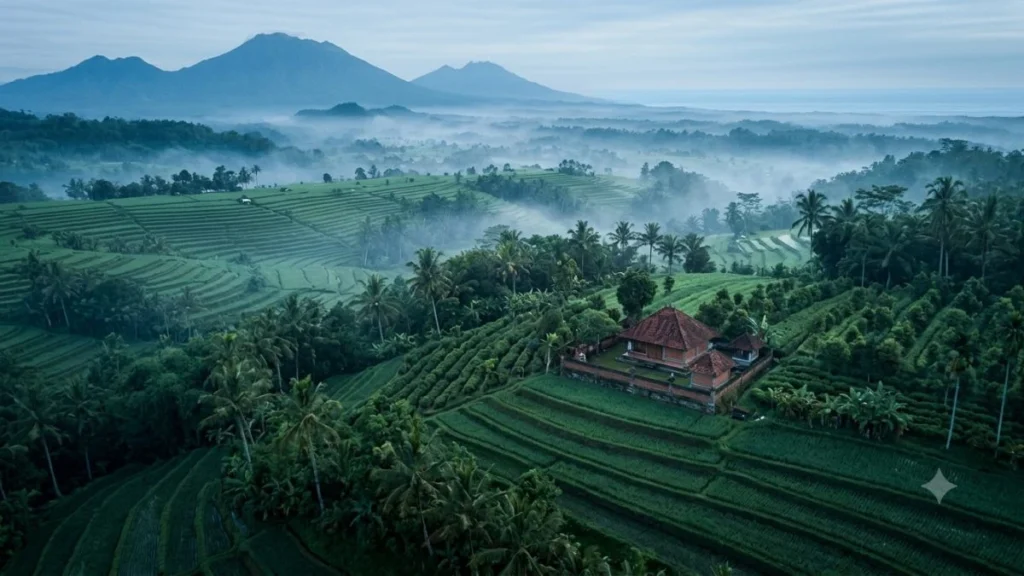
Munduk sits at around 1,000 metres elevation in the Buleleng Regency of North Bali, about 2.5 hours from Ubud and 2 hours from Seminyak. It is not on the standard Bali itinerary. It is not convenient to combine with a beach day. It requires a commitment of at least one night to justify the drive, and the drive itself — a winding climb through coffee and clove plantations above Lake Tamblingan — is part of what makes it worth going.
This munduk bali guide covers what the village actually offers, where to stay, what to do, and why the travellers who make the detour consistently describe it as one of the best decisions of their Bali trip.
Quick Facts
- Elevation: ~1,000m above sea level
- Distance from Ubud: ~75km, 2–2.5 hours
- Distance from Seminyak: ~85km, 2 hours
- Temperature: 18–24°C — significantly cooler than south Bali
- Best for: Nature, waterfalls, trekking, quiet, coffee
- Minimum stay: 1 night (2 nights better)
- Best season: Dry season April–October, though the green is best just after wet season
Why Munduk Exists on the Bali Map
Munduk was a Dutch colonial hill station — coffee and clove plantations established in the highlands during the colonial period, with the village developing as a supply and administrative centre for the surrounding agricultural operations. The plantation infrastructure is still present and still functioning: the coffee trees lining the roads into Munduk are not decorative, and the clove smell that hits you on certain stretches of the approach road is the drying of actual cloves from the surrounding farms.
The village itself is a single main street — Jalan Raya Munduk — with family compounds on both sides, a few guesthouses, several small warungs, and views north across the Buleleng plain to the Java Sea on clear mornings. The pace is slower than Ubud in the way that Ubud is slower than Canggu: not performatively slow, just genuinely quiet because there are fewer people and less commercial pressure.
What Munduk has that the rest of Bali doesn’t: cool air, plantation walks, waterfalls reachable on foot from the village, lake trekking through old-growth forest, and the particular quality of a highland morning — mist burning off the coffee plants, the Java Sea appearing and disappearing on the northern horizon — that doesn’t exist at lower elevation.
Getting There
The drive to Munduk from Ubud takes 2–2.5 hours and is better understood as part of the experience than as a necessary inconvenience. The route north from Ubud passes through Bedugul and the twin lakes of Buyan and Tamblingan before climbing the final steep section to Munduk itself.
The road above the lakes — the stretch between Danau Buyan and the Munduk turnoff — is one of the better drives in Bali: narrow, lined with old plantation trees, with lake views appearing through gaps in the vegetation on the right and the plantation rising on the left. Slow down on this section. Not just because the road warrants it, but because it’s worth seeing.
From Seminyak or Canggu: the route runs north through Tabanan, past the Jatiluwih area, and up through the highland road via Pupuan — a slightly longer route that passes through some of the best coffee and cacao country in Bali before reaching Munduk from the west. This road adds 30–45 minutes but is significantly more interesting than the Denpasar highway north.
Transport options: private driver (IDR 600,000–800,000 for the day from Ubud, dropping you at Munduk), or scooter for experienced riders comfortable with highland winding roads. Public transport does not reliably serve Munduk.
Where to Stay
Munduk’s accommodation is almost entirely small family-run guesthouses and simple plantation lodges — nothing resembling the villa infrastructure of south Bali or Ubud. This is a feature rather than a limitation: staying in a family guesthouse on the Munduk ridge means waking up to a view of the Buleleng plain from a terrace, eating breakfast made by the same family who owns the room, and operating at a pace the accommodation itself sets.
Munduk Moding Plantation — the most established property in Munduk, with private infinity pool villas overlooking the coffee plantation and the northern plain. Prices reflect the setting: IDR 2,500,000–4,000,000 per night. Worth it if the budget allows; the morning view from the pool terrace with the Java Sea in the distance is difficult to improve on.
Family guesthouses on Jalan Raya Munduk — several small properties with clean rooms, plantation or valley views, and breakfast included at IDR 250,000–500,000 per night. These are the right choice for travellers who want the Munduk experience without the resort pricing. Ask specifically for a room with a north-facing view of the plain.
Puri Lumbung Cottages — traditional Balinese lumbung (rice barn) style accommodation converted into guest rooms, set in garden grounds above the village. Mid-range at IDR 600,000–1,200,000 per night. One of the better-known properties in Munduk with a long track record.
Waterfalls: The Primary Activity
Munduk has four waterfalls reachable on foot or by scooter from the village, ranging from a 15-minute walk to a 2-hour trek. The waterfalls are fed by year-round springs from the highland plateau above — they don’t dry out in the dry season the way lower-elevation waterfalls sometimes do.
Munduk Waterfall (Air Terjun Munduk)
The most accessible — a 20-minute walk downhill from the main road on a marked path through coffee and clove plantation. The fall drops about 15 metres into a pool. The pool is swimmable in the dry season. Get there before 9am for the best light and before the day-trippers arrive from Bedugul. Entry IDR 20,000.
Melanting Waterfall (Air Terjun Melanting)
A 30-minute walk from the village on a trail that runs through plantation and then forest. Taller than Munduk Waterfall — approximately 25 metres — and quieter because the path is longer. The trail is well-marked; no guide required. Entry IDR 20,000.
Golden Valley Waterfall and Labuhan Kebo Waterfall
Further from the village — reachable by scooter to the trailhead and then 30–45 minutes on foot each. These two are often combined into a half-day walk that covers all four falls in sequence: Munduk → Melanting → Golden Valley → Labuhan Kebo, with the path returning to the main road above the starting point. Allow 3–4 hours for the full circuit. Go with a local guide for this route (ask at your guesthouse, IDR 100,000–150,000) — the trail between Golden Valley and Labuhan Kebo is less clearly marked.
Lake Trekking: Buyan and Tamblingan
Twenty minutes below Munduk, the twin lakes of Danau Buyan and Danau Tamblingan sit in a forested caldera — the collapsed remnant of an ancient volcano, now occupied by two lakes separated by a narrow land bridge of old-growth forest.
Lake Tamblingan is the less visited of the two and has no motorised boats on its surface — the local community has maintained this restriction as part of the lake’s sacred status. The forest around Tamblingan is among the oldest growth forest accessible to visitors in Bali. Pura Gubug — a water temple on the lake’s western shore, accessible only by traditional dugout canoe (jukung) — sits in vegetation that has not been cleared or planted.
The Tamblingan Trekking Route
The standard Tamblingan trek starts at the lake’s southern shore, takes a jukung canoe across to Pura Gubug on the western shore, and then follows a forest trail north along the lake edge before climbing through old-growth forest back to the main road above Munduk. The full circuit takes 3–4 hours. Hire a guide from the boat operators at the lake entrance (IDR 200,000–300,000 for a half-day including the canoe crossing) — the forest trail is not clearly marked and the guide provides botanical and cultural context that changes what you’re looking at.
The canoe crossing on Lake Tamblingan — flat water, mist on the surface in the morning, the forest closing in on both sides — is one of the more quietly extraordinary experiences available in Bali and almost entirely unknown to most visitors.
Lake Buyan
Adjacent to Tamblingan but larger and more accessible by road. The views from the ridge road above Buyan are the ones most visitors see from the car window on the drive to Munduk. Worth a stop on the descent — there are two or three informal viewpoints with parking — but the lake itself is less interesting than Tamblingan for trekking.
Coffee: What’s Actually Growing Here
The Munduk area produces arabica coffee at altitude — the elevation and temperature that arabica requires to develop complexity. The coffee sold in the tourist cafés of Canggu and Seminyak as “Bali coffee” often comes from this region, though it passes through several stages of processing and marketing before reaching the cup.
In Munduk itself, several small operations sell coffee directly from the farm: dried beans, roasted beans, or brewed on a small stove in the same building the beans were processed in. The price per kilogram is significantly below what the same coffee costs packaged and sold in south Bali. A 250-gram bag of locally processed arabica for IDR 50,000–75,000 is the right souvenir from Munduk — not the carved wooden mask from the market.
The kopi luwak (civet coffee) that appears on menus throughout Bali also has a presence in the Munduk area. The ethical concerns around civet coffee production — civets kept in cages and force-fed coffee cherries — are well-documented. Wild-harvested luwak coffee from genuinely free-ranging civets exists but is almost impossible to verify. Skip the luwak option and buy the standard arabica; it is genuinely excellent and the production is straightforward.
Cloves: The Other Crop
The smell that distinguishes the Munduk approach road from any other road in Bali is cloves — specifically, cloves being dried in the sun on tarps spread across driveways and roadside spaces. The clove trees are everywhere in this area: tall, dense, with small pink flowers that become the clove buds before drying.
Indonesia is the world’s largest producer of cloves, and the Buleleng highlands produce a significant proportion of the Bali harvest. The cloves grown here go primarily into kretek — the clove cigarettes that are Indonesia’s dominant cigarette type — and secondarily into cooking. Watching the drying process from the roadside on the drive into Munduk is one of those incidental moments of agricultural reality that makes the highland approach more interesting than the Ubud-to-Kintamani highway.
What to Eat in Munduk
Munduk’s food scene is small and local. The warungs on Jalan Raya Munduk serve straightforward Indonesian rice and noodle dishes at IDR 20,000–35,000. The guesthouse breakfasts — typically included in the room rate — run to toast with homemade jam, fried rice, or banana pancakes, eaten on a terrace with the northern view.
The Warung Enak on the main street is the most consistently recommended local option — generous nasi campur plates, cold Bintang, and a terrace that looks north over the plain. Nothing sophisticated; everything correct.
For something more substantial, the dining room at Puri Lumbung Cottages serves a longer menu at prices slightly above warung level but still reasonable — useful for an evening when you don’t want to walk further than necessary in the dark on an unlit road.
Combining Munduk with the Rest of North Bali
Munduk sits at the western end of a north Bali circuit that makes sense as a 2–3 day extension from Ubud. The route east from Munduk along the highland road passes through Bedugul and Lake Bratan (Pura Ulun Danu Bratan — the lake temple on Bratan’s shore is one of Bali’s most photographed temples, at its most atmospheric at dawn before the tour groups arrive), continues to Singaraja (Bali’s former Dutch colonial capital, with a distinct northern character from south Bali), and follows the north coast east toward Lovina.
Lovina — Bali’s main north coast resort area, about 45 minutes east of Munduk — offers a calmer, blacker-sand beach alternative to south Bali and is the departure point for the predawn dolphin watching boats that run daily in the calm seas of the Bali Strait. The dolphins are real; the armada of boats that pursues them at dawn is considerable. Manage expectations accordingly.
FAQ
Is Munduk worth visiting in Bali?
Yes — particularly for travellers on longer stays who want something different from the rice terrace and beach circuit. The combination of cool air, plantation landscape, accessible waterfalls, and the Tamblingan lake trek produces an experience that doesn’t exist elsewhere in Bali. The travellers who skip Munduk most often regret it; the ones who go almost universally recommend it.
How long should you spend in Munduk?
One night is the minimum — enough for an afternoon arrival, a waterfall walk, and a morning with the view before departure. Two nights is better and allows the Tamblingan trek, multiple waterfall walks, and the plantation roads at a pace that suits the village. Less than one night — a day trip from Ubud — is possible but misses the reason to go, which is the morning.
Is Munduk cold?
Cooler than the rest of Bali — 18–24°C, which feels cold if you’ve been in 30°C south Bali for a week. Bring a light jacket or layer for evenings and mornings. The temperature is one of Munduk’s features: sleeping under a blanket in Bali is not something available at sea level.
What is the best waterfall to visit in Munduk?
Munduk Waterfall is the most accessible and the most visited. Melanting is quieter and slightly more dramatic. For a half-day walk, the full four-waterfall circuit (Munduk, Melanting, Golden Valley, Labuhan Kebo) covers the full range with a guide from your guesthouse.
Can you drive to Munduk without a guide?
Yes — by scooter or private car. Google Maps navigates the route reliably with a local SIM. The roads are winding but in reasonable condition. The plantation trail walks and the Tamblingan forest trek benefit from a local guide; the driving does not.
Munduk is the Bali that most itineraries leave out. Not because it’s difficult or obscure — it’s neither — but because it doesn’t fit easily into the standard circuit and requires one more night than most itineraries have available.
The travellers who make the time for it describe it consistently in the same terms: the morning view from the guesthouse terrace, the walk through the plantation before the heat of lower Bali has even started, the canoe crossing on Tamblingan with the mist still on the water. These things are available, specific, and not found anywhere else on the island. They just require going.
For the broader North Bali extension, the drive from Munduk east to Lovina and along the north coast connects to the Bali road trip guide approach applied to the north. For the Ubud base before or after Munduk, the things to do in Ubud Bali guide covers the territory. For packing the highland kit — jacket, walking shoes, waterfall gear — the Bali packing list covers the dry season specifics.