
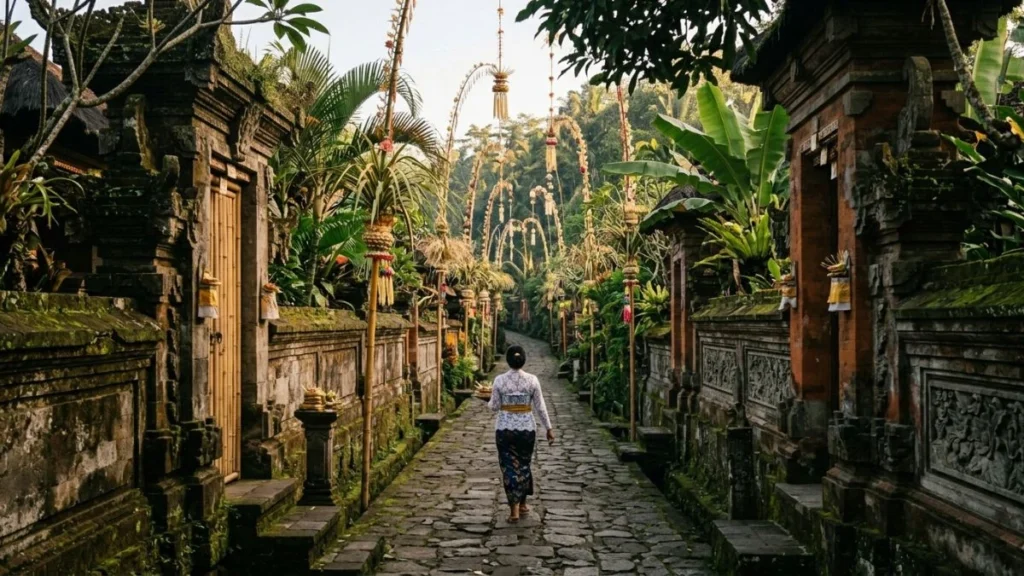
Ubud gets written about as a destination. The villages around it are where Ubud actually lives.
Within a 15-kilometre radius of the central market, there are farming communities that have maintained their layout and craft traditions for centuries, villages where the same families have been carving wood or casting silver for four or five generations, and small settlements on ridge roads and river gorges that most visitors drive past without stopping because nothing signals that stopping is warranted.
This guide to ubud hidden villages covers the ones worth finding — not hidden in the sense of secret or undiscovered, but hidden in the sense of being off the standard itinerary and requiring a small amount of intention to reach.
Quick Facts
- Getting around: Scooter hire (IDR 70,000–100,000/day) or private driver (IDR 500,000–700,000/day)
- Best time: Early morning (before 9am) for craft workshops and local market activity
- What to bring: Cash (small denominations), sarong and sash for temple visits
- Language: Basic Indonesian phrases go a long way in villages with less tourist traffic
- Entrance fees: Penglipuran IDR 30,000; most others free
Why the Villages Around Ubud Matter
The tourist infrastructure of central Ubud — the market, the cafés, the yoga studios, the gallery shops on Jalan Dewi Sita — exists in the form it does because of the villages surrounding it. The craft traditions that supply Pasar Seni Ubud with woodcarvings, silver jewellery, batik fabric, and woven goods come from workshops in Mas, Celuk, Tegallalang, and Batuan. The rice on every warung plate in Ubud was grown in the fields visible from the Campuhan Ridge. The offerings placed outside every shop and restaurant doorway every morning were assembled from flowers bought at dawn markets in Ubud and the surrounding villages.
Understanding this relationship — that central Ubud is a marketplace serving a much larger living community — changes what you look for when you leave the town centre.
Penestanan: The Village Behind the Rice Fields
Ten minutes’ walk west of central Ubud on Jalan Raya Campuhan, a steep flight of steps climbs from the main road up into Penestanan — a quiet village of artists’ studios, family compounds, and small guesthouses that has been home to a loose community of painters and sculptors since the 1950s.
The village occupies a ridge above the Wos River, with views east across rice fields toward central Ubud. The main lane through Penestanan is narrow enough that scooters and pedestrians share it by mutual negotiation rather than designated right of way. Family compounds line both sides, their gates decorated with the daily offerings that mark every Balinese household.
Several small galleries operate here — not the commercial gallery format of central Ubud, but studios where working artists sell directly. The work runs from the Ubud painting tradition through to more contemporary approaches. Prices are lower than the central gallery strip and the conversations are more genuine.
From Penestanan the path continues through the rice fields to the Campuhan Ridge Walk — a logical morning route that starts in the village, walks the ridge, and returns to central Ubud via Jalan Raya Campuhan.
Nyuh Kuning: The Village Below the Monkey Forest
At the southern end of Jalan Monkey Forest, past the Monkey Forest entrance, the road descends into Nyuh Kuning — a small village that sits directly below the forest reserve and is separated from central Ubud by about a kilometre of road but feels entirely different in character.
The village has a traditional layout: a single main lane with family compounds on either side, a village temple at the northern end, rice fields to the east. It attracts a small community of longer-term residents — artists, practitioners, people who came for a month and stayed for years — who value the quiet without wanting to be far from Ubud.
For visitors, Nyuh Kuning is most interesting as a walking destination: a 30-minute walk south from the Monkey Forest entrance, through the village, and back via the eastern rice field path produces one of the better short walks available from central Ubud. The rice fields east of Nyuh Kuning are less visited than Tegallalang and accessible on foot.
Petulu: The Heron Village
Three kilometres north of central Ubud on the road toward Tegallalang, Petulu is a small village with an unusual distinction: every evening at dusk, thousands of white herons (kuntul) return to roost in the trees lining the main village road. The arrival takes around 30 minutes — birds appearing in small groups from all directions, landing in the trees until the canopy is white with them.
The herons began roosting in Petulu in 1965, shortly after the political violence that killed an estimated 80,000–100,000 people across Bali during the anti-communist purges of that year. Petulu residents believe the herons carry the spirits of those who died. The birds are considered sacred and protected by the community. Nobody hunts them. Nobody disturbs the roosting trees.
Arrive around 5:30pm and position yourself along the main road. There’s no entrance fee, no formal viewing area — just a village road and several thousand birds coming home. It’s one of the most quietly extraordinary things available within easy reach of Ubud and costs nothing.
Mas: The Woodcarving Village
Six kilometres south of central Ubud on Jalan Raya Mas, the village of Mas has been a centre of woodcarving for at least four centuries. The tradition here predates tourism — the carved figures and masks produced in Mas served the ceremonial needs of Balinese temples long before they became export goods.
The main road through Mas is lined with workshops and showrooms: some large and commercial, some small family operations where a single carver works in a space behind the sales room. The work ranges from the mass-produced tourist items you’ll see in every market across Bali to genuinely individual pieces by skilled carvers working in the tradition their families have maintained for generations.
The best way to use a visit to Mas: ignore the large showrooms on the main road and look for the smaller workshops set back from the street. Watch a carver working. Ask about the wood — albesia, teak, hibiscus, each with different properties and uses. A piece bought directly from the workshop where it was made, at the price the maker sets rather than a market vendor’s margin, is a different object from the same piece bought at Pasar Seni Ubud.
Batuan: The Painting Village
Eight kilometres south of Ubud on the road toward Sukawati, Batuan is one of the oldest continuously inhabited villages in Bali and the origin point of the Batuan style of painting — dense, dark, intricate compositions depicting scenes from Balinese mythology and daily life, with none of the open space or natural colour palette of the Ubud style that developed later.
The Batuan style emerged in the 1930s when the same Western artists working with painters in Ubud — Walter Spies and Rudolf Bonnet — began working with artists here. The Batuan tradition predated their involvement and was not replaced by it — instead, Batuan painters incorporated Western influence while maintaining the dense compositional approach that characterises the style.
Pura Puseh Batuan — the village’s origin temple, dating to the 10th century — is one of the finest temple complexes in the Gianyar area and worth the drive independently of the painting tradition. Entry IDR 15,000. The temple is active; dress appropriately.
Several family galleries in Batuan maintain the traditional style and sell directly. The Batuan Painting Gallery on the main road has a representative collection and is a reasonable starting point.
Tegallalang: Beyond the Rice Terraces
Most visitors to Tegallalang spend 45 minutes at the main terrace viewpoint on the ridge road, take photographs, decline the swing operators, and drive back to Ubud. The terraces visible from that viewpoint are the upper section of a much larger landscape that extends down into the Cebok River valley below.
The lower section — accessible via a steep path from the main road or from the village of Cebok at the valley floor — is rarely visited. The subak irrigation channels that feed the terraces are more visible at the valley floor level. The sound of water moving through the system, the actual mechanics of how rice farming works in this landscape, is present in a way it isn’t from the ridge viewpoint above.
Allow an extra hour beyond the standard terrace stop. Wear shoes with grip — the paths into the valley are uneven. There’s no formal entrance to the lower section; you walk in from the road.
Sebatu: The Water Temple Village
About 18 kilometres north of Ubud near the town of Tegallalang (different from the rice terrace village of the same name — this Tegallalang is the subdistrict), the village of Sebatu is home to Pura Gunung Kawi Sebatu — a water temple built around a spring, with bathing pools fed by natural spring water, set in a jungle gorge surrounded by ancient trees.
It’s a smaller, quieter version of Tirta Empul with a fraction of the visitors. The temple is active, the spring water is cold and clear, and the setting — moss-covered stone, tropical canopy, the sound of water — is genuinely peaceful in a way that Tirta Empul’s crowd levels don’t always permit.
Entry: IDR 20,000. Sarong required. Combine with Gunung Kawi archaeological site (15 minutes east) and Tirta Empul (10 minutes south) for a logical north Ubud temple loop.
Keliki: The Village at the End of the Road
About 8 kilometres north of central Ubud, past Tegallalang rice terraces, a small road branches east off the main Kintamani highway into the village of Keliki. The road narrows quickly. Rice fields close in on both sides. The village itself — a handful of family compounds, a small temple, a community of artists who relocated here from Ubud over the past two decades for the quiet — sits at the end of the road with no particular reason to be there except that it exists and most visitors don’t know it does.
There’s nothing programmatic to do in Keliki. A few small homestays and one or two warungs serving rice plates. The walk from the village through the surrounding rice fields and back takes about an hour. On a clear morning, the views north toward the Kintamani caldera are unobstructed.
It’s the kind of place that rewards having no plan. The Ubud market guide and things to do in Ubud Bali guide cover the structured version of Ubud. Keliki is the unstructured version.
FAQ
Are the villages around Ubud worth visiting?
Yes — and for many travellers they’re the most memorable part of an Ubud trip. The villages are where the craft traditions, farming life, and ceremonial culture that central Ubud trades on actually exist. Visiting them directly produces a different quality of experience from consuming the products in a market.
How do you get to the villages around Ubud?
A scooter gives you the most flexibility — most of the villages listed here are within 20 minutes of central Ubud. A private driver works well for the further villages (Sebatu, Batuan) and removes the navigation burden. Several villages (Penestanan, Nyuh Kuning, Petulu) are reachable on foot from central Ubud.
Is Penglipuran village worth visiting from Ubud?
Yes. Penglipuran is about 18km north of Ubud near Bangli — roughly 40 minutes by scooter. It’s one of Bali’s best-preserved traditional villages, with a single main lane of identical bamboo gate entrances to family compounds maintained under a community agreement. It’s more visited than the other villages in this guide but the architecture and layout are genuinely distinct. Entry IDR 30,000. For a full comparison of Penglipuran with Tenganan, the Penglipuran vs Tenganan guide covers both in detail.
What is the best village to visit near Ubud for art?
Mas for woodcarving, Celuk for silverwork, Batuan for painting in the traditional Batuan style, Penestanan for contemporary artist studios. Each has a distinct tradition. If you can only choose one, Mas is the most accessible and the woodcarving tradition is the most visible — workshops are open to the street and easy to walk into.
Is it respectful to walk through Balinese villages as a tourist?
Yes, if done with basic courtesy. Dress modestly (shoulders and knees covered in village areas), move at a pace that doesn’t disrupt daily life, ask before photographing people or ceremonies, and buy something from a local warung or workshop if you spend meaningful time in a village. The villages around Ubud are accustomed to visitors. What they respond to positively is genuine interest rather than performative tourism.
The ubud hidden villages that stay with people are the ones visited without an agenda. Petulu at dusk with no expectation beyond watching birds come home. A conversation with a carver in Mas that runs longer than planned because the work is genuinely interesting. The lower section of Tegallalang at 7am with the irrigation water audible and no one else on the path.
Central Ubud is where you stay. The villages are where the trip happens.
For the full picture on Ubud itself, the things to do in Ubud Bali guide covers the wider territory. For the market that connects all these craft villages to the tourist economy, the Ubud market guide explains how it works.