
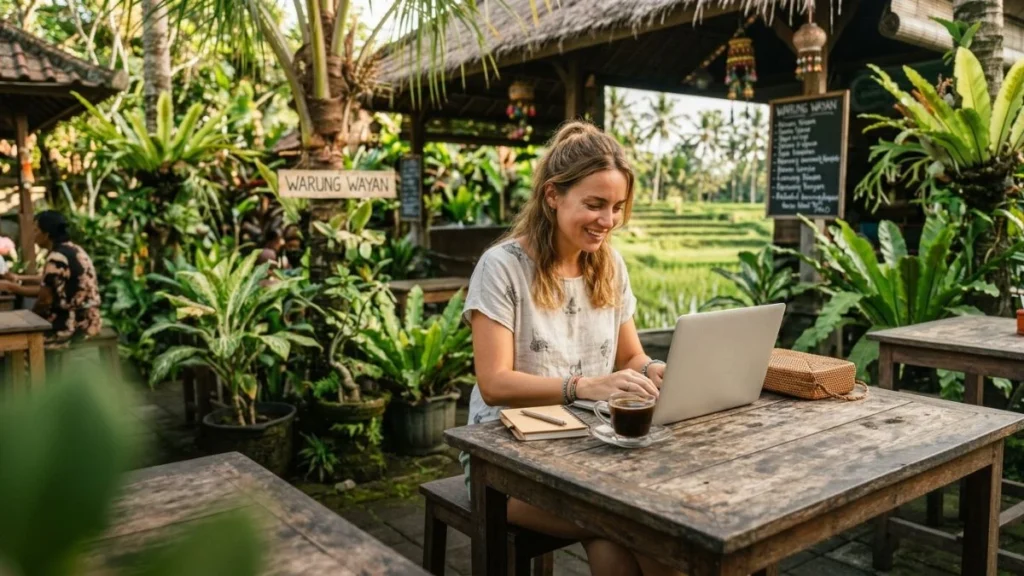
Bali has been a remote work destination since before remote work had a name. The combination of fast enough internet, affordable cost of living, good coffee, and a climate that makes sitting at a laptop outdoors feel like a reasonable life choice has made Bali — particularly Canggu and Ubud — one of the more established digital nomad hubs in Southeast Asia.
The bali digital nomad guide for 2026 covers what’s actually changed: the visa situation following the introduction of the Second Home Visa and the E33G digital nomad visa, the co-working infrastructure, where to base yourself, what the internet is actually like, and the honest cost of living as a remote worker in Bali today.
Quick Facts — Bali Digital Nomad 2026
- Best areas: Canggu, Ubud, Seminyak
- Co-working cost: IDR 100,000–250,000/day; IDR 1,500,000–3,500,000/month
- Average internet speed: 20–100 Mbps in co-working spaces; variable in cafés
- Cost of living: USD 1,200–2,500/month comfortable; USD 800–1,200 budget
- Visa options: Visa on Arrival (30 days), Social Cultural Visa B211A (up to 180 days), E33G Digital Nomad Visa (up to 5 years)
- Time zone: WITA (UTC+8) — good overlap with Australian and Asian business hours; challenging for European morning calls
The Visa Situation: What’s Actually Available in 2026
This is the area that has changed most significantly for digital nomads in Bali over the past two years and where the most outdated information circulates.
Visa on Arrival (30 days, extendable once)
The standard entry for most nationalities — IDR 500,000 at the airport or via the e-VoA platform before travel. Gives 30 days, extendable once for another 30 days at an immigration office (IDR 500,000 extension fee). Total: 60 days maximum on this visa class.
For short-term remote workers or those testing Bali before committing to a longer stay, VoA is the simplest option. The extension process at the Denpasar immigration office requires a visit in person — allow half a day and bring passport photos.
Social Cultural Visa B211A (up to 180 days)
The traditional longer-stay visa for Bali — requires a sponsor (a hotel, villa management company, or local individual who acts as guarantor), costs more in fees and agent handling, and gives up to 60 days initially with multiple extensions possible up to 180 days total.
The B211A has historically been the workhorse visa for digital nomads doing extended Bali stays. It still works. The sponsorship requirement sounds more complicated than it is — most villa management companies and several agents in Bali’s co-working scene handle this routinely. Budget IDR 3,000,000–5,000,000 all-in for the full 6-month process through a reputable agent.
E33G Digital Nomad Visa (up to 5 years)
Introduced in 2023, the E33G — officially the Second Home Visa in some documentation, the Digital Nomad Visa in others — is designed specifically for remote workers and independent earners working for companies or clients outside Indonesia.
Requirements include proof of income above a threshold (typically USD 2,000/month minimum, though requirements have shifted — verify current figures at immi.imigrasi.go.id), a criminal background check, and proof that your income source is outside Indonesia. The visa gives up to 5 years of residency with work authorisation for foreign-sourced income.
The E33G is the significant change in the Bali nomad landscape: for the first time, long-term remote workers have a legal, stable visa pathway that doesn’t require visa runs, sponsorship complications, or the ongoing uncertainty of the B211A extension process. Processing takes 2–4 weeks and is best handled through a Bali immigration agent — the paperwork is manageable but the Indonesian bureaucratic process benefits from local expertise.
Important: Working for Indonesian companies or earning Indonesian-sourced income on any of these visa categories is not permitted without a separate work permit. The E33G specifically covers income from outside Indonesia.
Where to Base Yourself: The Three Main Nomad Hubs
Canggu — The Main Hub
Canggu is the centre of Bali’s digital nomad scene — the highest concentration of co-working spaces, the most developed nomad infrastructure, and the largest community of remote workers on the island. The neighbourhood around Jalan Batu Bolong and Jalan Pantai Berawa has evolved significantly over the past five years from a surf village into a functional small-city environment with co-working, fitness, restaurants, and nightlife all within walking distance.
The trade-off: Canggu is noticeably more crowded and expensive than it was three years ago. Traffic on the main roads is Bali’s worst outside Denpasar. The character is increasingly international rather than Balinese — a feature for some, a limitation for others.
For nomads who want community, surf, and the feeling of being where everyone else is: Canggu is the right choice. For those who want to actually be in Bali rather than in a comfortable international bubble: Ubud or Pererenan (Canggu’s quieter western neighbour) are worth considering.
Ubud — The Cultural Alternative
Ubud has a smaller but established digital nomad community — drawn by the cooler temperature, the rice terrace environment, and the cultural richness that Canggu doesn’t offer. Co-working spaces are fewer but solid. The café scene is excellent for working from. The nightlife is quieter and the pace is slower.
For nomads who want to write, create, or do deep focused work: Ubud’s environment is distinctly better than Canggu’s. For those who need the social energy of a large nomad community or the surf: Canggu is the right call.
Internet speeds in Ubud’s co-working spaces are comparable to Canggu. The café internet is more variable — the main Jalan Dewi Sita and Jalan Raya Ubud cafés are generally reliable; the smaller cafés on village lanes are less so.
Seminyak — The Quieter South Option
Less talked about as a nomad base than Canggu or Ubud, Seminyak has decent co-working options, better restaurants per square kilometre than either, and a slightly older demographic that suits remote workers who aren’t looking for the hostel-adjacent social scene of Canggu. Closer to the airport than Ubud. Beach access better than Ubud. Quieter than Canggu without being as removed from the south Bali infrastructure.
Co-Working Spaces: What’s Available
Bali’s co-working infrastructure has matured into a genuine market with clear tiers.
Premium Co-Working (IDR 150,000–250,000/day; IDR 2,500,000–4,000,000/month)
Dojo Bali — the original Canggu co-working space, still one of the best. Fast internet (50–100 Mbps), reliable air conditioning, good community events, meeting rooms available. Multiple locations in Canggu.
Outpost — operates in both Canggu and Ubud. Good infrastructure, community events, visa support services available through affiliated agents. Popular with longer-stay nomads.
Livit — Canggu. Design-oriented space, good natural light, reliable infrastructure. Strong community of creatives and developers.
Mid-Tier Co-Working (IDR 80,000–150,000/day; IDR 1,200,000–2,000,000/month)
Several independent co-working spaces in both Canggu and Ubud in this range — reliable internet, basic amenities, less of the community programming of the premium spaces. Good for nomads who want a functional desk without the social infrastructure.
Café Working
Bali’s café scene is genuinely well-suited to working from — good coffee, reliable wifi in the better establishments, and a culture that doesn’t require you to order every 45 minutes. The cafés that work well for this: Hubud Library in Ubud, Nude Coffee Roasters in Canggu, Betelnut Café in Canggu for morning sessions. The ones that don’t: busy tourist cafés where wifi is shared across 50 people and tables are needed for lunch covers by midday.
Internet speeds at the better Canggu and Ubud cafés typically run 15–40 Mbps on wifi — adequate for video calls and standard remote work, less reliable for large file transfers or sustained video upload. For anything bandwidth-intensive, a co-working space is the better choice.
Internet: The Honest Picture
Internet quality in Bali has improved significantly over the past three years. The 2026 picture for digital nomads is broadly positive with specific caveats.
Co-working spaces: 30–100 Mbps consistently in the main Canggu and Ubud spaces. Reliable enough for video calls, cloud work, and most remote work requirements. Meeting rooms in premium co-working spaces often have dedicated connections.
Cafés: 10–40 Mbps, with significant variation. Peak hours (10am–2pm) in busy cafés reduce speeds noticeably. Test before committing to a long session.
Accommodation: Highly variable. Villas with dedicated fibre connections (increasingly common in Canggu) can reach 50–80 Mbps. Guesthouses and smaller properties often have shared connections running 5–15 Mbps. Check reviews specifically mentioning internet speed before booking if remote work is a priority.
Mobile data: Telkomsel is the most reliable network for coverage across Bali including rural and East Bali areas. A local SIM with data package costs IDR 100,000–200,000 for 20–30GB — sufficient as a backup or primary connection for moderate usage. Available at the airport and at minimarkets.
Power cuts: Bali experiences occasional power interruptions, more common in rural areas and during the wet season. Co-working spaces have UPS backup systems. For villa accommodation, asking about power backup before committing is sensible if your work is time-sensitive.
Cost of Living as a Digital Nomad in Bali
The daily cost of living is covered in the Bali on a budget guide in detail. For digital nomads specifically, the monthly cost structure looks like this:
Budget nomad (USD 800–1,200/month):
Guesthouse or shared villa room IDR 2,500,000–4,000,000 + warung food three meals IDR 1,500,000 + co-working or café IDR 1,500,000–2,000,000 + scooter hire IDR 2,000,000 + fuel IDR 500,000 + activities and social IDR 1,000,000 + visa and admin IDR 500,000 = approximately IDR 9,500,000–12,000,000 (USD 570–720). Add flights and travel insurance for the true monthly cost.
Comfortable nomad (USD 1,500–2,500/month):
Private villa with pool IDR 8,000,000–15,000,000 + restaurant and warung mix IDR 3,000,000 + premium co-working membership IDR 3,000,000 + scooter hire or Gojek IDR 2,000,000 + activities, yoga, social IDR 2,000,000 + visa and admin IDR 500,000 = approximately IDR 18,500,000–25,500,000 (USD 1,100–1,530). This is the range most digital nomads in Bali operate in comfortably.
The Community: How to Find Your People
Bali’s nomad community is large and reasonably easy to plug into. The structures that work:
Co-working community events — Dojo and Outpost both run regular networking and social events. These produce the most natural introductions between nomads with similar working structures.
Facebook groups — Bali Digital Nomads, Canggu Community, Ubud Expats and Nomads all have active memberships. Useful for accommodation recommendations, driver contacts, and understanding current conditions before arrival.
Yoga and fitness — in Ubud particularly, yoga studios function as a community infrastructure. A regular class at one of the main studios produces relationships quickly.
Surf schools and lineups — in Canggu, surfing functions the same way. The social structure of a surf lineup is more egalitarian than many other environments and produces quick introductions.
FAQ
Can I legally work remotely from Bali as a digital nomad?
Yes, with the right visa. The E33G Digital Nomad Visa (up to 5 years) is the legal pathway for remote workers earning from outside Indonesia. The Social Cultural Visa B211A allows stays of up to 180 days. Working on a tourist Visa on Arrival is technically not permitted — the E33G resolves this for long-term stays. For full current visa details, check immi.imigrasi.go.id or consult a Bali immigration agent.
How fast is the internet in Bali for remote work?
Co-working spaces in Canggu and Ubud offer 30–100 Mbps consistently — adequate for video calls, cloud work, and most remote work requirements. Café wifi runs 10–40 Mbps with variation at peak hours. A local Telkomsel SIM with data provides reliable mobile backup across most of the island.
What is the cheapest area in Bali for digital nomads?
Ubud is generally cheaper than Canggu for accommodation and daily living. East Bali (Amed, Candidasa) is significantly cheaper than both but has limited co-working infrastructure and less reliable internet — suitable for nomads with light connectivity requirements and a preference for solitude over community.
Is Canggu still worth it for digital nomads in 2026?
Yes — with adjusted expectations. Canggu is more expensive and more crowded than three years ago but remains the strongest infrastructure for nomads who want community, surf, and a built-in social life alongside the work. For those who prioritised Canggu specifically for the price or the quiet: Pererenan (immediately west) offers similar access with less traffic and lower accommodation costs.
How long can I stay in Bali as a digital nomad?
On a Visa on Arrival: 30 days, extendable once to 60 days total. On a Social Cultural Visa B211A: up to 180 days. On the E33G Digital Nomad Visa: up to 5 years with the possibility of renewal. The E33G is the significant development for long-term nomads — it provides a stable legal foundation that the previous visa options didn’t.
Bali in 2026 is a more mature digital nomad destination than it was five years ago — better infrastructure, clearer legal pathways, a more developed community, and higher costs that still represent good value relative to most home countries. The bali digital nomad guide picture is broadly positive: the things that made Bali work for remote workers a decade ago are still present, and the things that made it legally uncertain or practically unreliable have largely been addressed.
The honest caveat: Canggu is not what it was. For nomads who came to Bali specifically for a balance of tropical environment and working infrastructure, Ubud now makes as strong a case as Canggu — and for those who want to actually be in Bali rather than in an international bubble, arguably a stronger one.
For the cost of living breakdown, the Bali on a budget guide covers the detailed numbers. For visa and entry requirements, the Bali travel advisory 2026 has the current picture. For building life outside working hours, the things to do in Ubud Bali guide and the Ubud hidden villages guide cover the territory that makes the longer stay worthwhile.