
Ubud gets described as Bali’s cultural heart so often that the phrase has stopped meaning anything. What it actually means, practically: Ubud is a small town of around 30,000 people in the Gianyar Regency, sitting at roughly 200 metres above sea level in Bali’s central uplands, surrounded by rice terraces, river gorges, and a density of temples that would be remarkable anywhere else in the world.
The things to do in Ubud Bali that most itineraries list are accurate. The Monkey Forest is real. The rice terraces are real. The market is worth your time. But the list format flattens something that’s better understood as a set of overlapping layers — what you do here, and when, and how slowly, determines whether Ubud delivers what people come looking for or just confirms what they already saw on Instagram.
This guide is organised by how you’ll actually move through the area, not by ranking or popularity score.
Quick Facts
- Distance from Denpasar: ~25km north
- Elevation: ~200m above sea level
- Getting there: 45–60 min from Seminyak/Canggu; 40 min from Sanur; 2 hrs from Uluwatu
- Getting around: Scooter hire (IDR 70,000–100,000/day), private driver (IDR 500,000–700,000/day), or on foot for central Ubud
- Best base: Central Ubud (walkable) or Penestanan/Campuhan (quieter, 10 min walk west)
- Avoid: Arriving midday without a plan — Ubud at peak heat with no shade and no agenda is genuinely unpleasant
Walk the Campuhan Ridge at Dawn
If you do one thing in Ubud, do it before 8am, and this is the strongest candidate.
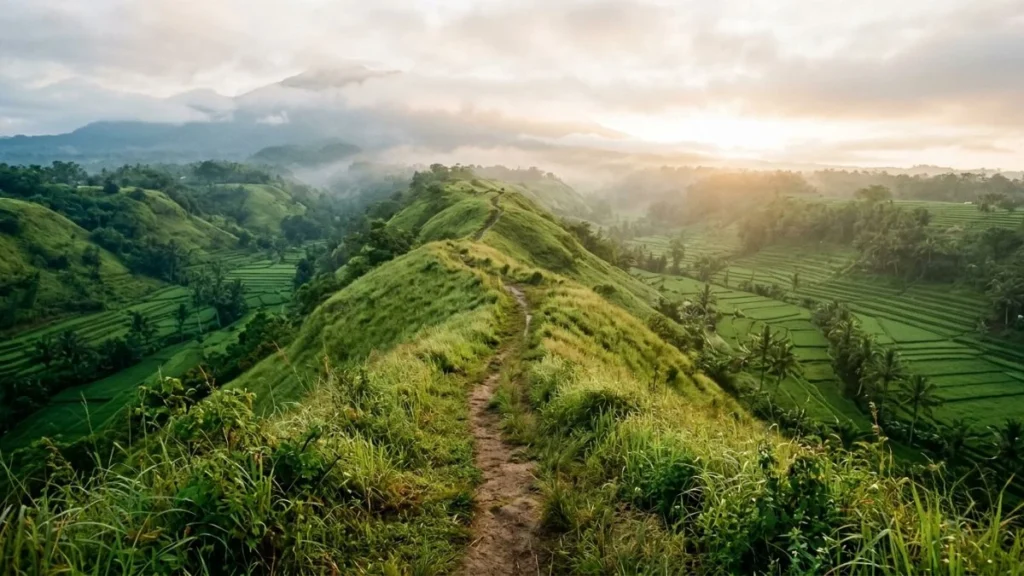
The Campuhan Ridge Walk starts at the Gunung Lebah Temple on Jalan Raya Campuhan, about a 15-minute walk west from the central market. From there, a paved path climbs onto a narrow ridge between two river valleys — the Wos Barat and Wos Timur rivers — and continues for about 2km through open grassland and small coconut groves before descending into the village of Bangkiang Sidem.
The walk takes around 45 minutes one way at a relaxed pace. At dawn the light comes from the east and hits the rice fields below the ridge in a way that changes every 10 minutes. By 9am the path is busier and the heat begins to build. By 10am it’s a different experience entirely.
There’s no entrance fee. The path is paved and mostly flat with a few gentle climbs. Bring water — there are warung stalls at both ends but nothing along the ridge itself.
Spend a Morning at Tegallalang Rice Terraces (But Go Early)
Tegallalang is about 12km north of central Ubud, and its terraced rice fields — carved into steep hillsides along the Pakerisan River valley — are genuinely among the most striking agricultural landscapes in Southeast Asia. The subak irrigation system used here, a cooperative water management tradition that dates back to the 9th century, was recognised by UNESCO in 2012.
The practical reality: Tegallalang is also one of the most photographed spots in Bali, which means arriving after 9am on any given morning involves crowds, swing operators, and a string of cafés along the ridge competing for your attention with increasingly elaborate photo props.
Arrive before 8am. The light is better, the terraces are quieter, and the farming activity — actual farmers tending actual rice — is visible in a way it isn’t when the site is operating at peak tourist volume. There’s an informal entry fee collected at several points along the road (IDR 10,000–20,000 per person, cash).
For a longer terrace experience without the crowds, the rice fields around Jatiluwih in Tabanan Regency (about 1.5 hours west) are larger, less visited, and part of the same UNESCO-listed subak system.
Visit Tirta Empul Temple
Tirta Empul, about 15km northeast of Ubud near the town of Tampaksiring, is one of Bali’s most important Hindu temples. Founded in 962 CE according to Balinese chronicle, it’s built around a spring that feeds a series of ritual bathing pools — petirtaan — where both Balinese Hindu worshippers and visitors can participate in a purification ritual.
The ritual involves moving along a row of fountains (pancuran) in sequence, submerging beneath each one and offering a short prayer. The meaning of each fountain differs; local guides and temple staff can walk you through the sequence. Sarong and sash are required and available to rent at the entrance (IDR 15,000–20,000).
What’s worth understanding before you go: this is not a tourist attraction that happens to have religious significance. It’s a functioning place of worship that is also open to visitors. The purification ritual is real. Balinese families come here for genuine spiritual reasons, not as performers for tourism. Approach it accordingly.
Entry fee: IDR 50,000 for adults. Open daily 8am–6pm.
See a Dance Performance at Ubud Palace
The Puri Saren Agung — Ubud Palace — hosts traditional Balinese dance performances most evenings, rotating through Kecak, Legong, Barong, and Wayang Wong depending on the night. Performances typically start at 7:30pm and run 60–90 minutes.
Kecak is the one most visitors are drawn to: no instruments, just a chorus of 50–100 men producing a rhythmic cak cak cak chant while dancers enact scenes from the Ramayana. The effect, performed outdoors in the Palace courtyard by firelight, is unlike anything else in Bali.
Tickets are IDR 100,000–150,000 per person, available at the gate from around 6pm. Arrive early for front seats — the courtyard fills up. The schedule changes weekly; the current program is posted at the gate and at the ticket booth directly across from the market on Jalan Raya Ubud.
If you want to see Kecak in a more dramatic outdoor setting, the clifftop performances at Uluwatu Temple (about 2 hours south) are staged at sunset and considered by many to be the stronger production — though the Ubud Palace setting has an intimacy Uluwatu can’t match.
Walk Through the Monkey Forest — and Understand What It Is
The Mandala Wisata Wenara Wana — universally known as the Ubud Monkey Forest — is a 12.5-hectare nature reserve and Hindu temple complex at the southern end of Jalan Monkey Forest, about a 15-minute walk from the central market.
It contains three temples, a cremation site, and approximately 700 long-tailed macaques (Macaca fascicularis) who have lived here for generations and are, by any reasonable measure, fully accustomed to human presence. The monkeys are not tame — they will take food from hands, bags, and occasionally glasses — but serious injuries are rare if visitors follow basic rules: don’t bring food in, don’t make eye contact at length, don’t try to touch them, don’t crouch down to their level.
The forest itself, dense with banyan trees and moss-covered stone carvings, is genuinely beautiful. The temples are active — resident priests maintain daily rituals. Entry is IDR 80,000 for adults. Open daily 9am–6pm.
A note worth making: the monkeys here are often described in travel content as “cheeky” or “mischievous.” The more accurate framing is that they’re wild animals in a pressured urban environment who have learned that tourists carry things worth taking. Respect and distance produce a better experience than attempts at interaction.
Explore the Villages Around Ubud
Central Ubud is walkable and interesting, but the villages within a few kilometres are where the craft traditions that supply the market actually live.
Mas (6km south) — woodcarving village. Workshops line the main road; most are open to visitors and watching a carver work a piece of albesia or teak is worth 20 minutes of anyone’s time. Prices at source are lower than at the market.
Celuk (8km south) — silversmithing village. Dozens of family workshops produce the filigree silverwork sold across Bali. Visiting directly means you can watch the process and buy at better prices than in Ubud.
Penglipuran (18km north, near Bangli) — one of Bali’s best-preserved traditional villages, with a single main lane flanked by identical bamboo gate entrances to family compounds. Residents maintain the traditional architecture under a village agreement. Entry IDR 30,000.
Petulu (3km north of central Ubud) — every evening at dusk, thousands of white herons return to roost in the trees along the main road through Petulu. The arrival takes about 30 minutes and is one of Ubud’s most underrated free experiences. Locals consider the herons sacred — said to be the spirits of those who died in the 1965–66 political violence. Arrive around 5:30pm.
Take a Cooking Class
Ubud has more cooking classes per square kilometre than almost anywhere in Southeast Asia, ranging from resort-attached productions with market tours included to small family operations where you cook in someone’s home compound.
What to look for: classes that include a market visit in the morning (usually Pasar Ubud or a local market outside the tourist centre), teach technique rather than just recipe-following, and end with you eating what you’ve made. The Balinese dishes worth learning — nasi goreng, lawar, sate lilit, bebek betutu — all have nuances that vary by family and region. A good teacher will explain why their version differs from the one you’ll find at a warung.
Prices range from IDR 350,000 for a basic 3-hour class to IDR 750,000 and above for full-day experiences with market visits. Book a day in advance during high season (July–August, December).
Eat at a Warung, Not a Restaurant
This belongs on any honest list of things to do in Ubud Bali because the gap between the two experiences is larger here than almost anywhere else in Indonesia.
Ubud has excellent international restaurants, and there’s nothing wrong with eating at them. But the nasi campur warungs — small family-run places serving rice with a rotating selection of side dishes — represent the actual food culture of this part of Bali and cost a fraction of the price.
Warung Ibu Oka on Jalan Suweta for babi guling (spit-roasted pork). Warung Babi Guling Pak Malen on Jalan Raya Mas for a less-touristed version of the same. The nasi campur stalls on Jalan Karna behind the market for rice plates at IDR 20,000–35,000. For a broader look at what’s actually worth eating and where, the Bali food guide to local eating and the honest guide to the best warungs in Ubud cover this in more detail.
Rent a Scooter and Leave Town
Ubud is most interesting as a base, not just a destination. On a scooter, the roads north toward Kintamani — past coffee plantations, small village markets, and the caldera of Mount Batur — take about an hour and reveal a part of Bali that feels genuinely different from the rice terrace circuit.
Mount Batur itself (1,717m) is hikeable. The standard sunrise trek leaves from Toya Bungkah village at around 3am and takes 2 hours to the rim. The view at dawn, across the caldera lake with the peak of Agung visible to the east, is among the better experiences available in Bali if you’re willing to do it without a guide company’s markup — the trail is clearly marked and can be done independently.
The road west from Ubud toward Jatiluwih passes through Pejeng (home to the Moon of Pejeng, a 3,000-year-old bronze drum in the Penataran Sasih Temple, one of the oldest bronze instruments in the world) and Blahbatuh before climbing into the cooler upland rice country of Tabanan.
FAQ
How many days do you need in Ubud?
Two full days covers the main sites comfortably. Three days allows for a village day trip, a cooking class, and the slower pace that makes Ubud what it is. Five or more days and you start to understand why people extend stays they didn’t plan to extend.
Is Ubud walkable?
Central Ubud — the market, Monkey Forest, Campuhan Ridge, Ubud Palace — is walkable if you’re staying in the centre. The surrounding villages and rice terraces require a scooter, bicycle, or private driver.
What’s the best time of year to visit Ubud?
The dry season (April–October) is the standard recommendation. July and August are peak season with higher prices and more visitors. April–June and September–October offer better balance of weather and crowd levels. The wet season (November–March) brings daily rain — usually in the afternoon — but also dramatically greener terraces and far fewer tourists.
Is Ubud safe for solo travellers?
Yes. Ubud is among the safest areas in Bali for solo travel. The main practical concerns are traffic on the main roads (take care crossing Jalan Raya Ubud), and scooter hire if you’re not an experienced rider — the roads outside the centre have real gradients and occasional loose gravel.
Do you need a guide for Ubud?
For the Campuhan Ridge Walk, Monkey Forest, and Tegallalang: no. For Tirta Empul’s purification ritual, a guide or temple staff member adds genuine value — understanding the sequence and meaning of the fountains changes the experience. For Mount Batur, an experienced local guide is worth considering for the pre-dawn navigation, though the trail is manageable without one.
The things to do in Ubud Bali that stay with people after they leave are almost never the ones at the top of the list. It’s the dawn walk before the town wakes up, the warung breakfast where nobody speaks the same language but the food arrives anyway, the evening the herons come back to Petulu. None of that requires a booking. Most of it requires arriving before 8am and slowing down enough to notice what’s actually there.
For the market specifically, the Ubud market guide covers timing, bargaining, and what’s actually worth buying. For eating your way through the rest, the honest guide to the best warungs in Ubud is the place to start.