
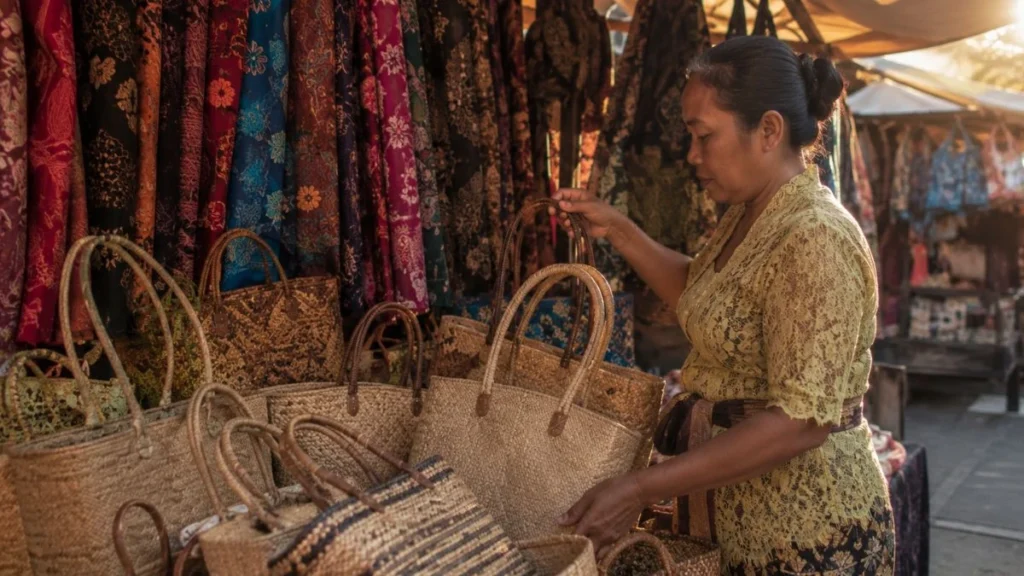
Pasar Seni Ubud — the Ubud Art Market — is one of the most visited spots in Bali. It’s also one of the most misunderstood. Most travellers walk through at midday, feel overwhelmed, buy nothing, and leave vaguely disappointed. Here’s what actually makes it worth your time.
The ubud market guide most people find online tells you what you can buy. This one tells you how the market actually works: its two distinct identities, the hours that matter, how bargaining functions here, what’s genuinely local versus what came off a truck from Denpasar, and which corners most visitors miss entirely.
Pasar Seni Ubud sits on Jalan Raya Ubud, directly across from Ubud Palace (Puri Saren Agung). You can’t miss it — and you probably shouldn’t. But timing, pace, and knowing what you’re looking at makes the difference between a forgettable tourist stop and something you’ll still think about months later.
Quick Facts
- Address: Jl. Raya Ubud No.35, Ubud, Gianyar Regency
- Hours: 6am–6pm daily (local market active from ~4am)
- Entrance fee: Free
- Best time: Before 9am, or 4–5pm
- Payment: Cash only (IDR)
- Bargaining: Expected — start at 40–50% of first price
The Market Has Two Completely Different Identities
This is the thing most guides don’t mention clearly enough: Pasar Seni Ubud is two markets sharing the same address on a daily schedule.
From around 4am until roughly 8–9am, the space functions as a local wet market. Vendors sell fresh produce, flowers for temple offerings, canang sari ingredients, spices, and daily household items. The buyers are Ubud residents, not tourists. The pace is fast. Prices are in the thousands of rupiah, not tens of thousands. No English, no sales pitches aimed at cameras — just the ordinary commerce of a Balinese morning.
By 9–10am, the transition begins. Morning stalls pack up, souvenir vendors arrive, and the market shifts into the tourist-facing version most visitors know: craft stalls, batik sellers, woodcarvings, silver jewellery, woven bags, paintings. Both are worth your time. They just require different hours and a different mindset.
What’s Actually Made Locally (and What Isn’t)
A fair question to ask at any craft market: where does this actually come from?
Most of what you’ll find at Pasar Seni Ubud originates from the ring of specialist villages around Ubud, not from the vendors themselves. This is not deceptive — it’s how the supply chain has worked here for generations. Woodcarvings come primarily from Mas village, about 6km south. Silver jewellery originates in Celuk, 8km further south. Batik and ikat textiles typically come from workshops in Gianyar. Woven ate grass bags — one of the more genuinely local products — are made in Tenganan and Penglipuran areas.
The craft families who make these items sell wholesale to market vendors. The vendors add margin and handle the tourist interaction. Nobody’s pretending otherwise if you ask.
What does get made on-site, or very nearby: the paintings. Ubud has a distinct painting tradition going back to the 1930s when Western artists Walter Spies and Rudolf Bonnet collaborated with Balinese painters and helped develop the Ubud style — detailed, narrative scenes from Hindu mythology and daily life. Mass copies have flat colour fills and identical compositions; individual work has variation in brushwork and scene composition. Ask the vendor where the artist is from.
The Items Worth Buying (and What to Pay)
Ata Grass Bags
Woven from ata grass dried and smoked over coconut husks, lined with batik fabric, fitted with leather handles. Genuinely durable, not easily replicated by factory production. A reasonable bag starts at IDR 150,000–200,000 after bargaining; larger, well-made versions run IDR 350,000–500,000.
Batik and Endek Fabric
Batik uses wax-resist dyeing; endek is traditional Balinese woven fabric with geometric patterns used for ceremonial dress. Scarves start around IDR 50,000; proper endek cloth IDR 200,000 and above per length. Look at weight and weave density, not just pattern.
Woodcarvings
Quality varies enormously. Look at the underside: machine-cut pieces have uniform flat surfaces; hand-carved work shows tool marks and slight asymmetry. If a vendor says something is teak, ask to smell it — teak has a distinct oily, slightly sweet smell even after finishing. Small decorative pieces start at IDR 50,000; genuine hand-carved work runs considerably higher.
Silver Jewellery
A lot of what’s sold here is silver-coloured but not actually silver. Genuine Balinese silverwork starts around IDR 100,000–150,000 for a simple ring. If authenticity matters, it’s worth a trip to Celuk village directly, where you can watch smiths at work and buy at source.
Paintings
Budget IDR 200,000–500,000 for a well-executed medium canvas in the Ubud style. Take a full pass through the market before committing. Quality varies stall to stall and it’s easy to overpay on first impression.
How Bargaining Works Here
The starting price a vendor quotes is calibrated to the gap they expect to negotiate. Most vendors operate in a range where 50–70% of opening price is where they’ll sell. Opening at 40% and settling in the middle is standard practice, not rudeness.
The exception is the first sale of the morning. Balinese market custom holds that the first transaction of the day brings luck for the rest of the trading day. Vendors selling to their first customer will often accept a lower price more readily than at any other time.
One firm rule: if you’ve agreed on a price verbally, you’re committed. Walking away after a price has been accepted is considered genuinely poor form and causes real offence. Only negotiate to the point where you’d actually buy.
The best haggling is quiet, unhurried, and slightly disinterested. The vendor who sees you hesitate between two similar bags across the aisle has more reason to match a lower price than one who can tell you’ve already decided.
When to Visit: The Hours That Actually Matter
Before 8am — local wet market partially operating. Tourist stalls not yet set up. The flower sellers are worth seeing at this hour: stacks of marigold, frangipani, and palm leaf offerings piled high for the day’s temple preparations.
8–10am — transition hour. Vendors are setting up, in their best mood of the day, genuinely happy to talk. Selection is at its fullest and prices often lower than later in the day.
10am–2pm — peak tourist hours. Crowded, warm, louder. Still worth doing, but adjust expectations for pace and bargaining outcomes.
4–6pm — underrated window. Tourist group numbers thin, vendors are often willing to clear stock before closing, and the light on the Palace across the road is at its best.
The Morning Local Market: What You’re Actually Seeing
The eastern section — behind the main souvenir rows, accessible from Jalan Karna — operates as Ubud’s daily food market year-round. Residents buy mangosteen, salak, rambutan, chilli, tempeh, tofu, and the fresh flowers and palm-leaf squares that go into canang sari offerings.
If you arrive before 8am, walk this section before anything else. You’re not going to buy much here, but you’ll understand something about Ubud that the main art market aisle doesn’t show you. The same women who arrange the offerings you see outside every temple and shop doorway are here, buying the flowers they’ll use that morning. The market happens whether visitors show up or not.
Getting There
Pasar Seni Ubud is at the central intersection of Jalan Raya Ubud and Jalan Monkey Forest. If you’re staying anywhere in central Ubud, walking is the obvious choice — parking near the market is limited and surrounding streets are often gridlocked by mid-morning.
From Canggu or Seminyak: roughly 1 hour to 1 hour 15 minutes by scooter or private driver. From Sanur: around 45 minutes. From Uluwatu: allow 2 hours. Gojek and Grab both operate in Ubud. The market pairs naturally with Tirta Empul (30 minutes northeast) or Tegallalang rice terraces (15 minutes north) if you’re structuring a full-day itinerary.
The market sits directly opposite the main Ubud Palace entrance. Evening Kecak or Legong dance performances at the Palace are ticketed separately (IDR 100,000–150,000; check schedules at the gate). A late afternoon market visit followed by an evening performance is a reasonable way to structure the time.
What’s Around the Market
Jalan Dewi Sita, one block south, has small boutiques and gallery shops selling work from individual local artists — no bargaining expected, generally higher price points, more suited to pieces you’d actually keep rather than give as gifts.
For food after the market: Warung Ibu Oka on Jalan Suweta (400 metres north) is Ubud’s most established babi guling (spit-roasted pork) warung. It gets busy by 11am and often runs out of the best cuts by early afternoon — another reason the morning hours work in your favour. Nasi campur warungs along Jalan Karna serve rice plates with rotating side dishes from IDR 20,000–35,000.
For more on eating your way through Ubud beyond the market, see the Bali food guide to local eating. For the best places to sit down after a morning’s browsing, the honest guide to the best warungs in Ubud covers what’s actually good.
FAQ
Is the Ubud Art Market Free to Enter?
Yes. No entrance fee. Walking through to browse without buying is completely normal.
What Time Does the Ubud Market Open?
The local wet market section begins around 4am. Tourist art market stalls open progressively from 8–10am and most of the market is active by 9am, remaining open until around 6pm.
Is It Safe to Buy Silver Jewellery at the Ubud Market?
Some silver here is genuine; some is silver-plated or alloy. If authenticity matters, ask whether the piece is sterling silver (perak asli). For guaranteed provenance, a trip to Celuk village is more reliable.
What’s the Difference Between the Ubud Art Market and Sukawati Art Market?
Both sell similar items. Sukawati (12km south in Gianyar Regency) is larger with more wholesale options and generally lower prices, but it’s a dedicated shopping destination with none of the surrounding galleries, cafés, or the Palace backdrop of central Ubud. If price is the priority and you have transport, Sukawati is worth the trip. Otherwise, Pasar Seni Ubud is the right choice.
Do Vendors Accept Card Payments?
Almost none. Bring cash in small denominations — IDR 10,000, 20,000, and 50,000 notes. Withdraw before arriving; ATMs immediately outside the market sometimes queue during peak hours.
The ubud market guide that most travellers find tells them the market is a must-see. That’s accurate. What it often leaves out is that the market rewards patience and timing far more than urgency. The vendors have been doing this for decades. The craft traditions behind what they sell go back generations. Arrive before the tour buses, walk the local market first, slow down — and it tends to deliver something closer to what you came to Bali for in the first place.