
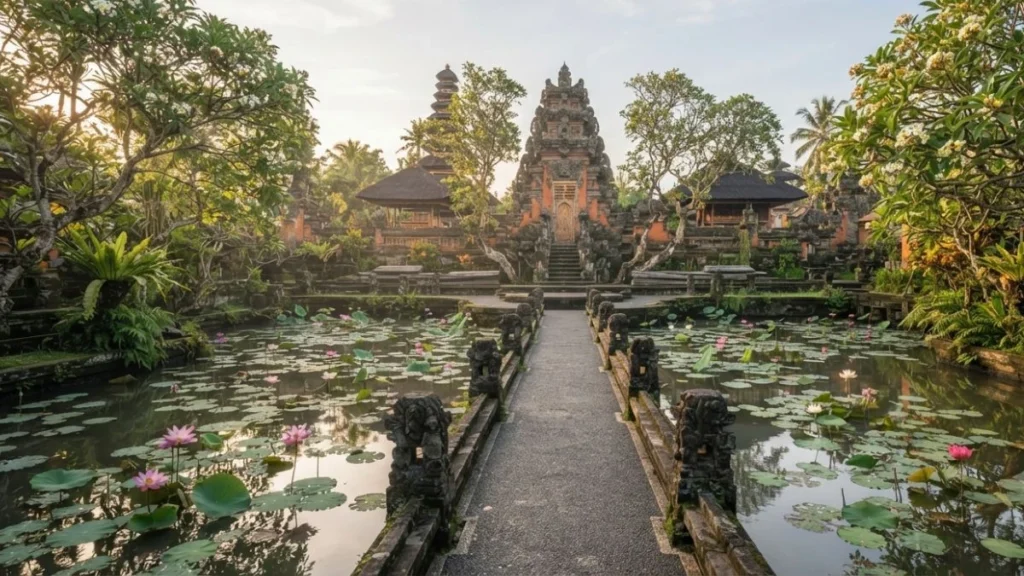
Saraswati Temple Ubud, officially Pura Taman Kemuda Saraswati and also known as the Ubud Water Palace, is the small lotus-pond temple that shows up in nearly every Ubud photo dump — a stone bridge crossing a bloom of pink lotus flowers, leading to an ornately carved gate just a few minutes’ walk from Ubud Palace. It’s genuinely one of the most photogenic spots in town, and also one where the practical details — whether there’s an entrance fee, when to actually go, what you can and can’t do there — vary enough between sources that it’s worth clearing up before you show up.
This guide covers the temple’s history, what a visit actually involves, and an honest note on the pricing confusion that’s followed this site in recent years.
Quick Facts
- Location: Jalan Kajeng, Ubud, about 170 metres from Ubud Palace, right beside Café Lotus
- Hours: generally 7am–5/7pm for the public garden; open 24 hours for worshippers
- Entrance fee: historically free, though some recent visitor reports mention a fee introduced in the IDR 35,000–65,000 range for the garden area — confirm locally and bring small cash either way
- Dance performance: most evenings, around IDR 100,000 per person, arrive 30–40 minutes early for a good seat
- Visit duration: 20–30 minutes for the garden alone, longer if staying for the evening dance
- Access: you can view and photograph the lotus pond, bridge, and outer gate; the inner temple and prayer area are off-limits to tourists
A Temple Built for Knowledge, Not Just Photos
Saraswati Temple is dedicated to the Hindu goddess of knowledge, wisdom, and the arts, a fitting choice for a temple sitting at the heart of what’s often called Bali’s “Capital of Art.” It’s relatively young by Balinese temple standards, completed in the early-to-mid 1950s and designed by I Gusti Nyoman Lempad, one of Bali’s most celebrated sculptors and architects, commissioned by the Prince of Ubud, Cokorda Gede Agung Sukawati. The lotus flower itself is symbolically central here — in Balinese Hindu belief, it represents purity and spiritual awakening, which is why the pond, rather than the temple building itself, has become the site’s defining image.
What You’ll Actually See
A stone bridge crosses directly through the lotus pond toward the temple’s main gate, the Kori Agung, flanked by carved statues and framed by frangipani trees along the water’s edge. This walkway is the money shot nearly everyone comes for, and it’s worth knowing upfront that you may need to wait your turn — the bridge and the small seating areas nearby get genuinely busy, especially midday and on weekends, and getting a clean shot without other visitors in frame takes patience. You can photograph freely around the pond, the bridge, and the outer gate, but entry into the inner temple grounds where active prayer takes place is generally reserved for worshippers, not tourists, even in appropriate dress.
The Honest Pricing Situation
Here’s the part that’s genuinely inconsistent across sources, so worth being upfront about: Saraswati Temple was free to enter for years, and plenty of current guides still describe it that way. But several more recent visitor reports describe a fee introduced for the garden area, landing somewhere between IDR 35,000 and 65,000 depending on the source and when they visited. It’s possible pricing has shifted more than once, or that enforcement varies by day and staff on duty. Either way, bring small cash notes when you visit, and treat any posted fee at the entrance as current information rather than assuming it’s free based on an older blog post.
The evening dance performance is a separate cost regardless — typically around IDR 100,000 per person, purchasable at the entrance or through Café Lotus next door. Some sources note the best seating for the dance requires a minimum spend at the cafe itself, so if front-row seats matter to you, plan to eat there rather than just buying a ticket and standing at the back.
Best Time to Visit
Early morning, shortly after opening around 7am, is consistently the best window — cooler air, softer light for photos, and noticeably fewer people crowding the bridge. If mornings don’t work, sunset offers a different but still striking version of the same view, particularly if a dance performance is scheduled that evening, though expect more competition for photo spots at that hour too. Midday is the one time worth actively avoiding if a clean, uncrowded photo matters to you.
Getting the Most Out of a Short Visit
Given how small the site actually is — most visitors spend well under half an hour here unless staying for the dance — it works best paired with other nearby stops rather than as a standalone destination. Ubud Palace, the Ubud Art Market, Museum Puri Lukisan, and Café Lotus itself (worth a coffee even outside the fee-versus-free debate) are all within a five-minute walk, making this an easy addition to a broader central Ubud loop rather than a special trip on its own.
FAQ
Is Saraswati Temple free to visit?
It’s genuinely unclear and possibly inconsistent — historically free, though some recent reports describe a fee in the IDR 35,000–65,000 range for the garden area. Confirm at the entrance and bring cash either way.
Can you go inside the main temple building?
No. Visitors can view and photograph the lotus pond, bridge, and outer gate, but the inner temple and prayer areas are generally reserved for worshippers.
How much does the evening dance performance cost?
Around IDR 100,000 per person. Some of the best seats require a minimum food or drink order at Café Lotus next door, so check if front-row seating matters to you.
What’s the best time to photograph the lotus pond?
Shortly after opening, around 7am, for the softest light and fewest people. Sunset is a solid second option, especially on evenings with a scheduled dance performance.
How long does a visit take?
Most visitors spend 20 to 30 minutes at the garden itself, longer if staying for the evening dance performance.
Final Thought
Saraswati Temple Ubud earns its reputation as one of the most photographed spots in town, even with some genuine confusion around current pricing. Go early, bring small cash just in case, and pair it with the other central Ubud sights nearby rather than treating it as a standalone stop. For more on what’s a short walk away, our Ubud Palace guide covers the neighboring royal compound, and our Ubud Market Guide rounds out the same central loop.