
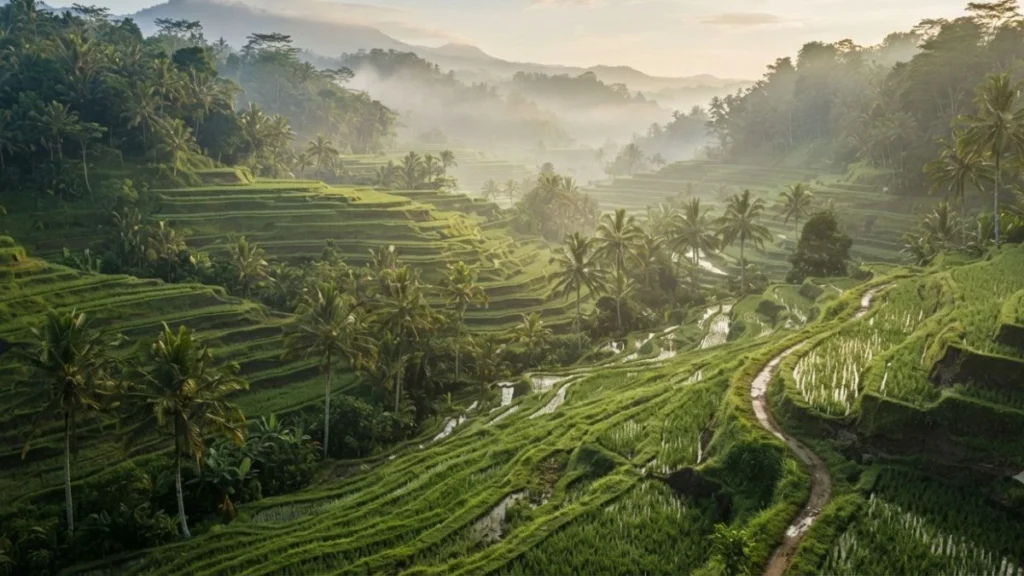
Tegalalang Rice Terrace is one of the most photographed spots in Bali, and it’s also one of the more confusing ones to actually pay for — there’s no single ticket counter, no fixed total cost, and multiple separate “donation” points along the walking paths that catch first-timers off guard. If you’ve already compared Tegalalang against Jatiluwih and picked Tegalalang for its convenience to Ubud, this guide covers what an actual visit costs and involves, fee by fee, so you’re not caught out mid-walk.
None of what follows is meant to scare you off — Tegalalang is genuinely worth seeing. It’s just a site where knowing the system in advance makes for a noticeably smoother visit.
Quick Facts
- Location: Tegallalang village, Jalan Raya Tegallalang, about 10 km / 20–30 minutes north of central Ubud
- Main entrance fee: roughly IDR 15,000–25,000 per person, paid at booths near the parking areas
- Additional path donations: IDR 10,000–20,000 per crossing at various points as you walk deeper into the terraces
- Swing rides: roughly IDR 150,000–350,000 per person depending on operator and swing type
- Parking: IDR 2,000–5,000 for scooters, IDR 5,000–10,000 for cars
- Best time: before 9am, ideally 7–8:30am, for cooler temperatures, better light, and fewer tour buses
Why There’s No Single Ticket Price
Here’s the honest structure: Tegalalang isn’t managed by one central authority the way a national park or museum would be. The terraces span land owned by multiple local farming families, and each entry point along the road has its own small booth charging its own entrance fee, typically IDR 15,000 to 25,000. Once you’re inside and start walking the trails deeper into the valley, you’ll hit additional informal donation points, usually run by the farmers whose land the path crosses, asking IDR 10,000 to 20,000 per crossing. None of this is technically a scam in the traditional sense — it’s genuinely how access to privately farmed terrace land here has developed — but it does mean your total cost adds up incrementally rather than being paid once at a gate.
Bring a stack of small notes, IDR 5,000 and 10,000 bills specifically, since booths rarely have change for anything larger and you’ll be paying repeatedly rather than once.
The Donation Points: What’s Reasonable and What Isn’t
Most travelers report paying somewhere between IDR 10,000 and 20,000 per person, per crossing, which is a reasonable rate to expect and pay without much friction. Where it tips into genuinely pushy territory is when someone asks for significantly more than that, or blocks a path insisting on payment before you can pass at all. You’re allowed to negotiate, decline politely, or simply say “sudah” (meaning “enough” or “already paid”) and walk on if someone is pressing for more than the going rate. Being polite but firm works better than either paying whatever’s asked or getting visibly frustrated — both tend to escalate the interaction rather than resolve it.
One additional scam pattern worth knowing: some locals along the paths will hand you a basket, a hat, or a farming tool and encourage you to pose for a photo, then expect a tip afterward that wasn’t made clear upfront. If you don’t want to pay for the photo, it’s fine to hand the item back and decline before the picture is taken, not after.
The Swings: Genuinely Optional, Genuinely Pricier Than the Terraces Themselves
Tegalalang’s swings, nests, and elevated photo platforms have become almost as well known as the terraces they overlook, and pricing here runs well above the entrance and donation fees — typically IDR 150,000 to 350,000 per person depending on the operator, swing height, and package. These are run by separate private businesses rather than the terrace donation system, so prices are generally fixed and posted rather than negotiable. If a swing photo isn’t a priority for you, it’s entirely skippable — the terrace views themselves, and the walk through them, are the actual reason most people find the visit worthwhile.
What the Walk Itself Involves
Plan for 30 to 90 minutes depending on how far into the terraces you go and how many stops you make. The paths are narrow, uneven, and genuinely slippery when wet — proper shoes with grip matter more here than at most Ubud-area attractions, and there’s minimal shade once you’re down in the valley itself, so a hat and water matter too. There’s no dress code since this is agricultural land rather than a temple, so skip bringing a sarong.
For the classic elevated view most photos show, look for the terraces with white paving blocks leading up to a flat viewing area — accessible from several of the entrance points along the road, most reliably through the Ceking Rice Terrace Area entrance.
Best Time to Visit
Arriving between 7 and 8:30am gives you the clearest light, coolest temperatures, and a genuine window before tour buses start arriving around 10am. Dry season months — roughly June through September — bring the greenest paddies and least muddy paths; visiting close to the April or October harvest periods means the fields take on a yellower hue rather than the vivid green most photos show. Rainy season (November–February) makes the dirt paths considerably more slippery, so if that’s when you’re visiting, budget extra caution and time.
FAQ
How much does it actually cost to visit Tegalalang Rice Terrace?
There’s no single fixed total — expect an entrance fee of roughly IDR 15,000–25,000, plus IDR 10,000–20,000 per additional donation point if you walk deeper into the terraces, plus separate fees for swings or photo platforms if you choose to use them.
Are the donation points at Tegalalang a scam?
Not inherently — they reflect the reality that the terraces span multiple privately farmed plots, and small donations are the informal system for crossing that land. It becomes a problem only if someone demands significantly more than the standard IDR 10,000–20,000 rate or blocks your path aggressively; in that case, it’s reasonable to negotiate or decline.
Do I need to pay for the swings to enjoy Tegalalang?
No. The swings and elevated photo platforms are entirely optional, run by separate operators from the terrace donation system, and priced well above the entrance fees. The terrace views and walking paths are the core experience.
What’s the best time to visit Tegalalang Rice Terrace?
Early morning, ideally 7 to 8:30am, for cooler temperatures, better light, and fewer crowds before tour buses arrive around mid-morning.
Do I need special footwear for Tegalalang?
Yes — shoes with real grip rather than flip-flops or sandals, since the dirt and stone paths get uneven and slippery, especially after rain.
Final Thought
Tegalalang Rice Terrace earns its reputation, but going in prepared for the layered fee structure — rather than expecting one clean ticket price — makes for a noticeably smoother visit. Bring small cash, stay polite but firm at the donation points, and skip the swings if they’re not your thing; the terraces themselves are the reason to come. If you’re still deciding between Tegalalang and Bali’s other major rice terrace, our Jatiluwih vs Tegalalang comparison covers that choice in more depth, and our Bali scams tourists should know guide rounds out the wider picture beyond just this one site.