
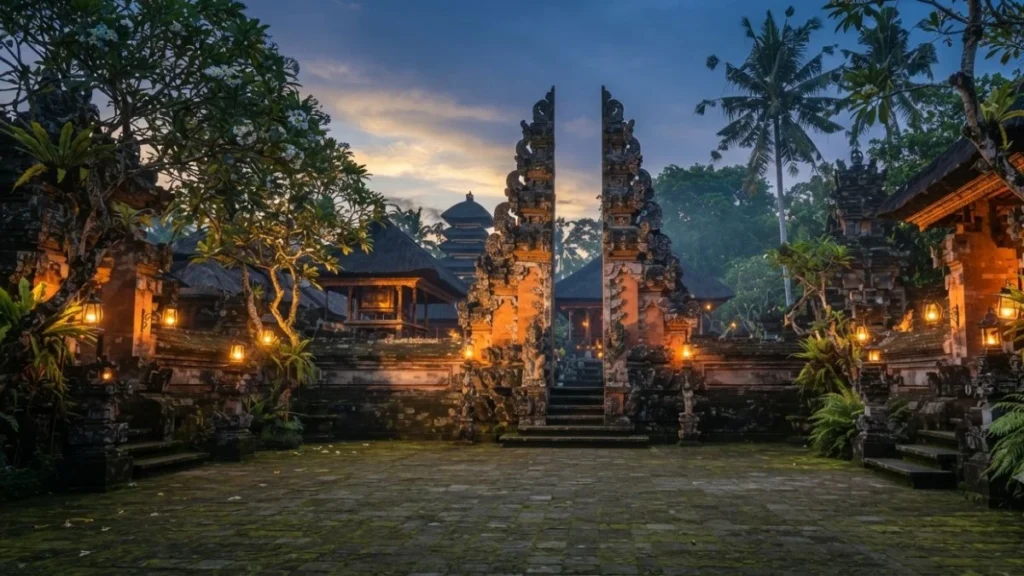
Ubud Palace, officially Puri Saren Agung, sits directly across from the Ubud Art Market at the literal center of town — free to enter during the day, and home to nightly traditional dance performances that have drawn visitors for decades. What makes it genuinely different from most Bali “palace” attractions is that it’s still a functioning residence: the royal family lives in the inner courtyards, and what you’re walking through during the day is only the public portion of a much larger, still-active compound.
This guide covers the history behind the palace, what to expect from the daytime visit versus the evening show, and an honest note on how repeat visitors feel about the dance performances specifically.
Quick Facts
- Location: Jalan Raya Ubud No. 8, directly opposite the Ubud Art Market
- Daytime entry: free, public courtyards open roughly 7am–6/7pm
- Dance performance: nightly around 7:30pm, tickets roughly IDR 100,000, bought at the door or from street vendors along Jalan Raya Ubud
- Seating: unassigned — arrive 30–45 minutes early for a good spot
- Best photo time: golden hour, just before sunset, when warm light hits the stone carvings
A Working Palace, Not Just a Museum
Ubud Palace was originally built around 1850 under King Cokorda Putu Kandel, the first ruler of the Ubud kingdom, and largely rebuilt after a major earthquake leveled much of the original structure in 1917 — the royal family used that rebuilding as an opportunity to bring in some of Bali’s finest stone carvers, which is part of why the current stonework is so detailed. The compound follows Asta Kosala Kosali, the Balinese architectural principles governing layout and orientation, similar in spirit to feng shui.
What sets Ubud Palace apart from a typical historical site is that the royal family still lives within the inner courtyards today — you’re only ever seeing the public-facing portion during a visit, not the full residence. It was Tjokorda Gede Agung Sukawati, the last ruling monarch (1910–1978), who’s credited with transforming Ubud into what it is now: he invited the German painter Walter Spies to live and work in the area in the 1930s, which drew a wave of foreign artists and effectively launched Ubud’s reputation as Bali’s arts capital.
What You’ll Actually See During the Day
The most photographed feature is the Candi Bentar, the split entrance gateway symbolizing a cosmic mountain divided into two equal halves. Past it, the Paduraksa inner gate features a large carved face of Bhoma, a mythological figure believed to filter out evil spirits and impure thoughts from those entering. The public courtyards themselves are modest in scale — don’t expect a sprawling European-style palace — but the detail in the “paras” volcanic stone carvings, the lotus ponds, and the traditional pavilions make it a worthwhile 20–30 minute wander even without staying for the evening show.
The Nightly Dance Performance: What to Expect
As the sun sets, the same courtyards transform into an open-air stage for traditional Balinese dance accompanied by a live gamelan orchestra — widely considered one of the more polished, professionally presented performances in Ubud, with a different dance staged most nights of the week (Legong, Barong, and Kecak-style performances depicting stories from the Ramayana and Mahabharata are common). Tickets run around IDR 100,000, purchasable at the venue or from street vendors nearby at the same price, and seating is unassigned, so arriving 30 to 45 minutes ahead matters if you want a clear view rather than a spot at the back.
Here’s the honest part: while most reviews are enthusiastic about the setting and cultural significance, some repeat visitors and locals note the performances can feel long or repetitive if you’ve already seen a similar show elsewhere in Ubud, since several venues around town stage comparable Legong and Barong performances most nights. If this is your only traditional dance show in Bali, Ubud Palace is a strong pick for the setting alone; if you’re comparing several venues, ask locally which specific dance is showing that night before committing, since story and energy vary more than the format does.
Getting There and Pairing It With Other Stops
Given its location directly opposite the Ubud Art Market, Ubud Palace fits naturally into a day already built around central Ubud — market browsing during the day, a stop at the palace courtyards, dinner nearby (the well-known Babi Guling Ibu Oka warung sits just across the road), and the dance performance as an evening close to the day. If you’re staying anywhere in central Ubud, it’s an easy walk; otherwise a short taxi or scooter ride gets you there without difficulty given how central and well-known the location is.
FAQ
Is Ubud Palace free to visit?
Yes, the public courtyards are free to enter during the day, roughly 7am to 6 or 7pm. Only the nightly dance performance requires a paid ticket.
How much does the Ubud Palace dance performance cost?
Around IDR 100,000 per person, purchasable at the venue door or from street vendors along Jalan Raya Ubud at the same price.
What time does the dance performance start?
Around 7:30pm nightly, with arrival 30 to 45 minutes beforehand recommended to secure a good seat, since seating is unassigned.
Can you visit the royal family’s private residence?
No. The royal family still lives in the inner courtyards of the compound, and only the public-facing areas are open to visitors.
Is the dance performance worth seeing if I’ve already seen one elsewhere in Ubud?
It depends on the specific dance and story being performed that night, since several venues in Ubud stage similar Legong and Barong performances. If it’s your first traditional dance show, Ubud Palace is a strong choice for the historic setting alone.
Final Thought
Ubud Palace works well precisely because it doesn’t try to be more than it is — a modest, still-living royal compound with genuinely detailed stonework by day and a proper cultural stage by night. Pair it with the market across the street and you’ve got a natural half-day loop in the center of town. For more on what’s nearby, our Ubud Market Guide covers the shopping side of the same street, and our Temples in Ubud guide rounds out the town’s other cultural landmarks.