
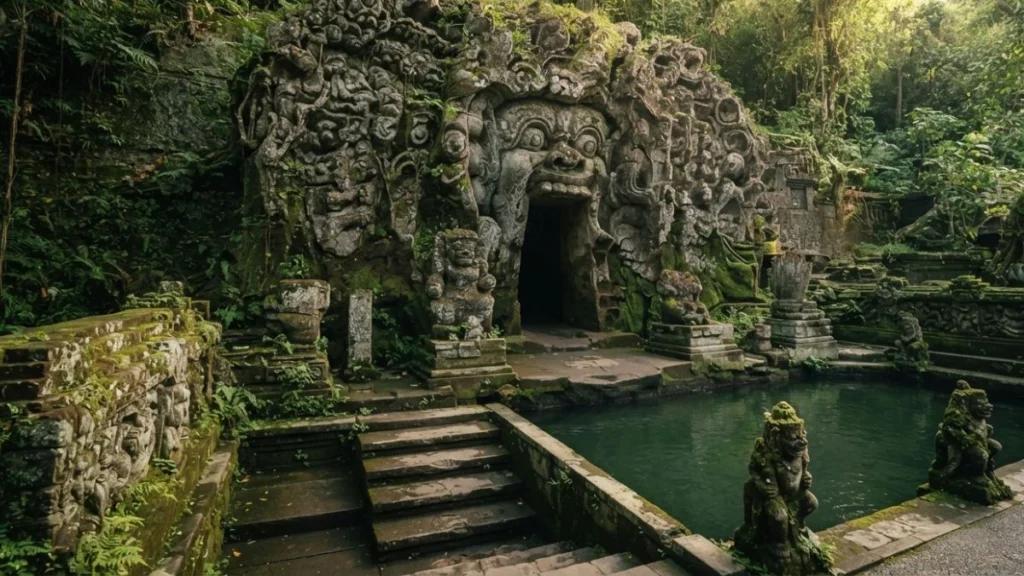
Goa Gajah, the Elephant Cave, is one of Bali’s oldest sites — a 9th to 11th-century cave temple carved into a cliff just outside Ubud, blending Hindu and Buddhist imagery in a way that reflects the island’s early spiritual history. It’s also a site where expectations matter: the cave itself takes about two minutes to walk through, and what actually makes Goa Gajah worth the stop is the surrounding complex — bathing pools, gardens, and jungle paths — rather than the cave alone.
This guide covers what to actually expect, the practical details, and an honest note on why some visitors leave impressed while others feel it was oversold.
Quick Facts
- Location: Bedulu village, Gianyar, roughly 10–15 minutes (5–6 km) southeast of central Ubud
- Age: dates to the 9th–11th century, one of Bali’s oldest archaeological sites
- Entrance fee: roughly IDR 50,000 for adults, IDR 25,000 for children (5–11), sarong included
- Hours: typically 8am–6pm daily (some sources list 8am–5pm — confirm on arrival)
- Dress code: cover shoulders and knees; a sarong is provided with your ticket
- Time needed: 1–2 hours to see the full complex, though the cave interior itself takes only a few minutes
What Goa Gajah Actually Is
The name translates to “Elephant Cave,” though there are no elephants at the site beyond a modern statue near the parking area — the name most likely derives from “Lwa Gajah,” an old name for the nearby Petanu River, rather than any literal elephant connection. The temple’s origins remain genuinely uncertain, though it’s believed to have been hand-carved by Hindu priests as a meditation hermitage sometime between the 9th and 11th centuries, later rediscovered by Dutch archaeologists in 1923.
The cave entrance itself is the site’s most photographed feature — a dramatic demon-faced carving with a gaping stone mouth, meant to ward off evil spirits and represent a passage to another realm. Inside, the cave is small and T-shaped, containing niches with a Ganesha statue and lingam-yoni symbols reflecting both Hindu and Buddhist influence. This part of the visit is genuinely brief; most people are through the cave interior in under five minutes.
The Bathing Pools and Gardens: The Actual Highlight
Down a flight of stone steps from the cave, the real draw of Goa Gajah opens up: a bathing pool with six carved stone statues (originally seven, before one was destroyed by an earthquake) pouring water from vases, representing the seven sacred rivers of Hinduism. This spring water is used for ritual purification, and visitors are sometimes able to join in splashing the water for a moment of their own. Beyond the pool, paths continue through gardens, past the ruins of a Buddhist temple structure, toward the Petanu River and a small waterfall — this jungle-and-water setting is what most repeat visitors describe as the actual highlight, rather than the cave itself.
The Honest Expectations Check
Reviews of Goa Gajah split fairly evenly between two camps: those who find it a genuinely peaceful, historically rich stop worth an hour of quiet wandering, and those who feel it’s oversold relative to the small size of the cave and the presence of pushy souvenir vendors near the entrance and exit paths. Both experiences are real. If you go in expecting a small but atmospheric ancient site, best appreciated as part of a broader day rather than a standalone destination, you’re less likely to feel let down. If you go in expecting a sprawling can’t-miss wonder based on how often it appears in “Ubud must-see” lists, the modest scale of the cave itself may surprise you.
Steps throughout the complex are uneven and get slippery in wet season, so proper shoes matter more here than the “quick temple stop” framing suggests.
Practical Rules and Etiquette
Goa Gajah remains an active worship site, not purely a museum piece, so treat it accordingly. Don’t photograph people during prayer or meditation, keep noise to respectful levels, and follow the dress code — shoulders and knees covered, with a sarong provided free with your entrance ticket. Ignore vendors near the entrance trying to sell you a sarong before you’ve even reached the ticket counter; it’s included in your fee. As with most Balinese Hindu temples, women who are menstruating are traditionally asked not to enter — enforcement is honor-based rather than checked at the gate, but it’s worth respecting the custom rather than testing it.
Pairing Goa Gajah With Other Stops
Given how brief the cave itself is, Goa Gajah works best combined with nearby sites rather than visited alone. Yeh Pulu, a short distance away, offers a quieter, far less crowded cliff carving site that most tourists skip entirely — worth the detour if you appreciated Goa Gajah’s history but want it without the crowds. The Ubud Monkey Forest, Tegalalang rice terraces, and central Ubud’s temples and markets are all close enough to fold into the same half-day loop.
FAQ
How much does it cost to visit Goa Gajah?
Roughly IDR 50,000 for adults and IDR 25,000 for children aged 5–11, which includes a sarong for the temple’s dress code. Parking is a small additional fee.
How long does it take to see Goa Gajah?
The cave interior itself takes only a few minutes, but the full complex — bathing pools, gardens, and river paths — is worth 1 to 2 hours if you want to see everything.
Is Goa Gajah worth visiting?
It depends on your expectations. As a brief, historically significant stop paired with other nearby sights, most visitors find it worthwhile. As a standalone “must-see” destination, some feel it’s oversold relative to its small scale.
What should I wear to Goa Gajah?
Shoulders and knees covered, as with any active Balinese temple. A sarong is provided free with your entrance ticket, so there’s no need to buy one from vendors near the entrance.
Can women visit Goa Gajah during their period?
Balinese Hindu custom traditionally asks menstruating women not to enter temple sites. This isn’t checked at the gate, but it’s respectful to follow the custom regardless.
Final Thought
Goa Gajah rewards visitors who treat it as a brief, atmospheric stop rather than the centerpiece of a day — the cave is small, but the bathing pools and jungle paths around it hold the real appeal. For more of Ubud’s temple sites, our Temples in Ubud guide covers what else is worth seeing nearby, and if monkeys are also on your list, our Ubud Monkey Forest guide is a short drive from here.