
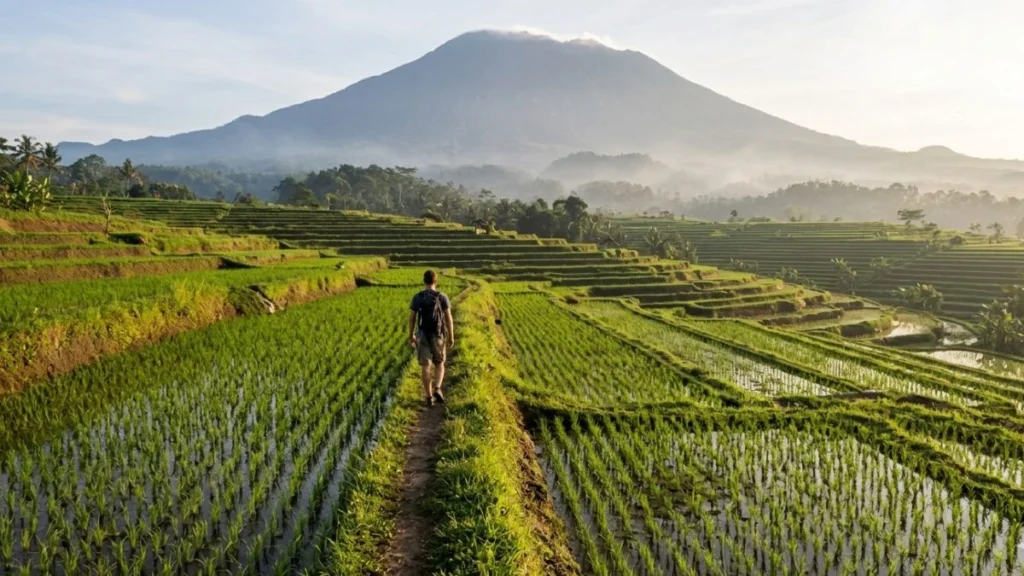
Sidemen Valley trekking guide: Sidemen is a rural valley in Karangasem regency, East Bali, where working rice terraces, river crossings, and direct views of Mount Agung make for some of the most rewarding trekking on the island — without the crowds or the entrance queues of Tegallalang.
This Sidemen Valley trekking guide covers the two main trekking options, what the terrain actually involves, how to find a local guide, and why Sidemen rewards visitors who slow down. Sidemen is 45km east of Ubud, pronounced see-da-men, and part of Karangasem regency — one of the least developed and most traditionally Balinese regions on the island. What you find here is working farmland, active village life, and rice terraces that exist because local families cultivate them, not because a developer built a viewing platform.
The comparison to Tegallalang is worth addressing directly. Tegallalang is close to Ubud, Instagram-optimised, and priced accordingly. Sidemen requires a longer drive, has no swing or rooftop café at the top of the terrace, and charges IDR 25,000 for the public walking trail. The tradeoff is that you walk through a rice field where a farmer is actually working, cross a real river, and may encounter no other tourists for an hour at a time.
For context on East Bali’s village culture — the banjar system, traditional compound architecture, and communal land management — the Penglipuran village guide covers the social structures that shape the landscapes you walk through in Sidemen.
What Sidemen Valley Actually Looks Like
Sidemen sits at around 300 metres elevation in a broad valley flanked by forested ridges, with the Unda and Telaga Waja rivers running through the floor. Mount Agung — Bali’s highest and most sacred volcano at 3,031 metres — dominates the northern skyline on clear days. The view of Agung from the rice terraces in Sidemen is one of the cleanest available from any accessible point on the island.
The rice terraces here are working agricultural land, not decorative landscaping. The subak irrigation system — a UNESCO-recognised cooperative water management practice that has governed Balinese rice cultivation for over a thousand years — is visibly active in Sidemen. Farmers coordinate water flow, planting cycles, and harvest timing through the local subak organisation. Walking through the terraces outside of harvest season, the paddies are green and flooded. During harvest (roughly March and September, though this varies by field), the stalks turn gold. Both are worth seeing; neither can be guaranteed on a specific date.
The Two Main Trekking Options
Option 1: The Public Walking Trail (Self-Guided)
The signposted public trekking route begins on the outskirts of Sidemen village. The entrance is marked by a small roadside booth where you pay IDR 25,000 per person. The trail runs approximately 3km through the rice terraces and takes around one hour at a relaxed pace, with an optional stop at the Panoramic Café roughly halfway around.
The path is narrow, clearly marked for the most part, and involves some uneven ground, irrigation channel crossings, and muddy sections after rain. Flip flops are not suitable. Trainers or light hiking shoes with grip are the minimum. After wet weather, sections become genuinely slippery.
This option works well for visitors who want to explore independently and do not need cultural context provided along the way. The views are the same as the guided route. What you miss is the conversation.
Option 2: Guided Trekking with a Local Guide
Several local guides operate in Sidemen, most bookable through accommodation or directly at the village. The most frequently recommended is Komang Adi from Sidemen Trekking, who grew up in the area and runs two-hour treks that include a local market visit before the walk.
A guided trek through Sidemen covers routes not on any public map, avoids the irrigation channels that can damage rice paddy infrastructure, and includes the kind of conversation — about Balinese agriculture, family structure, religion, and daily life — that turns a walk through a rice field into something substantially more than exercise. Pricing is typically IDR 150,000–300,000 per person depending on group size and route length.
The guided route often includes river crossings. In the dry season, this means wading through ankle-to-knee-deep water. After significant rain, water levels rise considerably — a good local guide will assess the crossing and reroute if it is unsafe.
What the Trekking Is Actually Like
The terrain in Sidemen is less manicured than Ubud’s rice terrace walks. Paths are narrower, less defined, and more variable underfoot. River crossings are real crossings — expect wet feet. The upside of this roughness is that the landscape feels genuinely agricultural rather than curated for visitors.
On a clear morning before 9am, the combination of low light on the rice paddies, mist in the lower valley, and the unobstructed profile of Mount Agung above is as good as landscape trekking gets in Bali. By 10am, the light flattens and the temperature rises. Start early.
Jess had been in Ubud for five days before a driver mentioned Sidemen casually — “same rice fields, no one there.” She booked a guided trek for the following morning and arrived expecting something similar to Tegallalang. The guide took her through a working paddy where a farmer was knee-deep in water, adjusting the irrigation channel by hand, and stopped to explain how the subak system allocated water between three different families on the same slope. She said later it was the first time in Bali she felt like she understood something rather than photographed it.
Sidemen Valley Trekking Guide: Practical Tips
Start time — Before 8am. Sidemen mornings are cooler than the coast, but by 10am the heat is significant. An early start also gives you the terraces before any other visitors arrive.
Footwear — Trainers or hiking shoes with grip are essential. The paths involve mud, wet rocks, and river crossings. Sandals work only in completely dry conditions and are a liability in the wet season.
Wet season — December to April brings frequent afternoon rain and higher river levels. Trek in the morning and finish before noon. River crossings may be impassable after heavy overnight rain — a good local guide will know and will reroute.
Dry season — May to October is more reliable for full routes including river crossings. The rice fields are greener and more photogenic during and just after the rainy season.
What to bring — Water (minimum 1.5 litres for a two-hour trek), sun protection, a small dry bag for your phone if crossing rivers, and cash for the entrance fee and guide payment. There are no ATMs in Sidemen village.
Photography — Ask before photographing farmers at work. Most will agree readily but the gesture of asking matters. Do not photograph ceremonies or temple activity without permission.
Beyond the Rice Terraces: What Else Is in Sidemen
Gembleng Waterfall — A short drive from the village, Gembleng has a series of rock pools near the top with open views across the surrounding jungle. The uppermost pool functions as a natural infinity pool. It is becoming more visited — arrive early to avoid queues for the pool. No entrance ticket, but a small donation is expected. Wear shoes with grip for the steep walk down.
Telaga Waja River Rafting — The Telaga Waja river runs alongside the valley and offers an 18km rafting course through forests, rice paddies, and past several waterfalls. It is the least crowded major rafting route in Bali. Book through accommodation or a Sidemen-based operator.
Bukit Cinta viewpoint — About 45 minutes north of Sidemen, this viewpoint offers one of the best sunrise views of Mount Agung on the island. The drive alone — through winding roads and traditional villages — is worth doing.
Ananda Bathhouse — A newer wellness facility in Sidemen with thermal pools, sauna, steam room, and cold plunge. Access costs IDR 500,000 for a two-hour slot. Useful on a rainy afternoon when trekking is not possible.
Getting to Sidemen
Sidemen is not easily reached by public transport. The practical options are:
Scooter from Ubud — About 45 minutes to one hour on clear roads via Klungkung. The road is well-surfaced for most of the route. The final approach into the valley is narrow in places.
Private car with driver — The most comfortable option and worth considering if you plan to combine Sidemen with Tirta Gangga, Candidasa, or the Lempuyang Temple on the same day. A full-day driver from Ubud covering East Bali runs IDR 400,000–600,000.
Grab or Gojek — Not reliably available in Sidemen itself. These apps work for getting to the area from nearby towns but are not practical for moving around within the valley once you arrive.
Sidemen is the version of Bali that exists when you take away the beach clubs, the infinity pools, and the organised excursions. What remains is agricultural land, a functioning traditional community, and one of the island’s most honest landscapes. The trekking here is not dramatic — it is immersive. The distinction is worth travelling 45km from Ubud to experience.
For the next step in exploring East Bali’s slow travel circuit, the Amed vs Candidasa guide covers the two coastal towns closest to Sidemen — both within an hour’s drive — and which one makes more sense depending on what you are looking for from the coast.
FAQ
Is the Sidemen Valley trekking suitable for beginners? Yes. The public trail is 3km on mostly flat terrain with some uneven sections. The guided routes vary in length and difficulty — a good local guide will adjust the route to the group’s fitness level. The main variable is river crossings, which can be challenging after heavy rain. Dry season visits are more predictable.
Do I need a guide to trek in Sidemen? No — the public walking trail is signposted and manageable independently. A guide adds cultural context, local knowledge of the best routes, and practical safety on river crossings. For a first visit, a local guide is worth the cost. For return visitors who know the terrain, independent walking is fine.
How much does trekking in Sidemen cost? The public self-guided trail costs IDR 25,000 per person at the entrance booth. Guided treks cost approximately IDR 150,000–300,000 per person depending on group size and route. Gembleng Waterfall has no entrance fee but asks for a small donation.
What is the best time of year to visit Sidemen for trekking? The dry season (May to October) offers the most reliable conditions for river crossings and full-route treks. The wet season (December to April) produces greener, more photogenic rice paddies but brings afternoon rain and higher river levels. Arriving early in the morning applies year-round.
How far is Sidemen from Ubud? Sidemen is approximately 45km east of Ubud — roughly 45 minutes to one hour by scooter or car depending on traffic. It is also about one hour from Candidasa on the east coast and 30 minutes from Klungkung town.