
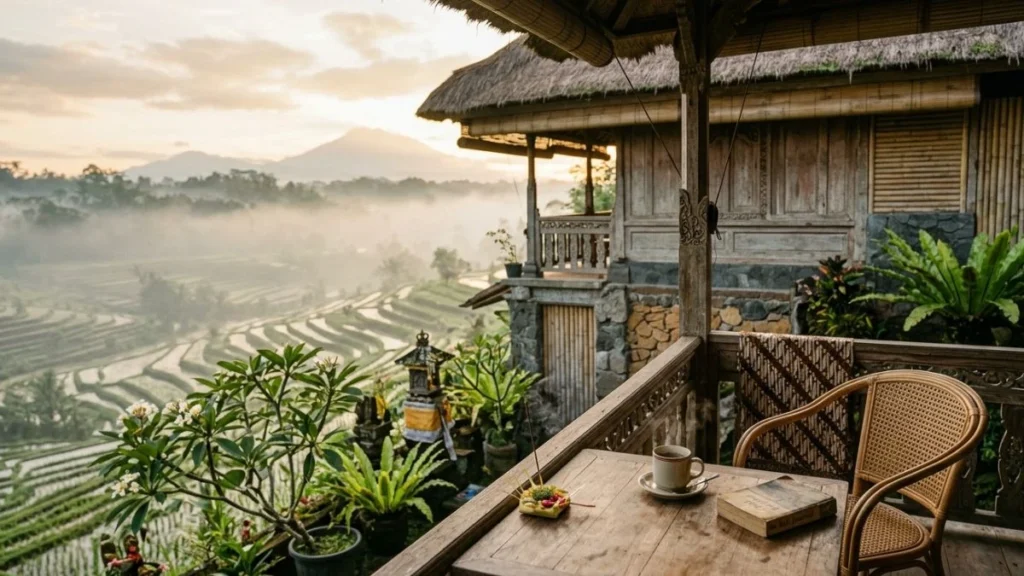
Best areas to stay in Bali for slow travel: For slow travellers, the right base in Bali is not the most convenient one — it is the one that puts you closest to the pace, landscape, and community you came to experience. That decision changes everything about the trip.
The best areas to stay in Bali for slow travel are not the same as the best areas for a first-time visitor on a week-long holiday. Seminyak, Kuta, and Canggu dominate most accommodation guides for good reasons — they are convenient, well-serviced, and easy. For slow travel, those qualities work against you. Convenience creates a buffer between you and the place. The areas that reward slow travellers are the ones where staying longer reveals more, not less.
This guide covers six areas honestly — what each is actually like to base yourself in, who it works for, and what it costs you in terms of access and trade-offs. It does not include everywhere in Bali. It includes the areas where slow travel is genuinely possible.
What Slow Travel in Bali Actually Means
Slow travel in Bali is not just a slower itinerary. It is a different relationship with where you stay. Instead of moving hotels every two days, you spend a week or more in one area — returning to the same warung for breakfast, walking the same rice field path at different times of day, getting to know the family at the guesthouse. The accumulation of repeated experience in one place is what produces the depth that a packed itinerary cannot.
It also means your base matters more. Staying in the right area for slow travel gives you walking access to temples, markets, and village life. Staying in the wrong area means spending your slow mornings in traffic trying to reach the place you actually wanted to be.
Ubud: The Most Obvious Choice — and Why It Still Works
Ubud is the default answer for cultural slow travel in Bali, and the default answer is correct — with qualifications. The centre of Ubud has become significantly more crowded, commercial, and traffic-heavy over the past decade. Jalan Monkey Forest and Jalan Hanoman are packed most mornings. The Instagram-facing version of Ubud — floating breakfasts, rice terrace swings, pool villas — has little to do with slow travel.
What still works in Ubud is the surrounding area. Staying in the villages immediately outside the town centre — Penestanan, Sayan, Tegallalang, or Mas — gives you the cultural infrastructure of Ubud (temples, ceremonies, markets, arts) without the congestion. A 10-minute walk from central Ubud puts you in working rice fields. A 20-minute walk reaches villages where odalan ceremonies happen without tourist observers.
Best for: Cultural immersion, temple access, arts and craft traditions, Balinese cooking classes, easy day trips to East and North Bali. Not ideal for: Beach access (nearest is 45 minutes), anyone who finds crowds and traffic draining rather than energising. Area to target: Penestanan, Sayan, or the northern outskirts of Ubud rather than the town centre.
Sidemen: The Best Slow Travel Base in East Bali
Sidemen is what Ubud was 20 years ago, with better views. The valley sits in Karangasem regency, 45km east of Ubud, at around 300 metres elevation. Working rice terraces run up the hillsides, Mount Agung dominates the skyline on clear days, and the village itself has no beach clubs, no rooftop bars, and no swing-over-the-jungle photo installations.
What Sidemen has is quiet, genuine agricultural landscape, a handful of well-run guesthouses and boutique lodges, and the kind of unhurried local life that makes slow travel feel like the right choice rather than a compromise. The Sidemen Valley trekking guide covers the walking routes in detail — but the value of basing yourself here rather than day-tripping is that you see the valley at different times of day and in different light, which is a different experience entirely.
Best for: Deep slow travel, rice terrace trekking, East Bali exploration, anyone who specifically wants to avoid the south Bali tourist circuit. Not ideal for: Nightlife, digital nomad infrastructure (limited coworking, unreliable fast internet in some properties), beach access. Realistic commitment: Two to four nights minimum to justify the drive. A week is better.
Sanur: The Underrated Coastal Base
Sanur is the coastal area most consistently overlooked by slow travellers who assume they need to choose between Canggu (noisy, trendy) and Ubud (cultural, inland). Sanur offers a third option: a calm beachfront town with a genuine local neighbourhood behind it, consistent infrastructure, and a pace that most other coastal areas in Bali have long since abandoned.
The beachfront promenade runs for several kilometres and is lined with cafés, local food stalls, and small resorts that have not been replaced by beach clubs. The beach itself has calm, swimmable water — uncommon on Bali’s southern and western coasts, which are generally surf beaches with dangerous currents. Sanur is also the departure point for boats to Nusa Penida and Nusa Lembongan, which makes East Bali island access straightforward.
The area behind the beachfront has traditional Balinese neighbourhoods, morning markets, and local warung that have not yet been replaced by smoothie bowl cafés. Staying a week in Sanur and exploring the back streets on foot or bicycle reveals a coastal Bali that most visitors drive through without stopping.
Best for: Families, older travellers, couples who want calm coastal life without sacrificing infrastructure, anyone using Nusa Penida as a day trip. Not ideal for: Surf, nightlife, the kind of social scene that Canggu offers.
Amed: East Coast Slow Travel at the Water’s Edge
Amed is a stretch of quiet fishing villages along Bali’s northeast coast, running from Culik in the west to Seraya in the east. The landscape is dramatically different from south Bali — drier, more rugged, with black sand beaches, traditional jukung outrigger fishing boats pulled up on shore, and direct views of Lombok’s Rinjani volcano across the strait on clear days.
Amed’s primary draw is diving and snorkelling — the USAT Liberty shipwreck at Tulamben, 15 minutes west, is one of the most accessible wreck dives in the world. But Amed works as a slow travel base for non-divers too. The pace is genuinely slow, the accommodation is mostly small family-run guesthouses and dive resorts, and the fishing village character of the main settlement has survived tourism better than most comparable areas in Bali.
The drive from south Bali is two to three hours, which is why Amed tends to attract travellers who commit to staying rather than passing through. That commitment is, in slow travel terms, exactly the point.
Best for: Divers and snorkellers, anyone seeking genuine coastal village life, travellers combining Amed with Sidemen and East Bali. Not ideal for: First-time visitors who need easy access to south Bali attractions, digital nomads needing fast reliable internet, anyone not prepared for the long drive.
Munduk: North Bali’s Highland Alternative
Munduk is a small highland village in the hills above Lovina in North Bali, at around 900 metres elevation. The temperature is noticeably cooler than the south, the landscape is coffee plantations, clove trees, and small waterfalls rather than rice terraces, and the village has remained genuinely quiet despite growing visibility on travel itineraries.
For slow travellers who have already spent time in Ubud and want a different highland experience, Munduk offers a complete change of landscape and pace. The area around the village has several well-marked walking trails, two lakes within day-trip distance (Tamblingan and Buyan), and a distinctly North Balinese cultural character that differs noticeably from the Ubud-centred version most visitors encounter.
Accommodation in Munduk is mostly small guesthouses and homestays, some with coffee plantation views. Infrastructure is limited — one good café, a handful of warung, no nightlife. That is the point.
Best for: Highland walking, cool climate, genuine village life, travellers combining North Bali with Amed and the East. Not ideal for: Beach access (Lovina is 45 minutes, north coast beaches are not Bali’s best), digital nomads, anyone who needs urban infrastructure nearby.
Candidasa: The Quiet East Coast Town Most People Drive Past
Candidasa sits on the East Bali coast between Padangbai and Amlapura, and most travellers experience it at 60km/h from the window of a car heading to Amed. That is a mistake. Candidasa is not glamorous. The beach was damaged by coral extraction decades ago and has never fully recovered — it is more stone jetties and volcanic sand than postcard coastline. But the seafront has a line of quiet cafés and small hotels with ocean views, the surrounding area includes Tirta Gangga water palace (15 minutes north) and Tenganan, one of Bali’s oldest traditional villages, and the general pace of the town is the slowest of any coastal area in the south and east of the island.
Candidasa rewards a stay of two to three nights for travellers who want an East Bali coastal base that is genuinely unhurried and within reach of the regency’s main cultural and natural attractions.
Best for: East Bali exploration, proximity to Tirta Gangga and Tenganan, travellers who want a coastal base without Amed’s remoteness. Not ideal for: Swimming beach, nightlife, anyone who needs convenience.
How to Choose Based on Your Trip Length
| Trip length | Recommended base |
|---|---|
| 3–4 days | Ubud (outskirts) or Sanur |
| 5–7 days | Ubud + Sidemen (split stay) |
| 8–14 days | Ubud + Sidemen + Amed or Munduk |
| 14+ days | One base per region; move slowly |
The pattern for slow travel in Bali is almost always: start in Ubud to establish cultural context, then move progressively east or north as the trip extends. Each area builds on the previous one. Jumping straight to Amed on day one without the cultural foundation that Ubud provides is possible but misses the connective tissue that makes East Bali legible.
FAQ
Is Ubud still worth it for slow travel given the crowds? Yes — if you stay outside the town centre. Penestanan, Sayan, and the northern outskirts retain the pace and character that made Ubud a slow travel destination. The centre of Ubud is best visited in the early morning and avoided at midday.
Which area in Bali is best for slow travel on a budget? Sidemen and Candidasa offer the best combination of slow travel character and affordable accommodation. Guesthouses in both areas run IDR 200,000–500,000 per night for clean rooms with views. Amed is similarly priced. Ubud’s outskirts are slightly more expensive but still affordable compared to south Bali.
Can I do slow travel in Bali without a scooter or car? In Ubud, partially — the town centre and immediate surroundings are walkable. In Sidemen, Amed, Munduk, and Candidasa, independent transport is effectively necessary. Gojek and Grab work in Ubud and Sanur but are unreliable in more rural areas. A scooter rental gives the most flexibility for the least cost.
How long should I spend in each area for genuine slow travel? Three nights is the minimum to feel settled in any area. Five to seven nights is where slow travel starts to work as intended — you develop routines, recognise faces, and begin to understand the rhythm of the place. Two nights is a visit; five nights is a stay.