
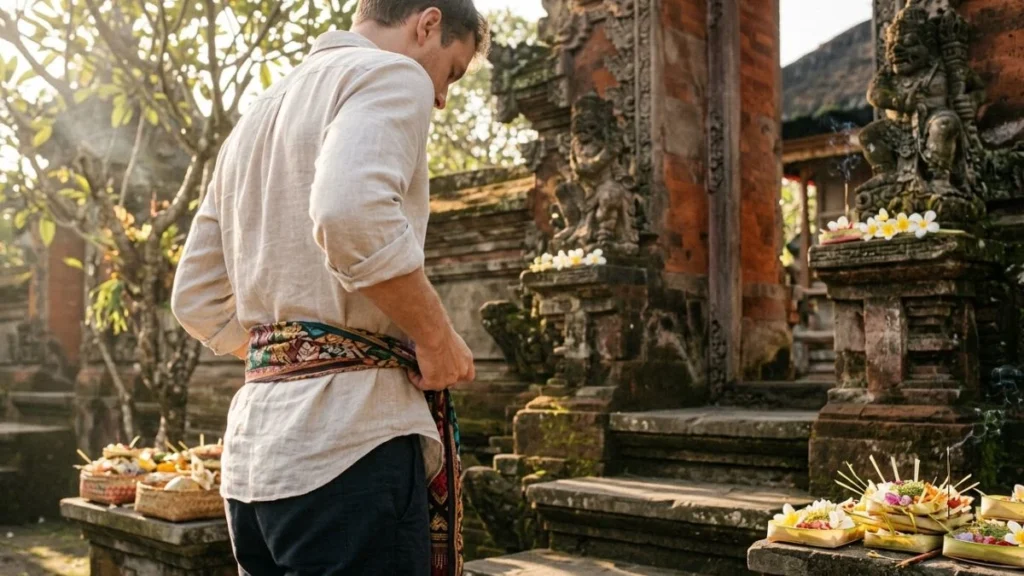
Bali temple etiquette for tourists: Bali’s temples — called pura — are active places of daily worship, not tourist attractions. Every rule around dress, behaviour, and access exists to protect the sanctity of spaces where Balinese Hindus pray, make offerings, and conduct ceremonies every day.
This guide to bali temple etiquette for tourists covers what actually matters before you enter a pura — the rules that are enforced, the ones that are often misunderstood, and the context that makes following them feel like genuine respect rather than compliance. Bali has over 20,000 temples and shrines. You will encounter them everywhere — at roadsides, inside hotels, at the corner of rice fields, and as major destinations. Understanding how to behave at each type changes how you experience all of them.
In 2025, the Bali Provincial Government strengthened visitor behaviour regulations through Governor’s Circular Letter SE No. 7/2025, which formally reminds visitors to dress modestly, respect holy sites, and follow instructions from temple staff. The regulations are not new in spirit — they are new in enforcement.
For context on how Balinese Hindu community life is organised around the temple system, the Penglipuran village guide explains the banjar structure and the three-temple layout — Kahyangan Tiga — that every traditional Balinese village is built around.
Why Bali Temple Rules Exist: The Context Most Guides Skip
Balinese temples are not heritage sites preserved for visitors. They are living religious spaces where daily offerings — canang sari — are placed every morning, where odalan ceremonies happen every 210 days, and where the community gathers for every significant ritual in the Balinese Hindu calendar. When a temple has 200 tourists walking through it on the same morning that a family is praying, the rules around dress and behaviour are not about aesthetics. They are about maintaining the conditions under which the space remains functional as a place of worship.
This is the frame that makes bali temple etiquette for tourists legible. Every rule has a reason rooted in Balinese Hindu cosmology or practical community need — not arbitrary formality.
The Non-Negotiable Rules: What Is Always Enforced
Sarong and Sash — No Exceptions
The sarong (kamen) and sash (selendang) are mandatory to enter any temple in Bali, regardless of what you are wearing underneath. This is enforced at the gate. You will not be allowed in without them.
Most major temples rent or lend sarongs at the entrance for a small fee — IDR 10,000 to 20,000, or sometimes a donation. Carrying your own is more practical, particularly at smaller village temples that may not have rentals available.
For women: sarong wrapped around the waist covering to the ankle, sash tied at the waist. Shoulders should be covered — a light scarf or shawl over sleeveless tops is accepted at most temples.
For men: sarong wrapped at the waist, sash tied. A t-shirt covering the shoulders is the minimum. A collared shirt or traditional batik shirt is more respectful at major temples.
The sarong is not optional if you are menstruating. Balinese custom asks that women who are menstruating do not enter temple sanctuaries. This rule is not always enforced at tourist-facing temples, but it is a genuine religious belief — not a rule designed for visitors — and it deserves to be treated as such.
No Entry to the Inner Sanctum (Jeroan)
Most Balinese temples have three courtyards: the outer (jaba sisi), middle (jaba tengah), and inner (jeroan). The innermost courtyard — where the main shrines are — is generally restricted to Balinese Hindus who are praying, particularly during ceremonies. As a visitor, you are typically welcome in the outer and middle courtyards. Do not enter the jeroan unless explicitly invited or directed by temple staff.
Menstruation and Physical Condition
Visitors who are menstruating, have open wounds, or are in a state considered ritually impure are asked not to enter the inner areas of the temple. This applies to Balinese worshippers and visitors alike. It is a matter of Balinese Hindu belief about the conditions required for sacred space to function — not a judgment about the person.
Behaviour Inside the Temple
Move quietly and slowly — Temples are not spaces for rushing. Walk calmly, speak at a low volume, and avoid drawing attention to yourself.
Do not climb or sit on shrines, statues, or walls — This is the rule most frequently violated by tourists and most offensive to Balinese worshippers. Shrines are sacred objects, not photo props. Do not touch them unless invited to.
Do not step over offerings — Canang sari and other offerings placed on the ground are active ritual objects. Walk around them, not over them.
Do not point your feet toward shrines — In Balinese Hindu cosmology, feet are the lowest and least pure part of the body. Sitting with feet pointing toward shrines is considered disrespectful. If you sit, tuck your feet to the side or behind you.
Do not position yourself higher than the priests or shrines during ceremony — Height carries spiritual significance. Do not climb walls or elevated structures to photograph a ceremony from above.
Photography — Permitted in outer courtyards in most temples. Not permitted during active prayer or in the innermost sanctum. If a ceremony is in progress, put the camera away entirely unless you have been explicitly invited to document it. As of 2025, no selfies or videos inside the jeroan are the formal guideline across major temple sites.
The Rules That Are Often Misunderstood
“Just wear a sarong and you’re fine”
The sarong is necessary but not sufficient. Behaviour inside the temple matters as much as what you are wearing at the gate. Tourists in sarongs who climb on shrines for photographs, step over offerings, or speak loudly during prayers are not behaving respectfully regardless of their dress.
“Small temples have no rules”
Village shrines and roadside temples have the same spiritual significance to the families who maintain them as Besakih or Tanah Lot have to their congregations. A small temple without a gate attendant is not an invitation to enter freely. If there is no one present and the gate is open, observe from outside unless you are with a Balinese host who invites you in.
“Temples are always open to tourists”
They are not. During certain ceremonies — particularly odalan — non-worshippers may be restricted from entering, or permitted only to observe from the outer courtyard. Temple staff will direct you. Follow their instructions without negotiation.
| Rule | Why it exists |
|---|---|
| Sarong and sash mandatory | Ritual modesty; bodily covering as respect for sacred space |
| No entry during menstruation | Balinese Hindu concept of ritual purity (cuntaka) |
| No shoes in some inner areas | Purity of the sacred ground |
| Do not step over offerings | Offerings are active ritual objects in communication with the divine |
| No selfies in the jeroan | Inner sanctum is active worship space, not a backdrop |
| Follow height rules | Cosmological significance of vertical space in Balinese Hinduism |
The Three Types of Temple You Will Encounter
Understanding which type of temple you are visiting changes what to expect in terms of access and etiquette.
Major tourist temples — Besakih, Tanah Lot, Uluwatu, Tirta Empul, Ulun Danu Beratan. These have formal entrance processes, sarong rental at the gate, staff managing visitor flow, and clearly marked restricted areas. Etiquette is enforced consistently. Entry fees apply.
Village temples (pura desa, pura puseh, pura dalem) — The three-temple system present in every traditional Balinese village. These are primarily for the local community. Visitors are generally welcome to observe from the outer courtyard but should not enter without a local host. During odalan, access may be restricted entirely.
Family compound temples (sanggah or merajan) — Private temples within a family’s pekarangan (compound). You will not enter these unless you are a guest of the family. If invited in as part of a home visit, follow your host’s lead on every detail.
Sarong in your bag, phone down during prayers, and feet tucked when you sit. Those three habits cover the majority of what respectful temple visiting looks like in practice. The deeper layer — understanding why the rules exist, what the space means to the people who use it every day — is what turns a temple visit from a tick on an itinerary into something that stays with you after Bali.
The temple system in Bali is inseparable from the ceremony cycle that governs Balinese Hindu life. If the Balinese cremation ceremony guide answered questions about how death is handled within that system, the next piece worth reading covers how the same community structures organise the living — through the banjar, the compound, and the daily offering practice that holds it all together.
FAQ
Do I need to wear a sarong at every temple in Bali? Yes. A sarong and sash are mandatory at every temple in Bali without exception. Most major temples provide rentals at the gate. Carrying your own is more practical for smaller village temples that may not have rentals available.
Can tourists enter Balinese temples during ceremonies? Sometimes, and with conditions. During odalan and other active ceremonies, non-worshippers may be restricted to the outer courtyard or asked to wait. At major public ceremonies, respectful observation from the perimeter is generally permitted. Follow the direction of temple staff without negotiation.
What happens if I dress incorrectly at a Bali temple? You will be stopped at the gate and asked to rent a sarong before entering. If your behaviour inside the temple is considered disrespectful — climbing on shrines, photographing during prayers — you may be asked to leave. Since 2025, enforcement of visitor behaviour rules has been formally strengthened across Bali’s temple sites.
Are there temples in Bali that tourists cannot enter at all? Yes. Some temples are restricted to Balinese Hindus only, particularly the innermost sanctuaries of major temples and all private family compound temples. Pura Besakih — Bali’s mother temple — has historically had issues with unlicensed guides pressuring tourists into areas they should not enter. Stick to clearly marked visitor paths and ignore anyone who offers to take you “inside” for a fee.
Is it disrespectful to visit Balinese temples as a non-Hindu tourist? No — respectful visiting by people of any background is generally welcomed by the Balinese. What is disrespectful is treating temples as photo backdrops, ignoring dress codes, or behaving in ways that disrupt active worship. Genuine curiosity, quiet behaviour, and following the rules are all that is required.