
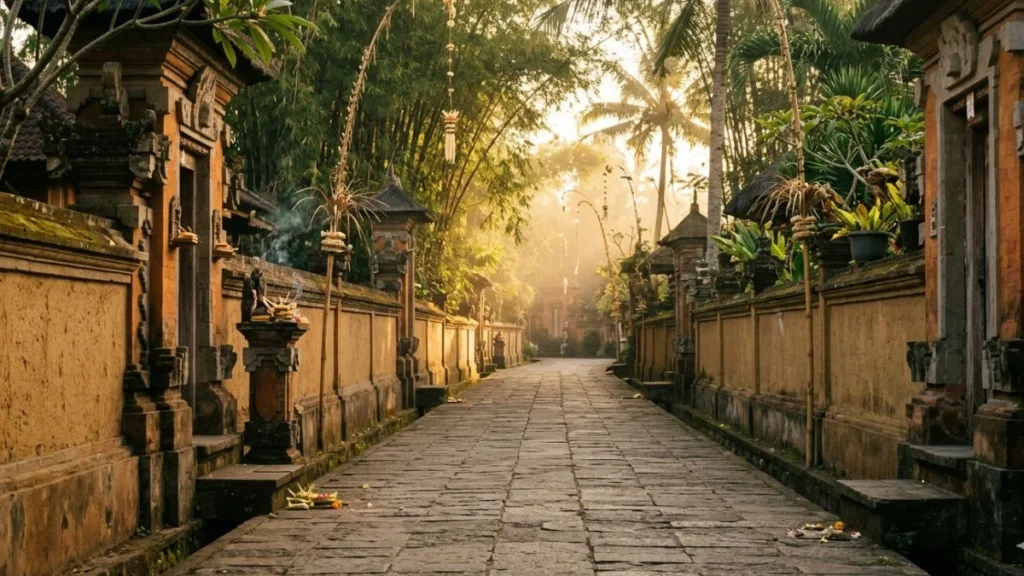
Penglipuran village Bali guide: Penglipuran is a living traditional Balinese Hindu settlement in Bangli regency where 76 family compounds are maintained along a single ceremonial axis according to 700-year-old communal laws — still practised today, not reconstructed for visitors.
This Penglipuran village Bali guide covers what most visitors walk straight past — because most visitors spend 40 minutes photographing the entrance gate before getting back on the tour bus. Penglipuran draws tens of thousands of visitors a year, but the village gives back in proportion to how slowly you move through it. The banjar system — the communal self-governance structure at the heart of Balinese Hindu life — is physically readable here in the architecture, the spatial layout, and the daily practice of the 900 or so people who live inside it. In 2024, the ticketing system was updated: a single IDR 50,000 entry fee for international visitors now covers both the residential lane and the bamboo forest, which previously required a separate payment.
Penglipuran sits in Bangli regency, 45km northeast of Ubud at roughly 700 metres elevation. The air is noticeably cooler than the coast — worth knowing if your itinerary puts you here at midday.
What Is Penglipuran Village, Really?
Penglipuran is not a cultural park or a heritage reconstruction. The families living here made a collective decision — and continue to renew it — to maintain building standards, ceremonial practices, and land-use rules that predate modern Indonesia by several centuries. The legal instrument behind this is a local awig-awig: a customary law enforced by community consensus rather than the state. Residents who build outside prescribed proportions or use non-traditional materials on compound facades face social and ceremonial consequences. No government decree keeps Penglipuran intact. The community does.
What this means for a visitor is that the village functions as a legible argument about Balinese cosmology — which is considerably more interesting than a row of photogenic gates. Understanding the layout turns a 40-minute photo stop into something worth two to three hours.
How the Village Is Laid Out
Penglipuran is built on a strict north–south axis aligned with kaja (toward sacred Mount Agung in the north) and kelod (toward the sea in the south). Every family compound sits along this axis in a fixed arrangement. The spatial logic comes from Tri Hita Karana — the Balinese philosophy of harmony between humans, nature, and the divine — which UNESCO recognised in its inscription of the Bali Cultural Landscape in 2012.
The Three Temple Zones Worth Understanding
The three temples follow the same north–south axis as the compounds. The pura puseh (origin temple) sits at the northern end facing Mount Agung. The pura desa (village temple) occupies the central section, where communal ceremonies take place. The pura dalem (death temple) sits at the southern end, facing away from the mountain. This tripartite structure — called Kahyangan Tiga — exists in every traditional Balinese village. In Penglipuran, all three are intact, accessible, and walkable in under an hour.
During odalan — the temple anniversary ceremony occurring every 210 days in the Balinese Pawukon calendar — the central section fills with ceremony. The village is not closed to visitors during odalan, but it is fully occupied. Attending as a respectful observer from the perimeter, sarong on, camera down during innermost rituals, is possible and instructive. Most tour groups skip odalan days because they require timing flexibility. That flexibility is worth planning for.
Reading the Compound Facades
Each of the 76 compound facades is rendered in the same ochre-toned plaster, with identical proportions dictated by the awig-awig. The visual uniformity is intentional. In Balinese Hindu social philosophy, the household is a unit of the community — not a display of individual status. Gate carvings vary slightly in ornamental detail, reflecting ceremonial standing and craft tradition rather than wealth.
The awig-awig here functions as an architectural anti-status law: every compound looks roughly the same from the outside because that is the agreed-upon condition of living in the village. Families who want to display prosperity move elsewhere. Those who stay accept the contract.
Ketut arrived at Penglipuran having read every article about it. He knew about the gates, the bamboo forest, the loloh cemcem. What he didn’t expect was to stand in front of the 40th compound on the lane — identical in proportion to the first 39 — and feel something shift. Not wonder at the aesthetics. Something closer to understanding what it costs a community to agree, every generation, to look the same.
The Bamboo Forest Most Visitors Skip
Behind the residential lanes, accessible via a path at the northern end of the village, lies roughly 45 hectares of bamboo forest that Penglipuran residents have managed collectively for generations. The community banned bamboo cutting except for ceremonial purposes — a restriction that predates modern conservation language by centuries. The result is a forest that functions as a forest: dense, cool, and quiet in ways the tourist-facing lane is not.
The bamboo is harvested selectively for penjor — the tall ceremonial poles decorated with coconut leaves and offerings that appear throughout Bali during the Galungan festival cycle. During Galungan (every 210 days), the entire main lane is lined simultaneously with penjor from all 76 compounds. The visual effect — a corridor of arching poles overhead from one end of the lane to the other — is one of the more striking things visible in Bali outside a major temple ceremony. If your timing is flexible, arriving during Galungan is worth planning around.
The forest is included in the IDR 50,000 entry fee since the 2024 ticketing update, but there is minimal signage at the main entrance directing visitors there. Most people never reach it. The temperature inside the canopy drops four to six degrees compared to the open lane — a practical reason to walk in beyond the aesthetics.
What Most Guides Get Wrong About Penglipuran
Almost every article about Penglipuran repeats the claim that it is “one of the three cleanest villages in the world.” This claim circulates widely and has no verifiable source. The actual basis for Penglipuran’s recognition is a 1995 Indonesian government award for environmental management, and subsequent regional recognition for maintaining traditional architecture. Neither translates to a global ranking.
The “cleanest village” framing sells Penglipuran as a spectacle of tidiness, which is both inaccurate and reductive. The cleanliness is a byproduct of the awig-awig system — not the point of it.
| What’s commonly said | What’s actually true |
|---|---|
| “One of the three cleanest villages in the world” | Indonesian government award (1995) — no verified global ranking exists |
| “Village frozen in time” | Living community; awig-awig updated periodically by consensus |
| “Entry fee: IDR 30,000” | Updated to IDR 50,000 in 2024 — now includes bamboo forest |
| “Best visited as part of Kintamani tour” | Standalone morning visit before 9am is significantly better |
| “Bamboo forest is near the village” | The forest is part of the village — included in entry, missed by most |
Penglipuran Village Bali Guide: Practical Tips
Timing, Dress Code, and How Long to Stay
Arrival time — Before 9am. Tour buses arrive around 10am. The village at 7:30am and at 11am are different experiences: one feels inhabited, the other managed.
Dress code — A sarong and sash are required to enter any of the three temple areas. Both are rentable at the entrance for IDR 10,000–15,000. Sleeveless tops and shorts are fine on the main lane; the sarong applies specifically at temple entrances.
Duration — Two hours covers the lane, bamboo forest, and food stalls. Three hours lets you sit near the pura desa during morning prayer activity, typically 7:30–8:30am, without intruding. A 45-minute pass-through is a waste of the entry fee.
Photography — The main lane is public space. Compound interiors are private. When a gate is open and residents are visible, make eye contact and wait for acknowledgment before raising a camera. Most residents respond warmly to a simple “Suksma” — Balinese for thank you.
Food stalls — Several stalls sell loloh cemcem, a traditional herbal drink made from Graptophyllum pictum leaves with a mild bitter, cooling quality. Around IDR 10,000 per cup. It is not a tourist invention — Balinese families have drunk it as a daily tonic for generations.
What to combine — Penglipuran sits on the direct route between Ubud and Kintamani. A logical same-day route: Tirta Empul first, then Penglipuran, then Kintamani volcano viewpoint. Always do Penglipuran before the crowds, not after.
Local insight: The best photographs at Penglipuran are not of the lane with tourists in it. They are of individual gate carvings in morning light, the pura desa courtyard from the entrance threshold, and the bamboo canopy from below — all available to anyone who arrives before 9am and walks past the first 50 metres.
Getting to Penglipuran Without a Tour Package
Penglipuran is 45km northeast of Ubud — roughly 1.5 hours by scooter via Bangli town. The road from Ubud through Bangli is well-surfaced and signposted. Scooter rental in Ubud runs IDR 70,000–100,000 per day.
A private car with driver covering Penglipuran, Tirta Empul, and Kintamani costs IDR 400,000–600,000 from Ubud. The difference between booking via Klook or Traveloka versus negotiating directly is usually IDR 50,000–100,000 — small enough that either works.
Without a scooter: shared minibuses from Ubud’s Batubulan terminal run to Bangli town intermittently through the morning. From Bangli, Gojek or Grab covers the final 8km to the village. Total cost under IDR 50,000 each way; total travel time around two hours each direction. This route works best for solo travellers with no fixed schedule.
Penglipuran is worth more time than most itineraries allow. The lane is the front door. The forest is the interior. The awig-awig that keeps both looking the way they do is the actual story — and it is one that residents have been writing collectively for several hundred years. Slow down enough to read it.
If you want to understand how these same principles operate at the scale of a single household — the layout of a Balinese family compound, the shrine hierarchy within it, and why gates face the directions they do — a dedicated piece on Balinese family compound structure covers what Penglipuran makes visible but rarely explains.
FAQ
How much is the entrance fee for Penglipuran village? The entrance fee for international visitors is IDR 50,000 per person as of 2024. This covers both the residential lane and the bamboo forest, which previously required a separate ticket.
What is the best time to visit Penglipuran village Bali? Arrive before 9am for the quietest experience. The most visually distinct period is during Galungan, when all 76 compounds erect penjor poles simultaneously along the lane. Checking the Galungan calendar before booking your Bali trip takes two minutes and can make a meaningful difference.
Can tourists attend ceremonies at Penglipuran? Yes. Ceremonies such as odalan are not closed events. Visitors may observe from the perimeter as respectful guests — sarong required, camera down during innermost rituals. Village staff near the entrance can advise on what is happening on a given day.
Is Penglipuran worth visiting without a guided tour? Yes — and arguably more so. A self-guided visit lets you spend time in the bamboo forest, sit near the pura desa during morning activity, and move at a pace that lets the architecture become readable. Guided tours optimise for efficiency. Independent visits optimise for understanding.