
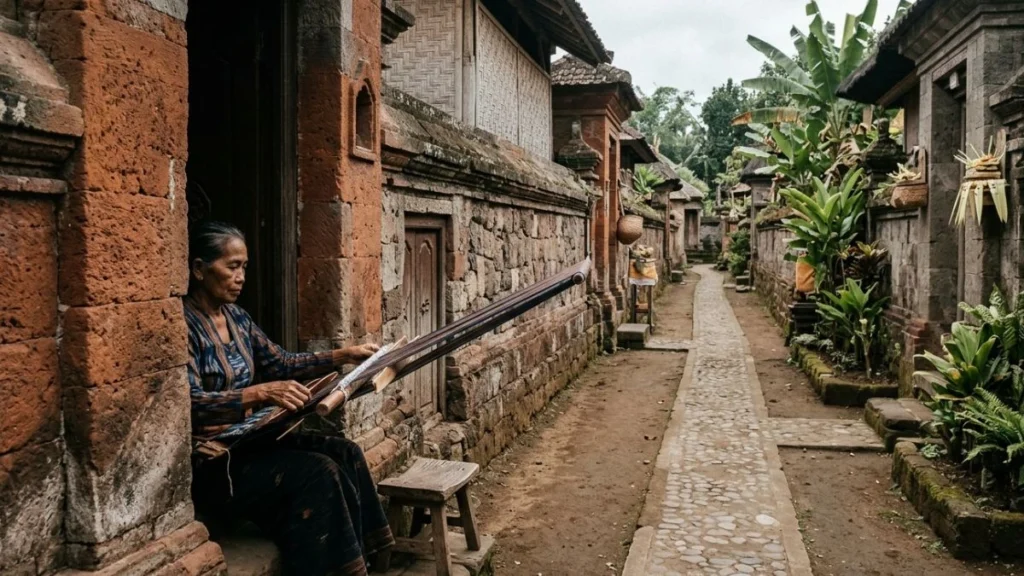
Penglipuran vs Tenganan village comparison: Penglipuran is organised, photogenic, and easy to navigate — a village shaped by tourism since 1993 without losing its cultural substance. Tenganan is older, less polished, and home to pre-Hindu Balinese Aga customs that exist nowhere else on the island. The right choice depends entirely on what you are looking for from a village visit.
The penglipuran vs tenganan village comparison comes down to one honest question: do you want a village that is easy to understand or one that takes more work to appreciate? Both are genuinely traditional. Both are worth visiting. They are not the same type of experience, and most articles avoid saying that directly because they want to recommend both equally.
This one will make the distinction clearly.
For visitors who have already read the Penglipuran village guide, this article fills in what Tenganan offers that Penglipuran does not — and vice versa — so the decision is based on what you actually want from the visit rather than which one appears first in a search result.
What Makes Tenganan Different From Every Other Village in Bali
Tenganan is a Bali Aga village — one of a small number of communities that predate the Hindu-Javanese cultural influence that shaped most of Bali’s contemporary architecture, ritual, and social structure. The Bali Aga are considered the original inhabitants of the island, and their customs, governance, and spiritual practices follow a distinct tradition that diverges from mainstream Balinese Hinduism in significant ways.
The most visible expression of this difference: Tenganan’s social organisation is based on a council of unmarried youth — daha teruna — whose ceremonial responsibilities govern the village’s ritual calendar. Marriage outside the village traditionally meant exile. The village has softened this rule in recent generations but the social contract of internal community loyalty remains structurally intact.
Tenganan is also the only place in Indonesia where geringsing — double ikat cloth — is woven. Double ikat is one of the most technically demanding textile traditions in the world: both the warp and weft threads are individually resist-dyed before weaving, and the pattern emerges only when the two sets of threads align correctly during the weaving process. A single piece of geringsing can take two to five years to complete. The cloth has ritual significance — it is believed to have protective properties and is used in specific Tenganan ceremonies. Visitors can watch weavers at work and purchase pieces, though authentic geringsing is expensive relative to other Balinese textiles.
The annual Perang Pandan (Pandan War) ceremony — where young men from the village fight each other with thorned pandan leaves as part of a ritual honouring the god Indra — is one of the most significant Tenganan ceremonies and one of the few in Bali with no equivalent elsewhere. It typically occurs in June or July.
What Makes Penglipuran Different From Tenganan
Penglipuran is mainstream Balinese Hindu in its cultural tradition — the same cosmological framework, the same Tri Hita Karana spatial philosophy, and the same temple system that governs every traditional village in Bali. Its distinction is not cultural uniqueness but architectural coherence: the awig-awig customary law that enforces uniform facade proportions has kept the village visually intact in a way that most Balinese villages have not maintained under economic pressure.
Penglipuran has been an official tourism village since 1993. The administration is professional, the entrance system is organised, and the residential lane is genuinely accessible to visitors who want to understand what they are looking at. The Penglipuran village guide covers the spatial logic, the bamboo forest, and what most visitors miss.
The honest version of the “too polished” criticism: Penglipuran has been shaped by tourism without being hollowed out by it. The families still live there, the awig-awig still governs construction, and the ceremony calendar still runs as it always has. What tourism has changed is the entrance infrastructure — not the village itself.
The Direct Comparison
| Penglipuran | Tenganan | |
|---|---|---|
| Cultural tradition | Mainstream Balinese Hindu | Bali Aga — pre-Hindu indigenous |
| Location | Bangli regency, central Bali | Karangasem regency, East Bali |
| Distance from Ubud | 45km / 1.5 hours | 65km / 2 hours |
| Tourism infrastructure | Organised — ticketed entrance, clear path | Basic — donation at gate, less defined visitor route |
| Entry fee | IDR 50,000 per person (2024 update) | No fixed fee — donation register at gate |
| Signature feature | Architectural uniformity, bamboo forest | Geringsing double ikat weaving, Bali Aga customs |
| Ease of understanding | High — layout logic is readable | Lower — cultural context requires more background |
| Photography | Photogenic, widely photographed | Less structured visually, more ethnographically interesting |
| Best combined with | Tirta Empul, Kintamani | Candidasa, Tirta Gangga, Amed |
| Crowd level | Moderate to high at peak hours | Low to moderate |
The Honest Assessment of Each
Penglipuran delivers what it promises: a coherent, accessible traditional village where the architecture is genuinely intact and the spatial logic is readable without background knowledge. Visitors who arrive with no understanding of Balinese village structure will still have a meaningful experience. Visitors who arrive having read about Tri Hita Karana, awig-awig, and the three-temple layout will have a significantly richer one. It is the better choice for visitors on a short Bali trip, visitors based in Ubud, and anyone for whom easy accessibility is a practical requirement.
Tenganan rewards prior knowledge and patient observation. The village is not designed for visitors in the way Penglipuran is. The layout is less immediately legible, the weaving workshops operate on the weavers’ schedule rather than a visitor timetable, and the cultural significance of what you are seeing — the geringsing cloth, the Bali Aga social structure, the architectural preservation of a pre-Hindu tradition — is not self-explanatory from the path. Visitors who arrive without context will likely find it underwhelming. Visitors who understand what they are looking at will find it one of the most substantively interesting cultural sites in Bali.
Ravi had a single afternoon to choose between the two. His driver, unprompted, asked him one question: “Do you want to take photos or do you want to understand something?” Ravi said understand. The driver drove to Tenganan. Ravi stood in front of a woman weaving geringsing for twenty minutes — watching the alignment of warp and weft produce a pattern from what looked like undifferentiated coloured thread — and said afterward that he had not understood what he was watching until the pattern appeared, and that the moment it did was the most interesting thing that had happened to him in two weeks in Bali.
Which to Visit If You Can Only Choose One
Choose Penglipuran if: You are based in or near Ubud, have a half day available, want an accessible and visually coherent experience, or are combining it with Tirta Empul and Kintamani on the same day.
Choose Tenganan if: You are doing an East Bali circuit, are genuinely interested in pre-Hindu Balinese culture, want to see geringsing weaving in person, or are visiting in June–July when the Perang Pandan ceremony is scheduled.
Visit both if: You are spending more than ten days in Bali and want to understand the difference between mainstream Balinese Hindu village tradition and the Bali Aga variant that preceded it. The two villages together make an argument about Balinese cultural history that neither makes alone.
FAQ
What is the difference between Penglipuran and Tenganan village?
Penglipuran follows mainstream Balinese Hindu tradition and is known for its architectural uniformity, maintained by awig-awig customary law. Tenganan is a Bali Aga village — one of Bali’s pre-Hindu indigenous communities — with a distinct social structure, the geringsing double ikat weaving tradition, and ceremonies that exist nowhere else in Bali. Penglipuran is more accessible and easier to interpret without background knowledge. Tenganan is more culturally distinctive but rewards prior context.
Is Tenganan village worth visiting?
Yes, if you are interested in Bali’s pre-Hindu indigenous culture and willing to engage with what you are seeing. Tenganan is not as visitor-friendly as Penglipuran and the experience requires more patience and background knowledge to be rewarding. For visitors primarily interested in photography or a quick cultural stop, Penglipuran is the more satisfying choice. For visitors interested in Balinese cultural history, Tenganan is the more substantive one.
How far is Tenganan from Penglipuran?
Approximately 45km by road — roughly one hour driving via Klungkung and Candidasa. The two villages are in different regencies: Penglipuran in Bangli, Tenganan in Karangasem. They are not practically combinable in a single efficient day trip from Ubud without a very long driving day. Most visitors choose one per trip and visit the other on a subsequent stay.
What is geringsing cloth from Tenganan?
Geringsing is a double ikat textile woven exclusively in Tenganan — the only place in Indonesia where both warp and weft threads are individually resist-dyed before weaving. A single piece can take two to five years to complete. The cloth has ritual significance in Tenganan ceremonial life and is believed to carry protective properties. Authentic geringsing is significantly more expensive than standard Balinese textiles — prices reflect the years of work involved.
When is the best time to visit Tenganan?
Year-round for the weaving and village architecture. June or July for the Perang Pandan (Pandan War) ceremony — the specific date varies by year according to the Balinese calendar. If this ceremony is your primary reason for visiting, confirm the exact date through local sources before planning your trip.