
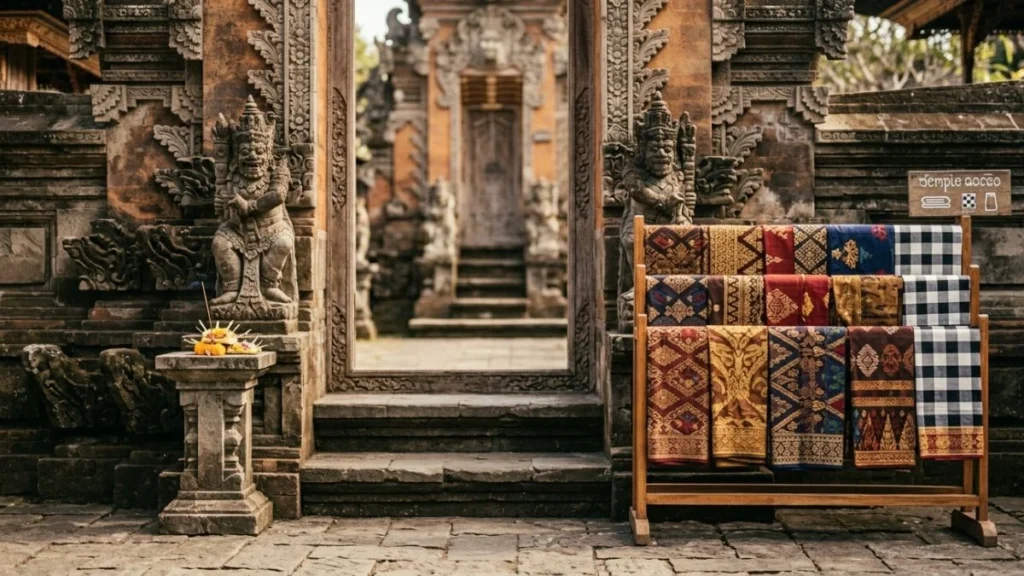
What to wear at a Balinese temple: Every visitor entering a Balinese temple must wear a sarong (kamen) wrapped around the waist and a sash (selendang) tied over it. Both are mandatory at every temple in Bali regardless of what you are wearing underneath. Shoulders must be covered. This is a gate condition, not a suggestion.
Knowing what to wear at a Balinese temple before you arrive is not just a matter of avoiding embarrassment at the entrance — it is the difference between being turned away and being welcomed into one of the most active sacred landscapes in Southeast Asia. The dress code is enforced. The rules are consistent across all of Bali’s 20,000+ temples, and since Governor’s Circular Letter SE No. 7/2025 was issued, enforcement has been formally strengthened across major temple sites. Getting it right takes two minutes of preparation and costs nothing beyond carrying a sarong in your bag.
This guide covers the exact requirements for men, women, and children, what the rules mean and why they exist, and the specific situations that most visitors get wrong.
For the broader context of how to behave respectfully inside a temple — not just at the gate — the Bali temple etiquette guide covers what is expected once you are inside, including photography, spatial restrictions, and ceremony attendance.
The Two Non-Negotiables: Sarong and Sash
These two items are required at every Balinese temple without exception:
Sarong (kamen) — a length of fabric wrapped around the lower body from the waist to the ankle. It represents modesty and signals that you are entering a sacred space with appropriate intention. Wearing long trousers underneath does not replace the sarong — the sarong must be worn over whatever is on your lower body.
Sash (selendang) — a narrower strip of fabric tied around the midsection, over the sarong. In Balinese belief, the sash represents the boundary between the physical and spiritual self — tying it marks the transition into a sacred space. It is tied in a simple knot or bow at the front or side.
Both items together form the entry requirement. A sarong without a sash, or a sash without a sarong, is not complete. Temple staff check both at the gate.
Most major tourist temples — Tanah Lot, Uluwatu, Tirta Empul, Besakih, Ulun Danu Beratan — provide sarong and sash rentals at the entrance for IDR 10,000–20,000. Some provide them at no cost as part of the entrance fee. The rental sarongs are clean, functional, and meet the temple’s requirements. They are also often damp from the last person who wore them and cut from heavy fabric. Carrying your own lightweight sarong is more practical if you plan to visit more than one temple.
For Women: What to Wear and What to Adjust
Upper body: Cover your shoulders. A t-shirt or blouse with sleeves is the simplest solution. If you are wearing a sleeveless top, a light scarf or shawl over the shoulders is accepted at most temples. A kebaya — the traditional Balinese women’s blouse — is the most respectful option and is always appropriate.
Lower body: Sarong wrapped from the waist to the ankle, over whatever you are wearing. Long skirts or trousers underneath make no difference — the sarong is still required.
Sash: Tied over the sarong at the midsection.
Menstruation: Balinese Hindu tradition asks that women who are menstruating do not enter the inner sanctuary of a temple. This is not enforced at the gate — no one asks — but it is a genuine religious belief that is observed by Balinese women themselves, and it deserves acknowledgment as part of the cultural system rather than dismissal as inconvenient superstition.
What to avoid: Transparent fabric, very tight clothing, beach cover-ups that double as clothing, and anything with offensive graphics or imagery.
For Men: What to Wear and What to Adjust
Upper body: A t-shirt covering the shoulders is the acceptable minimum. A collared shirt or traditional batik shirt is more respectful at major temples. Sleeveless shirts and tank tops are not acceptable inside temple areas.
Lower body: Sarong wrapped from the waist to at least below the knee — ideally to the ankle. Over shorts, trousers, or board shorts.
Sash: Tied over the sarong at the midsection.
Headpiece (udeng): Not required for visitors but respectful at major ceremonies and active odalans. A Balinese man attending a ceremony always wears an udeng. Visitors wearing one demonstrate a level of preparation that Balinese worshippers notice and appreciate.
For Children
Children are expected to follow the same dress requirements as adults at temple entrances. Children in sarongs are a gate requirement at major temples. Many temples provide children’s sarongs in smaller sizes at the rental counter. If you are travelling with young children, bring a small sarong for each child rather than relying on rental availability.
How to Wear a Sarong Correctly
The sarong is wrapped around the lower body in a single layer, tucked or folded at the waist to secure it. The correct technique:
Step 1: Hold the sarong horizontally in front of you, the full width across your lower body.
Step 2: Wrap it around to the back, bringing both ends to the front. The sarong should reach from your waist to your ankle.
Step 3: At the front, fold or gather the excess fabric to one side and tuck it into the waist fold. The left-side tuck is the standard Balinese approach.
Step 4: Tie the sash around the midsection over the sarong — one simple knot or bow at the front is sufficient. The sash does not need to be tight; it needs to be present and tied.
The whole process takes under two minutes. Temple staff or vendors at the gate will assist if you are uncertain — this happens many times a day and no one will be impatient.
What Happens If You Dress Incorrectly
At major tourist temples: you will be stopped at the gate and offered a sarong rental before entry. If you refuse the rental or cannot be made to comply, you will not be allowed in.
At smaller village temples without a gate attendant: there may be no one to stop you physically. This does not mean the requirement does not apply. Entering a temple in inappropriate dress is disrespectful to the community that maintains it regardless of whether enforcement is present.
Under Governor’s Circular SE No. 7/2025, visitors who behave disrespectfully at sacred sites — which includes entering inner sanctuaries without proper dress — can be asked to leave and, in serious cases, reported to the tourism police.
The Practical List: Carry This in Your Bag
For a day that includes any temple visit — planned or unplanned — carry the following:
Your own sarong — lightweight cotton or rayon, minimum 1.5m long and 1m wide. These are available throughout Bali at markets for IDR 30,000–80,000 and at Ubud Art Market at varying quality levels.
A sash — or a longer scarf that can function as both shoulder cover and sash.
A light scarf or shawl — for shoulder coverage if your outfit for the day includes sleeveless tops.
These three items add minimal weight to a day bag and remove all practical barriers to entering any temple you encounter, whether it was on your itinerary or not.
Temple-Specific Notes for 2026
Pura Besakih — strict enforcement. Full sarong, sash, and shoulder cover required. Do not hire unofficial guides at the entrance — enter through the official ticketed counter and follow the marked visitor path.
Pura Tanah Lot — sarong and sash required. Rentals available at the entrance. The outer courtyard is accessible to visitors; the temple platform is for Balinese Hindus only.
Pura Uluwatu — sarong and sash required. The Kecak performance area in the evening is separate from the temple itself — different dress requirements apply for the performance versus the temple proper.
Pura Tirta Empul — sarong and sash required. For visitors participating in the purification pool (melukat), a separate bathing sarong is available for rent. Do not enter the holy spring pools in your regular sarong.
Village temples without gate staff — the same dress requirements apply as at major tourist temples. The absence of enforcement does not alter the cultural expectation.
Claudia had done two weeks in Southeast Asia and had her temple outfit system worked out: a loose scarf in her bag for mosques in Malaysia, a shoulder wrap for temples in Thailand. In Bali she added a lightweight sarong and a sash bought at the Ubud market on day one for IDR 45,000. For the rest of the trip, every gate opened without negotiation. She said it was the lowest-effort thing she had done that made the biggest difference to how her days worked.
FAQ
Do I need to wear a sarong at every Balinese temple?
Yes. A sarong and sash are mandatory at every temple in Bali without exception. This applies to major tourist temples and small village temples equally. Most major temples provide rentals at the gate; carrying your own is more practical if you plan to visit multiple temples in a day.
Can I wear trousers instead of a sarong at a Balinese temple?
No. Long trousers do not replace the sarong requirement. The sarong must be worn over whatever you are wearing on your lower body — including trousers, shorts, or a long skirt. The sarong is a specific cultural garment with ritual significance; it is not a substitute for modesty coverage.
What happens if I arrive at a Balinese temple without a sarong?
At major temples, you will be directed to the rental counter and offered a sarong and sash before entry. At smaller temples without rental facilities, you may be turned away. Carrying your own sarong eliminates this scenario entirely.
Is there a dress code for children at Balinese temples?
Yes. Children are expected to follow the same sarong and sash requirements as adults. Many temples provide children’s sarongs at rental counters; confirming availability before visiting with young children is recommended. Bringing your own children’s sarong is the most reliable approach.
What does the sash represent in Balinese culture?
In Balinese Hindu belief, the sash (selendang) tied at the midsection represents the boundary between the physical and spiritual self. Tying it marks the conscious transition into a sacred space. It is tied in a simple knot or bow — the style is less important than the act of wearing it.