
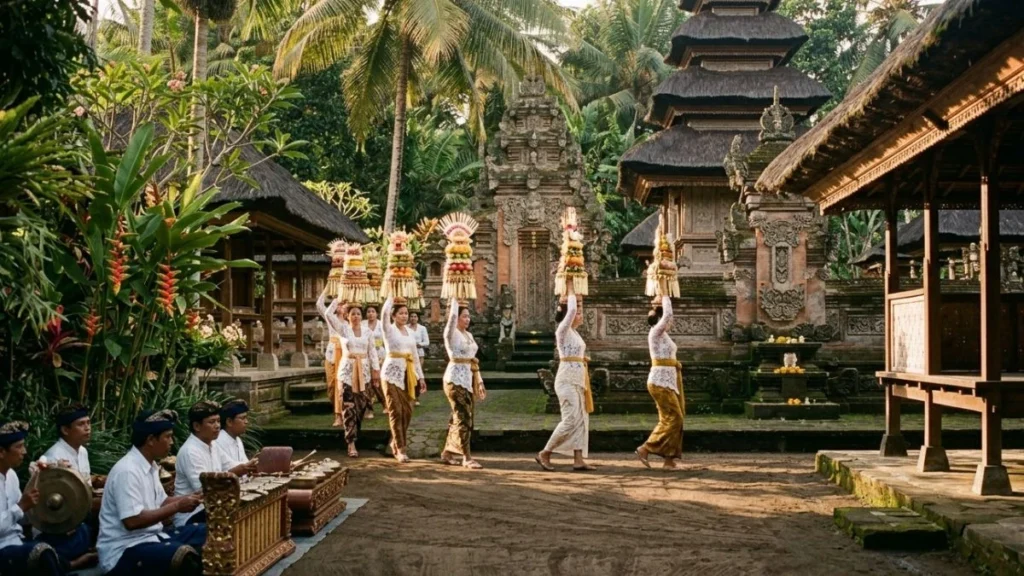
Odalan ceremony Bali what happens: Odalan is a temple anniversary ceremony held every 210 days according to the Balinese Pawukon calendar. The deities are believed to descend to the temple during this period. The community gathers to welcome them with offerings, prayer, sacred dance, and gamelan — for three days at minimum, up to eleven days at major temples.
The odalan ceremony Bali what happens question comes up the moment a visitor notices a temple suddenly decorated with tall penjor poles, women in ceremonial dress carrying stacked offerings on their heads, and the sound of gamelan emerging from a compound that was silent the day before. Bali has over 20,000 temples. Because each one has its own odalan date based on the 210-day Pawukon calendar, a temple ceremony is taking place somewhere on the island almost every day of the year. Understanding what is happening — not just that something is happening — changes the entire experience of witnessing it.
This article covers the structure of odalan, what each part of the ceremony involves, the difference between the sacred dances performed inside the temple and the cultural performances held outside it, and how to find and attend one respectfully. For the broader context of how temple ceremonies fit into Balinese Hindu daily life, the Bali temple etiquette guide covers what is expected of visitors at any sacred site — the same principles apply during odalan, with heightened significance.
What Odalan Is and Why It Happens
The word odalan derives from wedalan — meaning “to arrive” or “to visit” in Balinese. The ceremony marks the anniversary of a temple’s consecration and the moment when the temple’s guardian deities are believed to descend from their abode on Mount Agung to inhabit the temple and receive offerings from the community.
The date is determined by the Pawukon calendar — a 210-day cycle unique to Bali consisting of ten interlocking weeks of varying lengths. When a temple is consecrated, the specific day on that calendar becomes the temple’s permanent anniversary. Because 210 days is approximately seven months in the Western calendar, each temple celebrates odalan roughly twice per year from a Western calendar perspective.
Bali’s temple system is threefold at every level. Each village has three temples — pura puseh (origin), pura desa (village), and pura dalem (death). Each family compound has a sanggah or merajan. Each banjar (hamlet) has its own temple. A major temple like Pura Besakih — the mother temple on Agung’s slopes — contains multiple subsidiary temples within its complex, each with its own odalan date. In practice, this means there is almost always a ceremony happening somewhere within reach.
The Preparation: Days Before the Ceremony
Odalan preparation begins days or weeks before the ceremony itself. The preparation is as much a part of the event as the ceremony:
Temple cleaning and decoration — The temple compound is cleaned, repaired, and decorated with fresh penjor (bamboo poles with hanging offerings), woven palm leaf decorations called lamak, and arrangements of fruit, flowers, and young coconut leaves. The colours — yellow and white gold from jajan (traditional cakes), green from palm, red from flowers — transform the temple’s appearance.
Offering preparation — Families in the banjar prepare banten (ceremonial offerings) in the days before. These are elaborate constructions of woven palm leaves, flowers, cooked rice, fruit, cakes, and incense arranged in specific formats depending on the type of prayer they accompany. The women of each household are primarily responsible for this preparation, which can take hours per offering set.
Inviting the deities — A preliminary ritual called mendak (invitation) is performed by priests to formally invite the deities to descend and inhabit the temple for the duration of the odalan. Without this invitation, the main ceremony cannot proceed.
The Three Days: What Actually Happens
A standard village odalan lasts three days, though the structure varies. The core sequence:
Day 1 — Arrival and preparation The community gathers at the temple in full ceremonial dress. Pemangku (temple priests, distinguishable by their white robes and headpiece) open the ceremony with prayers and holy water. Families bring their prepared offerings and arrange them at the relevant shrines. The temple is formally prepared to receive the deities.
Day 2 — The main ceremony The principal prayer session takes place on the second day, timed to coincide with the auspicious period of the day as determined by the pemangku. This is the most active day — the most elaborate offerings are presented, the sacred dances are performed, and the gamelan orchestra plays continuously through the ceremony.
The prayer sequence involves worshippers sitting in the temple courtyard, each family with their offering arrangement in front of them. A pemangku or pedanda (high priest) leads the prayers — reciting Sanskrit and Kawi-language mantras while ringing a genta (ceremonial bell). The congregation responds at specific intervals, makes gestures with flowers held between the fingers, and sprinkles holy water (tirta) on themselves.
Day 3 — Departure of the deities A closing ritual formally concludes the odalan and asks the deities to return to their abode until the next anniversary. The offerings are cleared, the decorations come down over the following days, and the temple returns to its between-ceremony state.
For significant temples — those with particularly powerful shrines or important historical status — the odalan may last five, seven, or eleven days. Pura Besakih’s main odalan is one of the most elaborate ceremonies in Bali and draws worshippers from across the island.
The Sacred Dances: Not Performed for Tourists
This is the point most articles about odalan gloss over, and it is worth stating clearly.
The dances performed during odalan are not cultural performances in the sense that Kecak or Legong at a tourist venue are cultural performances. They are ritual acts — offerings to the deities in the form of movement and music. The distinction between sacred (wali) and secular (balih-balihan) dance in Balinese performance tradition is strict.
Wali dances — performed in the innermost courtyard (jeroan) of the temple during odalan — include:
Rejang Dewa — performed by young women and girls, dressed in ceremonial gold and white, moving in slow deliberate procession. The dance is a formal welcome to the deities, not an entertainment piece. The movements are prescribed and specific. Visitors who have seen this dance from the outer courtyard often describe it as the most quietly affecting thing they have witnessed in Bali.
Topeng Pajegan — a solo sacred mask dance performed by a priest-dancer (dalang) who embodies a series of characters through mask changes. The performance is simultaneously theatrical and ritual — a complete spiritual cycle enacted through the single performer.
Baris — sacred warrior dances performed in groups, representing divine protectors.
Bebali dances — performed in the middle courtyard — are ceremonially significant but slightly less restricted. Shadow puppet performances (wayang kulit) often occur overnight during major odalans — not for entertainment but as a ritual requiring the presence of specific stories at specific ceremonies.
Visitors who observe these dances from the outer courtyard are seeing the public-facing edge of a ritual, not the ritual itself.
The Gamelan: What the Music Is Doing
The gamelan orchestra that plays during odalan is not background music. Each piece of music is specific to a phase of the ceremony — certain compositions are played during the arrival of offerings, others during the peak prayer period, others during specific dances. The musicians are part of the ceremony, not accompaniment to it.
Gamelan ensembles in Bali are banjar-based — each hamlet maintains its own orchestra and performs at that hamlet’s temple ceremonies. The musicians are not professionals in the Western sense; they are community members who have trained and performed together for years, often since childhood. The ensemble performs as a ritual duty, not a paid engagement.
How to Find an Odalan
Unlike Kecak or commercial temple performances, odalan is not listed on ticketing platforms. The ways to find one:
Ask your accommodation — The most reliable method. Guesthouses and small hotels with Balinese staff know the ceremony calendar in their area and can tell you when the nearest banjar temple is holding its odalan. Ask directly: “Is there a temple ceremony nearby this week?”
Ask your driver — Balinese drivers are embedded in local banjar networks and typically know what ceremonies are coming up. A trusted driver is the second most reliable source.
Walk in the evening in village areas — Gamelan is audible from considerable distance. In Ubud, Sidemen, and traditional village areas, following the sound of gamelan in the early evening frequently leads to an odalan in progress.
Time your trip around major odalans — Pura Besakih and other significant temples announce their major ceremonies in advance through Bali tourism media and local community boards. A quick search for “odalan Besakih 2026” or the equivalent will surface dates when they are publicly known.
How to Attend as a Visitor
The standard rules that apply at any Balinese temple apply at odalan, with greater weight:
Dress — Sarong and sash are mandatory. During odalan, temple staff enforce the requirement more strictly than on ordinary days because the ceremony is active. Carry your own sarong — do not rely on rentals being available at the entrance during a busy odalan.
Where you can go — Outer courtyard (jaba sisi) and middle courtyard (jaba tengah) are generally accessible to respectful visitors. The inner courtyard (jeroan) is for worshippers. Do not attempt to enter the jeroan unless you are part of the praying congregation.
Photography — Permitted in the outer areas. Not in the innermost prayer space. Never photograph the sacred dances at close range or from elevated positions. The standard: if you would not do it at a religious service in your own country, do not do it here.
Timing — Arriving in the evening is often more practical than midday for witnessing the active ceremonial period. The most visually concentrated activity — the arrival of women with offerings on their heads, the gamelan at full volume, the sacred dances — tends to happen in the late afternoon and early evening.
Behaviour — Sit or stand quietly, do not walk in front of praying worshippers, move to the side if a procession passes, and respond to any direction from temple staff without discussion.
Fatima had been in Ubud for four days and had not yet managed to see a ceremony. On her fifth evening she walked toward the sound of gamelan coming from a lane she had not taken before and found the outer courtyard of a banjar temple full of worshippers in white and gold, the gamelan audible and physical in the chest, and a procession of women with meter-high offering towers moving through the gate. She stood at the outer wall for an hour. A temple staff member found her a place to sit where she could see the middle courtyard. No one charged her anything. No one asked her to leave. She said it was the only hour of the trip that felt like she had actually arrived somewhere.
FAQ
How often does odalan happen in Bali?
Every temple in Bali holds odalan every 210 days according to the Pawukon calendar — roughly twice per year in Western calendar terms. With over 20,000 temples on the island, a temple ceremony is taking place somewhere in Bali on virtually every day of the year. Village and banjar temples hold smaller three-day ceremonies; major temples like Pura Besakih hold ceremonies lasting up to eleven days.
Can tourists attend an odalan ceremony in Bali?
Yes, with conditions. The outer and middle courtyards of most temples are accessible to respectful visitors during odalan. The inner courtyard (jeroan) is for worshippers in active prayer. A sarong and sash are mandatory. Photography in the innermost ritual areas is not appropriate. Village odalans are genuinely open community events — respectful visitors are generally welcome as long as they observe the dress code and follow the spatial restrictions.
What should I wear to an odalan in Bali?
A sarong wrapped at the waist and a sash tied over it are the minimum. Covered shoulders are expected — a light scarf or shawl over sleeveless tops is acceptable. During odalan the enforcement of dress requirements is stricter than on ordinary temple visit days because the ceremony is in active religious use. Bring your own sarong rather than relying on rentals being available.
How do I know when an odalan is happening near me?
Ask your accommodation staff or driver — both are typically connected to local banjar networks and know what ceremonies are coming up in the area. In village areas during the evening, the sound of gamelan is audible from significant distance and is the most reliable indicator that a ceremony is in progress.
What is the difference between odalan and Galungan?
Both are Balinese Hindu ceremonies based on the Pawukon calendar, but they operate at different scales. Galungan is an island-wide ceremony — every temple, every family compound, every household celebrates simultaneously, and the entire island is visibly transformed with penjor poles. Odalan is temple-specific — each temple celebrates its individual anniversary on its own date. A village experiencing odalan is having a local ceremony. Bali during Galungan is experiencing an island-wide one.