
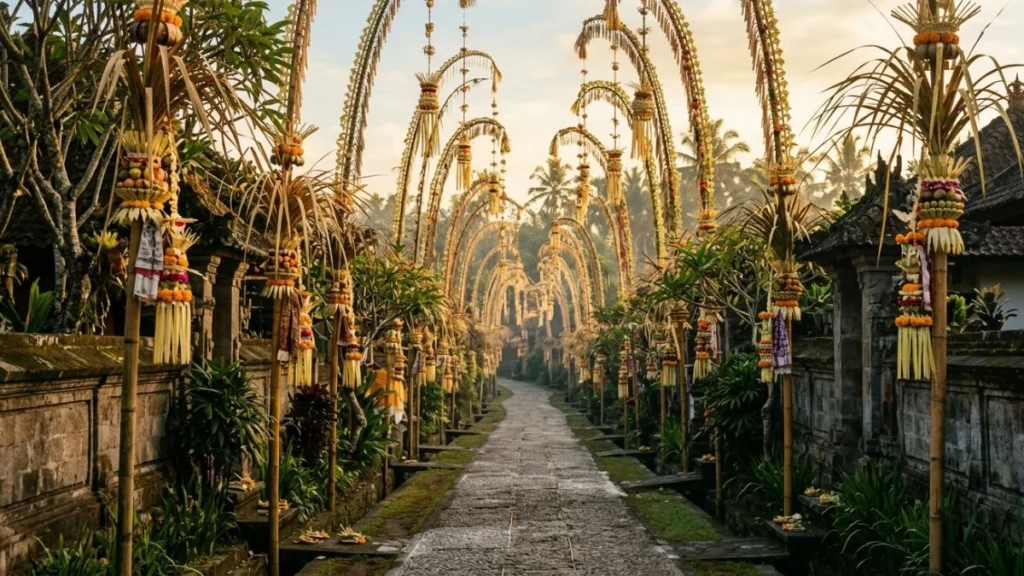
Galungan festival in Bali: Galungan is the most important festival in the Balinese Hindu calendar — a ten-day period beginning on Buda Kliwon Dungulan (Wednesday of the Dungulan week) when ancestral spirits return to family compounds and every village on the island is decorated with tall bamboo penjor poles. In 2026, Galungan falls on Wednesday 17 June. Kuningan, the closing day, is Saturday 27 June.
The galungan festival in Bali transforms the island in a way that no other event does — not a regional ceremony, not a local odalan, but a simultaneous island-wide celebration where every family, every compound, and every village participates on the same day. If you are in Bali when Galungan begins, you will know it before you look at a calendar: every road in every village is lined with arching bamboo penjor poles decorated with coconut leaves, woven offerings, fruit, and flowers — one per family compound, erected simultaneously in the days before the festival.
Galungan opens the ten-day period and Kuningan closes it. Together they celebrate the victory of dharma — order and righteousness — over adharma, the forces of chaos. Galungan welcomes ancestral spirits back to family homes; Kuningan, ten days later, sees them off again.
In 2026, the confirmed dates are: Galungan on Wednesday 17 June 2026, and Kuningan on Saturday 27 June 2026. 2026 is a rare year with only one Galungan — the previous cycle fell in late November 2025, and the next arrives in early January 2027 — which leaves June 2026 as the island’s single Galungan of the year.
For travellers already planning a Bali trip, knowing this date is worth more than most pieces of pre-departure research. For slow travellers building a longer itinerary, the Bali slow travel itinerary 2 weeks shows how the festival period fits into a broader East and Central Bali circuit.
What Galungan Is and What It Celebrates
Galungan’s core narrative is the defeat of the demon king Mayadenawa — a powerful ruler who forbade his subjects from practising Hinduism — by the god Indra. The victory of dharma over adharma is re-enacted symbolically each Galungan through offerings, prayer, family gathering, and the physical transformation of every compound and street with penjor.
The ancestral dimension is equally central: during Galungan, the spirits of ancestors are believed to descend to earth, and families honour them with offerings and prayers. The ten days from Galungan to Kuningan are the window during which these spirits are present in the family compound. The penjor outside each gate marks the compound as a place of welcome.
Bali’s rice terraces, temples, and village networks follow the philosophy of Tri Hita Karana — harmony between humans, nature, and the divine. Rather than relying on the international calendar, Bali uses the 210-day Pawukon cycle, which determines when Galungan falls. Because 210 days does not divide evenly into 365, Galungan lands on a different date in the Western calendar each cycle and typically occurs twice per Gregorian year — though as noted, 2026 is an exception with only one occurrence.
The Ten Days: What Each One Involves
Different days mark different rounds of celebration and unique festivities, with the full period lasting around ten days. Three days before Galungan, on Penyekeban day, bananas are prepared as offerings. The following day, Penyajaan, fried rice cakes (jaja) are made as offerings. The day before the festival, Penampahan, chickens and pigs are slaughtered to prepare a feast. Traditional food prepared on this day includes satay and lawar.
Galungan Day — The main day. Families rise before dawn, dress in ceremonial clothing, and begin the morning with prayer at the family compound temple. Offerings prepared over the preceding days are presented at the family shrine, at the household entrance, and at the banjar temple. The penjor are fully decorated and standing. By mid-morning, the roads are filled with people moving between family compounds and temples in formal dress.
Manis Galungan (Day after Galungan) — The social day. Families visit relatives, share ceremonial food, and the atmosphere shifts from the focused devotion of Galungan Day to something more celebratory. This is the day when the cooking of the preceding day is eaten, shared, and exchanged between households.
Kuningan (Ten days after Galungan) — The closing day. The ancestral spirits return to their abode. A final round of offerings and prayers marks the end of the cycle. Yellow rice (nasi kuning) is prepared specifically for Kuningan — the colour yellow (kuning) gives the day its name. By the afternoon of Kuningan, the penjor begin to come down.
What the Penjor Is and What It Means
The penjor is the most visible physical marker of Galungan — and the one that most visitors photograph without understanding what it represents.
A penjor is a tall bamboo pole, typically five to eight metres high, that curves at the top under the weight of its decorations. It is erected outside the entrance gate of each family compound in the days before Galungan. The decorations — coconut leaves, young bamboo shoots, woven palm leaf ornaments, fruit, flowers, and a small offering platform at the base — are specific in their arrangement and meaning.
The penjor represents Mount Agung — the pole is the mountain, the curve at the top represents the peak, and the decorations represent the offerings and natural abundance of the land. Planting it outside the compound gate is a physical statement of gratitude and reverence directed toward the mountain and the divine.
Each penjor is made by the family that erects it, using bamboo from their own property or from the community’s managed bamboo grove. In villages with communal bamboo reserves — Penglipuran being the most documented example — the harvest timing and distribution of bamboo for penjor is governed by village custom.
Seeing 76 penjor arching simultaneously over Penglipuran’s main lane at Galungan, or driving through any traditional village in the days after the festival begins, is one of the more striking visual experiences available in Bali — and one that no resort pool photograph has ever accurately conveyed.
What Bali Is Like During Galungan: Practical Reality
Roads: Significantly busier in the days around Galungan Day and Manis Galungan as families travel for visits. The south Bali tourist corridor is affected but manageable. Village roads — particularly around traditional areas like Ubud, Sidemen, and Bangli — are busier than usual but not gridlocked.
Temples: More active and more restricted. Major temple ceremonies coincide with Galungan across the island. The temple etiquette requirements apply with greater weight than on ordinary days. Sarong and sash are mandatory. The Bali temple etiquette guide covers what is expected.
Accommodation: Books out earlier than usual in popular areas. If you are planning to be in Bali during the June 2026 Galungan, book accommodation at least two to three months in advance for Ubud and surrounding villages.
Restaurants and services: Most tourist-facing restaurants, cafés, and shops remain open during Galungan. Some Balinese-owned businesses close or operate reduced hours on Galungan Day itself while family ceremonies take priority. Expect reduced availability on the day, with normal operations resuming the following day.
What remains open: The island does not shut down for Galungan the way it does for Nyepi. Flights operate normally. Hotels remain open. The difference is ceremonial density and road traffic, not the cessation of normal life.
Where to Experience Galungan Most Directly
Village areas rather than resort zones: The penjor and ceremonial activity are concentrated in traditional village areas. Ubud’s outskirts and surrounding villages — Penestanan, Sayan, Mas, Celuk — are more directly immersed in the festival than central Ubud town. Sidemen, Penglipuran, and any traditional banjar area will be more visually and ceremonially active than Seminyak or Canggu.
Morning of Galungan Day: The most active ceremonial period is the early morning — families in formal dress moving between compound and temple, offerings being carried, gamelan audible from multiple directions simultaneously. Being in a village area before 8am on Galungan Day is worth the early alarm.
Manis Galungan for accessibility: The day after Galungan is less intensely ceremonial and more socially open — families are visiting, food is being shared, and the atmosphere is celebratory rather than focused on prayer. Visitors who are cautious about being present during active religious ceremony often find Manis Galungan more comfortable while still being fully within the festival period.
Kuningan for the closing ceremony: The final day has its own distinct character — the yellow rice, the final offerings, the beginning of the penjor coming down. It is quieter than Galungan Day but has a specific completeness to it that slow travellers appreciate.
Tomás had timed his Bali trip without checking the festival calendar and arrived three days before Galungan entirely by chance. He watched the penjor go up outside every gate on his street over the course of two days — the neighbourhood transforming incrementally until the morning of Galungan itself when the lane looked nothing like the lane he had arrived in. His host invited him to the family compound for the morning ceremony. He sat in the outer courtyard for an hour, understood nothing of the prayers, and said afterward that understanding nothing had made no difference to what he felt he had witnessed. Some things do not require translation.
Galungan Dates: 2026, 2027, and 2028
Confirmed Galungan and Kuningan dates:
- 2026: 17 June (Galungan) — 27 June (Kuningan)
- 2027: 11 January (Galungan) — 23 January (Kuningan); 9 August (Galungan) — 21 August (Kuningan)
- 2028: 6 March (Galungan) — 18 March (Kuningan); 2 October (Galungan) — 14 October (Kuningan)
Use these dates as planning anchors — building your Bali trip to include the days around Galungan is one of the more reliable ways to encounter the island at its most ceremonially active.
FAQ
When is Galungan in 2026?
Galungan falls on Wednesday 17 June 2026. Kuningan, the closing day of the ten-day festival period, falls on Saturday 27 June 2026. 2026 is a rare year with only one Galungan — the Pawukon 210-day calendar usually produces two Galungan dates per Gregorian year, but the spacing in 2026 means only one falls within the calendar year.
Is Bali shut down during Galungan?
No. Bali remains fully open during Galungan unlike Nyepi, which closes the airport and shuts all roads for 24 hours. During Galungan, flights operate normally, hotels remain open, and most tourist-facing businesses continue with normal hours. Balinese-owned businesses may close or reduce hours on Galungan Day itself. Roads are busier than usual in the days around the festival as families travel between compounds.
What is a penjor in Bali?
A penjor is a tall bamboo pole erected outside each family compound gate in the days before Galungan. It curves at the top under the weight of its decorations — coconut leaves, woven palm offerings, fruit, and flowers. The penjor represents Mount Agung and expresses gratitude and reverence toward the divine. During Galungan, every family compound erects one simultaneously, transforming every village lane with arching poles from one end to the other.
How often does Galungan happen in Bali?
Galungan follows the 210-day Balinese Pawukon calendar — which means it occurs approximately every seven months, or typically twice per Gregorian calendar year. Because 210 days does not align evenly with a 365-day year, the Western calendar dates shift with each cycle. In 2026, only one Galungan falls within the calendar year; in 2027, there are two.
Can tourists attend Galungan ceremonies in Bali?
Yes, with the same respectful conditions that apply at any Balinese ceremony. The public aspects of Galungan — the penjor decorations, the processions on village streets, the open temple courtyards — are accessible to visitors dressed appropriately in sarong and sash. Private family compound ceremonies are for the family. If a host invites you into their compound for the morning prayers, that is a genuine invitation and should be treated as such.