
Nyepi Day Bali complete guide: Nyepi is the Balinese Hindu New Year — a 24-hour period of total silence, darkness, and stillness observed island-wide on a date determined by the Saka calendar. In 2026, Nyepi falls on Thursday 19 March from 6am to 6am on 20 March. The airport closes. Roads close. Every person on the island — visitor or resident — stays indoors.
This nyepi day bali complete guide covers what actually happens before, during, and after Nyepi — because the version most articles present (airport closed, stay in your hotel, nice stars) is accurate but incomplete. Nyepi is the most significant day in the Balinese Hindu calendar. It is preceded by one of the most spectacular street events in Southeast Asia and followed by a day that marks one of the most genuine cultural transitions you can witness anywhere on earth. Understanding all three parts — the ogoh-ogoh procession, the silence itself, and the day after — changes the experience entirely.
In 2026, Nyepi falls on Thursday 19 March. The silence begins at 6am on March 19 and ends at 6am on March 20. Check your flight dates against this before booking. No flights land or depart from Ngurah Rai International Airport during the 24-hour period. The airport closure is not a partial reduction — it is a complete shutdown, enforced, with no exceptions.
For travellers already planning around Bali’s festival calendar, the Galungan festival guide covers the other major Balinese Hindu celebration — a very different experience from Nyepi but equally worth planning around.
What Nyepi Is and Why Bali Goes Silent
Nyepi marks the beginning of the Balinese New Year according to the Saka calendar — a lunar-solar calendar system distinct from both the Gregorian calendar and the 210-day Pawukon cycle that governs Galungan. The Saka New Year falls on a different date each Gregorian year but consistently lands in March.
The purpose of Nyepi is not celebration in any conventional sense. It is a spiritual reset — a day on which the entire island is purified by collective stillness. The Balinese belief is that evil spirits (bhuta kala) descend to the island at the new year. By making Bali appear completely deserted — no lights, no movement, no sound — the island deceives the spirits into believing it is uninhabited. The spirits find nothing to inhabit and move on.
The silence is simultaneously an external act and an internal practice. For Balinese Hindus, Nyepi is governed by four principles called Catur Brata Penyepian:
Amati Geni — no fire and no light. Hearths are unlit. Electric lights are kept at minimum or off entirely. Hotels draw curtains to prevent light escaping.
Amati Karya — no work. All businesses, offices, shops, and services are closed.
Amati Lelunganan — no travel. Every road is closed. No vehicles, no walking outside, no movement on the streets.
Amati Lelanguan — no entertainment. No music, no loud activity, no internet-heavy consumption. Some hotels restrict Wi-Fi during Nyepi; others limit it voluntarily.
These four principles apply to everyone on the island — Balinese Hindus and tourists equally. The enforcement is handled by Pecalang — traditional Balinese community security — who patrol the streets throughout the 24 hours. Their presence is calm and consistent. If you are found outside your accommodation during Nyepi, you will be asked to return immediately.
The Night Before: Ogoh-Ogoh Parade
The evening before Nyepi — called Pengrupukan, which in 2026 falls on Wednesday 18 March — is the most visceral public event in the Balinese ceremonial calendar, and one of the most underreported in travel content that focuses on the silence rather than what precedes it.
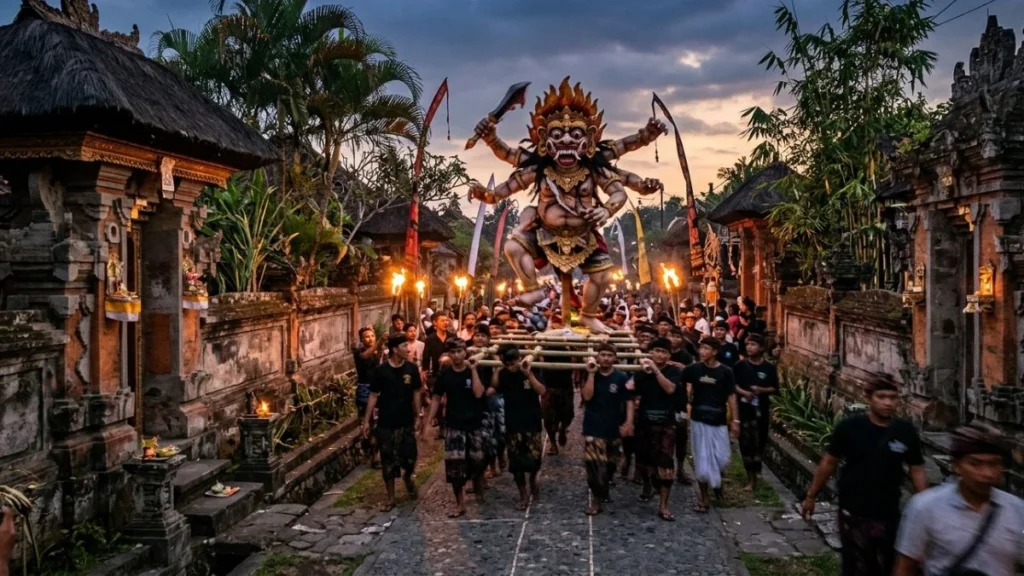
Ogoh-ogoh are enormous handmade demon statues constructed by each banjar over the preceding weeks and months. They are typically two to ten metres tall, built from bamboo frames covered in papier-mâché, styrofoam, and fabric, painted in vivid and detailed depictions of demonic figures from Balinese Hindu cosmology. The craft invested in them is significant — many banjars spend the equivalent of several months of community labour producing a single statue.
On the evening of Pengrupukan, the ogoh-ogoh are paraded through the streets of every village and town in Bali, carried on platforms by teams of young men, accompanied by gamelan music, crowds of spectators, and deliberate noise and chaos. The purpose is to attract and agitate the evil spirits — drawing them into the open where they can be driven away by the silence that follows. After the procession, the ogoh-ogoh are traditionally burned.
In Ubud, Denpasar, and Kuta, the ogoh-ogoh processions fill the main streets from approximately 6pm. In smaller villages, they start slightly later and run until midnight. Being in Bali on the evening of 18 March 2026 and not seeing the ogoh-ogoh parade is a genuine missed opportunity. It is free, it is everywhere, and it is the direct context for the silence that follows — understanding the chaos of Pengrupukan makes the stillness of Nyepi the following morning more legible.
The Six Rituals: The Full Nyepi Cycle
Most Nyepi guides focus only on the 24-hour silence. The full cycle spans six days and provides the context that makes the silence make sense:
Melasti (3–4 days before Nyepi) — A purification ceremony in which sacred objects (pratima) from village temples are carried in procession to the sea or a sacred lake to be cleansed. Thousands of Balinese Hindus dressed in white make their way to the nearest beach or lake, accompanied by gamelan, offerings, and prayer. In 2026, Melasti takes place on the weekend before Nyepi — March 15 or 16 depending on the village. Witnessing Melasti at Sanur beach or Kuta beach in the early morning is one of the more striking experiences the festival period offers.
Tawur Kesanga (Day before Nyepi) — A community purification ritual performed at the crossroads (catus pata) of each village. This ceremony represents the Balinese cosmological cleansing of the earth — offerings are placed at the intersection to appease the bhuta kala.
Pengrupukan / Ogoh-Ogoh parade (Evening before Nyepi) — covered above.
Nyepi — The 24-hour silence.
Ngembak Geni (Day after Nyepi) — The day normal life resumes. In 2026, this falls on Friday 20 March. Balinese Hindus perform melukat (spiritual cleansing) at water temples, visit relatives, and reconnect socially. The island returns to movement gradually — roads open at 6am but the pace of the morning is noticeably gentle.
Ngembak Geni 2026 note: Nyepi in 2026 is followed immediately by Eid al-Fitr on 21–22 March. Bali is home to significant Muslim communities in Denpasar and Lombok nearby — the juxtaposition of the Balinese Hindu Day of Silence followed directly by the Islamic New Year celebration is specific to 2026 and worth knowing if you are staying through the period.
What the 24 Hours of Silence Are Actually Like
For visitors, Nyepi is confined to your accommodation. What that experience is depends almost entirely on where you are staying.
At a hotel: Most hotels prepare Nyepi packages — meals delivered to rooms, in-room yoga or meditation programmes, guided stargazing from the property grounds. The professional infrastructure makes the day manageable and often genuinely enjoyable. Many guests describe it as the most restful 24 hours of their trip.
At a private villa or guesthouse: The experience is more direct. The staff may be minimal. The silence outside your walls is literal — no traffic, no machinery, no ambient city sound. If you are in a village area rather than a resort compound, the darkness after sunset on Nyepi night is complete in a way that modern life rarely produces. The absence of light pollution makes the night sky over Bali one of the few genuinely dark skies available within a short flight of a major international hub.
At a family homestay: If your host has a family compound ceremony planned for Nyepi, and you are close enough to the family to be included, this is the most direct access available. Family Nyepi observation — shared meals from the Penampahan preparations, the family prayer at the compound temple, the collective stillness — is not a tourist programme. It is the actual thing.
What the silence feels like is difficult to describe to someone who has not experienced it. By mid-morning of Nyepi Day, the absence of traffic noise becomes audible as a presence rather than an absence. By afternoon, the birds are louder than anything else. By evening, when the light goes and the stars are visible from the guesthouse courtyard, the sensation is not inconvenience. It is something closer to the island revealing a version of itself that the other 364 days of the year do not allow.
Practical Logistics for Visitors
Flight planning: Check your arrival and departure dates against 19 March 2026. Ngurah Rai International Airport closes at 6am on March 19 and reopens at 6am on March 20. No flights operate during this window. A flight landing at 8am on March 19 does not exist — it will be rescheduled to March 18 or March 20.
Arrival before Nyepi: Arriving in Bali on March 17 or 18 allows you to witness the Melasti procession and the ogoh-ogoh parade before being indoors for the silence. This is the recommended approach.
Departure after Nyepi: Departing on March 20 or later allows you to experience Ngembak Geni — the day the island returns to movement. The morning of March 20 has a specific quality that is worth staying for if your schedule allows.
Stock up beforehand: Shops close for Nyepi Day. If you are at a private villa or small guesthouse without a full kitchen service, buy food and water on March 18. Most minimarkets and warungs close by early evening on March 18 in preparation.
Internet: Officially, internet use is minimised during Nyepi as part of the Amati Lelanguan principle. In practice, hotel Wi-Fi typically remains available on a reduced basis. Do not plan work obligations for Nyepi Day. Do not plan to stream video or conduct video calls at full quality.
Medical emergencies: The exception to the no-movement rule. Emergency vehicles operate during Nyepi. If you or a travel companion experience a medical emergency, your accommodation will assist with contacting emergency services — the system for handling this is established and functional.
Nyepi Dates: 2026, 2027, and 2028
Because Nyepi is determined by the Saka calendar, the date shifts each year:
- 2026: Thursday 19 March (6am) — Friday 20 March (6am)
- 2027: Wednesday 7 April (6am) — Thursday 8 April (6am)
- 2028: Sunday 26 March (6am) — Monday 27 March (6am)
Check these dates against your planned Bali trip as early as possible — particularly if you are travelling in March or April.
Fatimah had booked a flight landing at 7am on March 19 without checking the Nyepi date. She found out three weeks before departure from a fellow traveller in a forum. She rebooked to March 18, arrived in time for the ogoh-ogoh parade in Ubud that evening, and spent the following day at her guesthouse in the silence. She said the flight rebooking cost her IDR 450,000 in change fees, and that she would have paid considerably more had she known in advance what she would have missed by flying in on the wrong day. The ogoh-ogoh were four metres tall and her street had six of them.
FAQ
When is Nyepi Day in 2026?
Nyepi 2026 falls on Thursday 19 March. The silence begins at 6am on March 19 and ends at 6am on March 20 — a full 24 hours. Ngurah Rai International Airport is completely closed during this period. No flights arrive or depart.
Can tourists visit Bali during Nyepi?
Yes — tourists can be in Bali during Nyepi, but must remain inside their accommodation for the full 24 hours. The rules apply to everyone on the island equally, enforced by Pecalang community security. Tourists who comply describe the day as one of the most remarkable experiences of their trip. Tourists who resist find it uncomfortable quickly.
What are the rules during Nyepi in Bali?
Four rules apply to everyone during Nyepi: no fire or bright lights (Amati Geni), no work or business activity (Amati Karya), no travel or movement outside (Amati Lelunganan), and no entertainment or loud activity (Amati Lelanguan). These are not suggestions — they are enforced by community security patrols throughout the 24 hours.
What is the ogoh-ogoh parade before Nyepi?
The ogoh-ogoh parade — called Pengrupukan — takes place on the evening before Nyepi. Enormous handmade demon statues built by each banjar are paraded through village streets accompanied by gamelan, crowds, and deliberate noise, before being burned. In 2026, Pengrupukan is on the evening of Wednesday 18 March. The parade starts around 6pm in major areas and is one of the most spectacular public events in Bali.
What is Ngembak Geni?
Ngembak Geni is the day after Nyepi — in 2026, Friday 20 March — when normal activity resumes. Balinese Hindus perform melukat spiritual cleansing, visit family, and reconnect socially. Roads reopen at 6am. The morning of Ngembak Geni has a specific quality of gradual return that slow travellers who stay through the full cycle consistently describe as one of the more moving transitions of the festival period.