
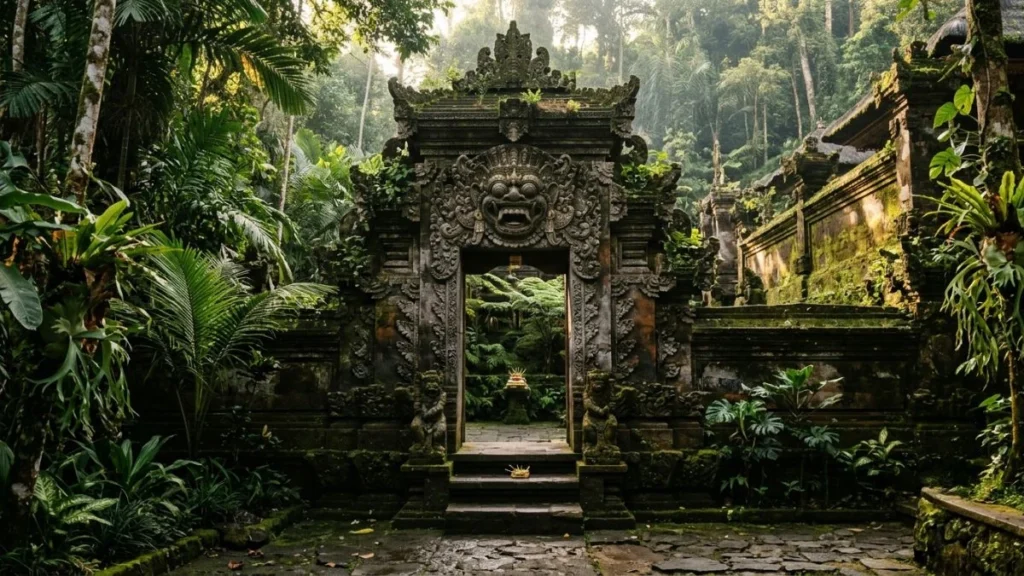
Ubud and its surrounding villages sit within one of the densest concentrations of Hindu temples anywhere in Bali. Estimates put the number of temples in the Gianyar Regency — the administrative area that includes Ubud — at over 1,000. Most travellers visit one or two. The ones who slow down and look more carefully tend to find that the temples here operate on a logic that becomes more interesting the more you understand it.
This guide to temples in Ubud Bali covers the major sites worth your time, the smaller temples most visitors walk past, what’s actually happening inside them, and the practical etiquette that determines whether your visit is welcome or awkward.
Quick Facts
- Entry fees: IDR 30,000–50,000 at major temples; many smaller temples free
- Dress code: Sarong and sash required at all temples — available to rent/buy at gates
- Photography: Generally permitted in outer courtyards; inner sanctuaries often restricted
- Best time to visit: Early morning (before 9am) or late afternoon (after 4pm)
- What to avoid: Visiting during active ceremonies without invitation or guidance
How Balinese Temples Actually Work
Before listing specific temples, it’s worth understanding the system they belong to — because Balinese temples are not monuments or museums. They are active places of worship maintained by the communities they serve, and understanding their structure changes what you notice when you visit.
Every family compound in Bali has a small family temple (sanggah) in its northeast corner. Every village has at least three temples: the pura puseh (temple of origin, facing the sacred mountain), the pura desa (village temple, for daily life), and the pura dalem (temple of the dead, facing the sea). Above these sit district temples, regional temples, and the great state temples that serve the whole island.
The temples most visitors see — Tirta Empul, Goa Gajah, Gunung Kawi, Pura Taman Saraswati — are part of this layered system. Each has a specific function, a specific community of worshippers, and a specific set of ceremonies tied to the Balinese calendar. They are not interchangeable cultural attractions. Knowing which temple you’re at and why it matters produces a different experience from treating them as a visual checklist.
The Major Temples Near Ubud Worth Visiting
Pura Taman Saraswati — Central Ubud
The most accessible temple in central Ubud, on Jalan Kajeng just off Jalan Raya Ubud. Built in the 1950s and dedicated to Saraswati, the Hindu goddess of knowledge, arts, and learning — an appropriate patronage for a town built on artistic tradition.
The defining feature is the lotus pond in front of the temple: a large rectangular pool filled with lotus flowers that frames the carved red-brick facade behind it. Evening Legong dance performances are staged here several nights a week, using the temple and its pond as backdrop.
Entry to the outer courtyard is free. The inner temple requires a sarong and sash. Early morning — before 8am — the pond catches the light before the tourists arrive and the café tables on either side fill up. Worth 20 minutes even if you’re not staying for a performance.
Goa Gajah — Elephant Cave Temple
About 4km east of central Ubud on the road toward Gianyar, Goa Gajah dates to the 9th century and takes its name — Elephant Cave — from a misidentification by early Dutch scholars who thought the carved demon face at the cave entrance resembled an elephant. It doesn’t, particularly. What it is: a meditation cave carved directly into a rock face, its entrance framed by an elaborate carving of demons, foliage, and supernatural creatures meant to represent the boundary between the ordinary world and the sacred space within.
Inside the cave are two alcoves with lingam shrines. The cave itself is small — perhaps 10 metres deep, 2 metres wide. What surrounds it is more interesting: terraced gardens, two bathing pools with carved figures pouring water, and a river gorge below that has yielded Buddha statues and other artefacts suggesting the site served both Hindu and Buddhist practice.
Entry: IDR 50,000. Sarong required. Open 8am–5pm. Go early — the cave entrance gets crowded by mid-morning.
Gunung Kawi — Rock-Cut Shrines in a River Gorge
About 18km northeast of Ubud near Tampaksiring, Gunung Kawi requires a descent of roughly 300 steps into a river gorge cut by the Pakerisan River. What waits at the bottom is one of Bali’s most extraordinary archaeological sites: ten candi — tall stone memorial shrines carved directly into the cliff face — standing in two rows on opposite sides of the river, each around 8 metres high.
Dating to the 11th century, they are believed to commemorate King Anak Wungsu of the Warmadewa dynasty and his consorts. The carvings are worn by a thousand years of tropical humidity but the scale and setting — a narrow gorge with the river running past ancient carved stone — is unlike anything else in Bali.
The 300-step descent is worth it. The 300-step return is also worth knowing about before you go. Entry: IDR 50,000. Sarong required. Open 7am–5pm. Combine with Tirta Empul (15 minutes north) for a logical half-day in the Tampaksiring area.
Tirta Empul — The Purification Temple
About 15km northeast of Ubud, Tirta Empul is Bali’s most important water temple, built around a spring that feeds the ritual bathing pools where Balinese Hindu worshippers perform purification ceremonies. Founded in 962 CE according to Balinese chronicle.
The experience of walking through the bathing pools — moving from fountain to fountain in sequence, submerging beneath each one — is available to visitors who approach it with appropriate intention. This is not a tourist attraction that happens to have religious significance. Balinese families come here for genuine spiritual reasons. A sarong and sash are required, and getting wet is part of the process — bring a change of clothes or a quick-dry layer.
Entry: IDR 50,000. Open 8am–6pm. The site gets crowded from 10am. Combine with Gunung Kawi for a Tampaksiring half-day, or pair with the Presidential Palace (visible from the road above, not open to visitors) and the rice terraces of the Pakerisan valley.
Smaller Temples Most Visitors Miss
Pura Gunung Lebah — Campuhan
At the base of the Campuhan Ridge Walk, where the two branches of the Wos River meet, Pura Gunung Lebah sits at a confluence point — considered spiritually significant in Balinese cosmology, where the meeting of two rivers produces protective energy. The temple is active and beautifully maintained. Most visitors walk past it on the way to the ridge path.
Worth 10 minutes before or after the ridge walk. No entry fee for the outer courtyard. Sarong required if you want to enter further.
Pura Kehen — Bangli
About 45 minutes northeast of Ubud in the town of Bangli, Pura Kehen is one of Bali’s state temples and arguably the most visually impressive temple complex within reach of Ubud that most travellers don’t visit. An eleven-tiered meru (pagoda) dominates the inner courtyard. The entrance is through a series of split gates (candi bentar) flanked by ancient banyan trees whose roots have grown into the walls over centuries.
It’s quieter than any of the major Ubud-area temples. Entry: IDR 30,000. Open daily.
Pura Penataran Sasih — Pejeng
On the road between Ubud and Tampaksiring, in the village of Pejeng, this temple houses the Moon of Pejeng — a bronze kettle drum approximately 186cm tall, believed to be the largest bronze drum cast in a single piece in the ancient world and dating to around 300 BCE. It sits in an open pavilion in the inner temple, visible from the outer courtyard.
The temple itself is active and not primarily a tourist site. The drum is genuinely significant — worth a stop on any drive toward Tampaksiring.
Temple Etiquette: What Actually Matters
A sarong and sash are required at every temple in Bali. Both are available to rent or buy at the entrance gates of major temples. If you’re visiting multiple temples in a day, carrying your own is more practical than renting repeatedly — any shop in central Ubud sells them for IDR 50,000–100,000.
Beyond the dress requirement, a few things that actually matter:
During active ceremonies — if a ceremony is in progress when you arrive, observe from a respectful distance rather than moving through the worshipping crowd. You may be invited closer by a temple priest or community member. Wait for that invitation rather than assuming access.
Photography — the outer courtyards of most temples are photographable. The inner sanctuaries — where the most sacred shrines sit — are often restricted. Watch for signs and watch what local visitors are doing. If in doubt, ask.
Women during menstruation are traditionally asked not to enter temples. Signage at the entrance will indicate this. It’s a matter of Balinese spiritual belief, not personal judgement — observe it as you would any other religious custom you encounter while travelling.
Behaviour inside — temples are not Instagram locations first. Entering a temple in Bali is entering a place of genuine ongoing spiritual significance. Move quietly, don’t climb on structures, don’t position yourself above shrines for photographs. These are basic courtesies that make the difference between being a welcome visitor and one who isn’t.
For a more detailed guide to what to wear specifically, the Bali temple etiquette guide covers the rules and the reasoning behind them.
Organising a Temple Day from Ubud
A practical half-day route that combines several of the above without backtracking:
Morning route — Tampaksiring loop (half day, ~4 hours):
Start at Gunung Kawi (7am, before crowds), walk the gorge, climb back up, drive 15 minutes to Tirta Empul, complete the purification pools, continue to Pura Penataran Sasih in Pejeng on the return to Ubud. Return via the rice terraces of the Pakerisan valley for a natural finish.
Afternoon route — Central Ubud walk (2 hours):
Pura Gunung Lebah at Campuhan (start of the ridge walk), Campuhan Ridge itself, return to central Ubud via Jalan Raya Campuhan, finish at Pura Taman Saraswati for the lotus pond at golden hour. Evening Legong performance at the temple if the schedule aligns.
Private driver for the Tampaksiring loop: IDR 500,000–600,000 for the half day. The central Ubud route is entirely walkable from any accommodation in the town centre.
FAQ
How many temples are there in Ubud?
The Gianyar Regency, which includes Ubud and its surrounding villages, has over 1,000 temples. Central Ubud alone has several dozen, ranging from major sites like Pura Taman Saraswati to small family compound temples not open to visitors.
Do I need a guide to visit temples in Ubud?
For the major sites — Goa Gajah, Gunung Kawi, Tirta Empul — no guide is required. For Tirta Empul’s purification ritual specifically, a guide or temple staff member adds genuine value by explaining the sequence and meaning of the fountains. For smaller temples during active ceremonies, a knowledgeable local companion changes the experience significantly.
What is the entrance fee for temples in Ubud Bali?
Major temples charge IDR 30,000–50,000 per person. Pura Taman Saraswati’s outer courtyard is free. Many smaller village temples have no formal entrance fee but a donation box is usually present.
Can you visit Balinese temples during a ceremony?
Yes, with appropriate behaviour. Observe from a respectful distance initially and wait for an invitation to move closer if a ceremony is in progress. Dress modestly, move quietly, and follow the lead of the worshippers around you rather than the other tourists.
What should I wear to visit temples in Ubud?
A sarong covering the legs to the ankle and a sash tied around the waist are required at all temples. Both are available to rent at major temple entrances. Shoulders should be covered — a light shirt or scarf serves this purpose in the heat.
The temples in Ubud Bali that stay with people aren’t always the famous ones. Gunung Kawi’s carved cliffs in a river gorge at 7am, before the tour groups arrive, is a different experience from Tirta Empul at noon. Pura Kehen in Bangli, almost empty on a weekday afternoon, gives you the space to actually look at what you’re standing in front of.
The pattern that works: arrive early, move slowly, and resist the impulse to treat temples as a checklist. The ones worth visiting reward the time you give them, not the speed at which you move through.
For the full picture on etiquette and what to wear, the Bali temple etiquette guide is the place to start. For building a full Ubud itinerary around the temples, the things to do in Ubud Bali guide covers the wider territory.