
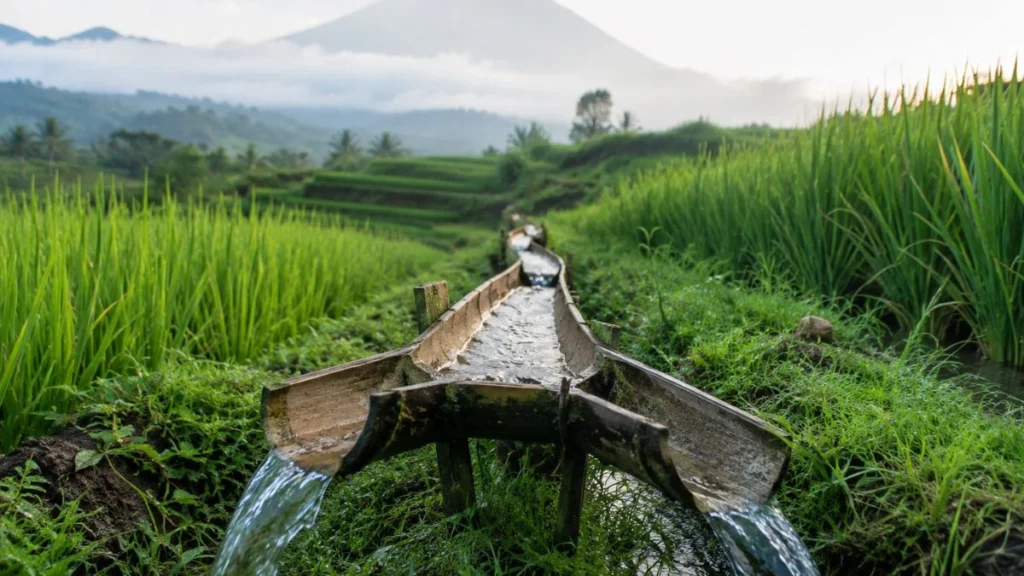
Jatiluwih vs Tegallalang rice terraces: Tegallalang is 15 minutes from Ubud, heavily commercialised, and genuinely photogenic. Jatiluwih is 90 minutes from Ubud, UNESCO-listed, significantly larger, and has almost no commercial activity on the terraces themselves. They are not interchangeable — they serve different types of visit.
The jatiluwih vs tegallalang rice terraces question comes up on every Bali itinerary that runs longer than a week. The short answer: if you have one afternoon and want a striking photograph close to Ubud, Tegallalang delivers. If you have a morning, a scooter, and want to walk through working farmland without a swing installation in the frame, Jatiluwih is the correct answer. They are not competing for the same experience — they are genuinely different places with different characters.
This is the comparison most articles avoid making clearly because both destinations generate traffic. This one will make it clearly.
For travellers building an East or Central Bali slow travel circuit, the Bali slow travel itinerary 2 weeks covers how both sites fit into a longer route without requiring a dedicated day for either.
What Tegallalang Actually Is in 2026
Tegallalang is a narrow valley of terraced rice fields about 12km north of Ubud centre, carved into a steep gorge through which the Pakerisan River runs. The terraces are genuine — they are farmed using the traditional subak irrigation system — and the physical landscape is dramatic. The gorge drops steeply on both sides of the main road, and the view from the rim is the one in every Bali photograph from the 2010s.
What Tegallalang has become is a different question. The rim of the gorge is now lined with cafés, swing operators, and vendors. The swings — suspended over the gorge for photographs — charge IDR 100,000–200,000 per session. The cafés charge IDR 50,000–150,000 entrance fees that are redeemable against food and drink. The terraces themselves are accessible from the floor of the gorge, but reaching them requires walking through the commercial infrastructure at the top.
Peak hours — 9am to 2pm — are genuinely crowded. The photographs that circulate of Tegallalang were taken either very early in the morning or with a long lens that removes the surrounding context. Neither is dishonest — the landscape is real. But arriving at 11am on a busy day and expecting that landscape without the crowd is a misread of what Tegallalang has become.
What still works at Tegallalang: arriving before 8am, walking down into the gorge rather than staying on the rim, and treating the cafés and swings as optional add-ons rather than the point of the visit. The terraces at the floor of the valley are quiet even when the rim is not.
Entry: No single entrance fee for the terraces themselves — individual cafés and swing operators charge separately. Budget IDR 50,000–150,000 if you use any of the rim infrastructure. The walk into the gorge and along the lower terrace path is free.
What Jatiluwih Actually Is
Jatiluwih sits in Tabanan regency, about 700 metres above sea level on the southwestern slopes of Mount Batukaru. The terraces cover approximately 600 hectares and were inscribed on the UNESCO World Heritage List in 2012 as part of the Subak cultural landscape — the same irrigation system that the Tegallalang terraces use, but here on a scale that makes the system’s logic visible rather than implied.
The difference in scale is the most important practical point. Tegallalang’s terraces occupy a gorge you can cross in 30 minutes. Jatiluwih’s walking path runs for approximately 7km and takes two to four hours to complete at a thorough pace. The path passes through active farming land — you will see farmers working, irrigation channels diverting water between paddies, and the physical infrastructure of the subak system rather than an interpretation of it.
Commercial activity at Jatiluwih is concentrated at the entrance — a car park, a ticket booth, and a small cluster of warung and restaurants near the start of the path. Once you walk 200 metres in, the commercial layer essentially disappears. There are no swings, no themed cafés on the terrace path, and no operators selling photographs. The terraces are the point.
The entrance fee is IDR 50,000 per person, payable in cash only — card payment is not available at the gate. Parking costs IDR 3,000 for scooters and IDR 5,000 for cars. Namecheap
The temperature at 700 metres is noticeably cooler than south or central Bali. On overcast mornings, the terraces sit in low cloud. On clear mornings, Mount Batukaru is visible above the upper fields. The light before 9am is the best available — flat, cool, and without the harsh shadows that midday produces on an open hillside.
The Direct Comparison
| Tegallalang | Jatiluwih | |
|---|---|---|
| Distance from Ubud | 12km / 20–30 min | 50km / 90 min |
| UNESCO listed | No | Yes (Subak system, 2012) |
| Terrace scale | Small gorge | 600 hectares |
| Walking trail length | 30–60 minutes | 2–4 hours (full path) |
| Commercial activity on terraces | High — swings, cafés, vendors | Minimal beyond entrance |
| Entry fee | No set fee; individual operators charge | IDR 50,000 per person, cash only |
| Payment method | Cash and card | Cash only |
| Best arrival time | Before 8am | Before 9am |
| Elevation | ~600m | ~700m |
| Crowd level (peak hours) | Very high | Low to moderate |
| Suitable for | Quick visit, photography, Ubud day trip | Trekking, slow travel, UNESCO tourism |
The Information Gain Most Articles Skip
The subak system at Jatiluwih is not just a visual feature — it is a functioning water governance structure. The farmers in Jatiluwih coordinate water allocation, planting schedules, and harvest timing through a subak council that has operated continuously for centuries. The UNESCO inscription was specifically for this social organisation, not just the physical terraces. Walking through Jatiluwih and seeing a farmer adjusting an irrigation channel is not incidental — it is the actual thing that UNESCO recognised as worth preserving.
Tegallalang uses the same irrigation system. The difference is that at Jatiluwih, the scale of the landscape makes the system’s logic readable — you can trace a water channel from the top of the hillside through multiple paddies to the valley floor and see why the coordination exists. At Tegallalang’s scale, the system is present but compressed into a space where other things compete for attention.
This distinction matters to slow travellers in a specific way: Jatiluwih is a place where you can learn something about how Bali works. Tegallalang is a place where you can see what Bali looks like.
Priya had been to Tegallalang on day three of her first Bali trip and had the photograph to show for it. On her second trip, longer and slower, she drove to Jatiluwih on a Tuesday morning, arrived at 7:30am before the car park filled, and walked the full path. An hour in, she stopped to watch a farmer reroute a stream with a single bamboo pole, adjusting the flow between his field and his neighbour’s. She stood there for ten minutes. The photograph she took of the bamboo pole in the channel is the one she kept.
Which One to Visit Based on Your Trip
Visit Tegallalang if: You are based in Ubud, have an afternoon free, want a visually striking destination without a long drive, and are comfortable with a commercial environment if you arrive early enough.
Visit Jatiluwih if: You have a scooter or driver, can commit two to four hours, want to walk through working farmland rather than view it from a café terrace, and are interested in the cultural and agricultural system behind the landscape rather than just the landscape itself.
Visit both if: You are spending more than ten days in Bali and want to understand the contrast. Tegallalang first, Jatiluwih second — in that order, so that the scale difference registers correctly.
The drive to Jatiluwih passes through Pura Luhur Batukaru — Bali’s second-most important temple, set in mountain forest and almost always quiet — which makes the route itself worth the trip even if you only spend an hour at the terraces.
Practical Notes
Getting to Tegallalang: 12km north of Ubud on Jalan Raya Tegallalang. Reachable by scooter in 20–30 minutes from central Ubud. No dedicated parking — roadside on the rim.
Getting to Jatiluwih: 50km northwest of Ubud via Tabanan. Approximately 90 minutes by scooter or car. The road from Tabanan town climbs steadily through villages and plantation land. Google Maps is reliable for the route. The road narrows in the final 10km — manageable on a scooter, slow in a car with oncoming traffic.
Cash: Both sites are cash-only for any payments at the terrace itself. The nearest ATM to Jatiluwih is in Tabanan town, 30 minutes away. Withdraw before you go.
Wet season: Both sites operate year-round. Wet season (November to April) brings afternoon rain and greener, more photogenic paddies. The Jatiluwih path becomes muddy in sections after rain — footwear with grip is more important than in the dry season.
FAQ
Is Jatiluwih better than Tegallalang? They serve different purposes. Tegallalang is closer, quicker, and more visually dramatic from the rim. Jatiluwih is larger, quieter, UNESCO-listed, and rewards a longer visit. For slow travellers, Jatiluwih is the more substantive experience. For visitors with limited time in Ubud, Tegallalang is the practical choice.
How long does it take to walk Jatiluwih? The full walking path is approximately 7km and takes two to four hours at a thorough pace including stops. A shorter loop of the lower terraces takes 60–90 minutes. The path is well-marked and loops back to the entrance — you do not need to retrace your steps.
What is the entrance fee for Jatiluwih in 2026? IDR 50,000 per person for international visitors, plus IDR 3,000 for scooter parking or IDR 5,000 for cars. Cash only — no card payment available at the gate. Carry enough Rupiah before arriving.
Can I visit both Tegallalang and Jatiluwih in one day? Technically yes — they are in opposite directions from Ubud and the combined driving time is approximately 3–4 hours. In practice, doing both properly in one day is rushed. If forced to choose one per day, Tegallalang in the morning from Ubud, Jatiluwih on a separate day with a driver heading west.