
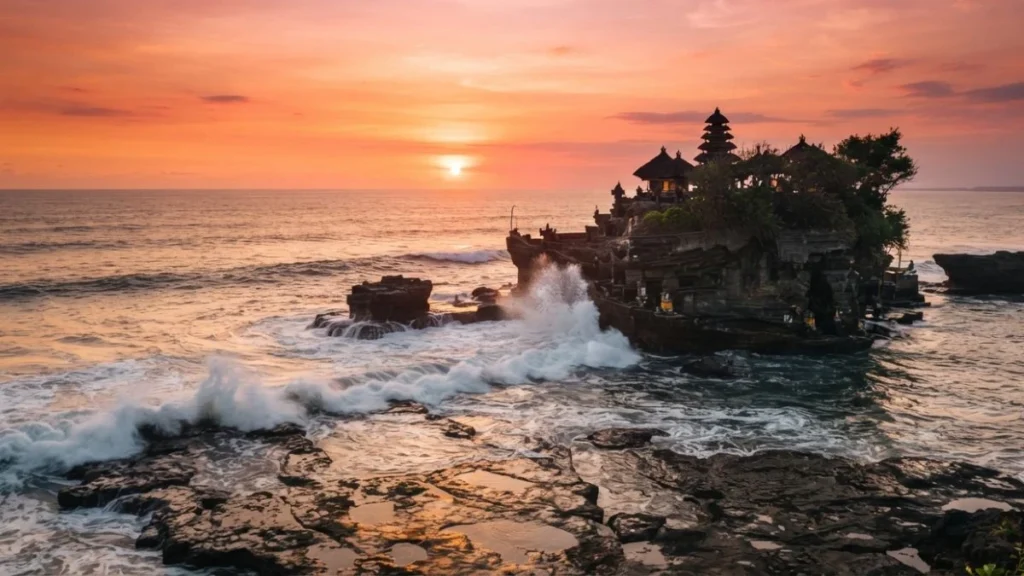
Tanah Lot Temple earns its reputation as one of Bali’s most photographed sunset spots — a Hindu shrine perched on a rock outcrop in the Indian Ocean, silhouetted against an orange sky most evenings. It’s also, honestly, one of Bali’s most commercialized temple experiences, with crowded cliffside viewing, a strip of souvenir stalls between the parking lot and the temple, and a detail most guidebooks skip entirely: a meaningful portion of the rock you’re photographing was rebuilt in the 1990s to keep it from sliding into the sea.
None of that makes Tanah Lot not worth visiting. It just means the honest version of this visit involves managing your timing, your expectations, and a bit of myth-busting before you go.
Quick Facts
- Location: Beraban village, Tabanan regency, roughly 1–1.5 hours from Ubud
- Entrance fee (2026): IDR 75,000 for foreign adults, IDR 40,000 for children (5–10); domestic visitors pay considerably less
- Hours: 7am–7pm daily; the temple itself remains accessible to Balinese Hindu worshippers at any hour
- What decides your experience: tide, not just time of day — low tide lets you walk to the temple base, high tide gives you the “floating temple” look but keeps you at a distance
- Sunset: typically 5:30–6:30pm depending on season, with crowds building from around 4pm
The Rock Is Partly Not Original
Here’s the detail worth knowing before anything else: roughly a third of the rock formation you photograph at Tanah Lot was reconstructed in the 1990s. Coastal erosion had engineers worried the natural rock supporting the temple would eventually collapse into the sea, and a Japanese-funded restoration project stabilized the base using reinforced fibre-cement, carefully colored and textured to blend in with the surrounding natural stone. It reads as completely authentic from the cliffside viewpoints most visitors use — but if you’re down at the lower beach during low tide and look closely, the seams between original rock and reconstruction are visible.
This doesn’t make Tanah Lot less worth seeing. If anything, it adds a layer most visitors never learn about: this is a genuinely ancient sacred site being actively kept standing through deliberate modern intervention, not a static ruin.
Tide Matters More Than Time
The single biggest planning variable at Tanah Lot isn’t when you arrive — it’s the tide. At low tide, a walkway of wet sand opens up, letting you approach the base of the rock and, if you want, receive a holy water blessing from a priest stationed at a freshwater spring that emerges directly from the saltwater outcrop, a detail locals consider genuinely remarkable. At high tide, that path disappears entirely, and the temple takes on the “floating on water” look most famous in photographs — striking, but only from a distance. Both versions have real appeal, and checking a tide chart for your specific visit date (published by Indonesia’s meteorological agency, BMKG, and available through most tide apps) matters more than picking a time based on generic advice alone.
Regardless of tide, non-Hindu visitors can’t enter the temple itself — it’s reserved for worshippers, and this is standard practice across Bali’s active temples, not something unique to Tanah Lot.
The Holy Water Blessing: Set Realistic Expectations
If you do the low-tide blessing, know going in that it’s a brief, donation-based ritual — a priest places a bit of rice on your forehead and splashes holy water, taking perhaps a minute per person in a moving line. Some visitors describe it as a meaningful, if quick, spiritual moment; others, especially those expecting something more ceremonious, come away feeling it was rushed and transactional given the crowd moving through. Go in treating it as a brief blessing rather than a deep ceremonial experience, and it’s more likely to land the way it’s meant to.
Sunset: Worth the Crowd, But Know What You’re Signing Up For
Sunset is genuinely Tanah Lot’s best hour, and it’s also, unavoidably, the most crowded. Arrive by 4:30–5pm if you want a decent spot on the cliffside east lawn, which delivers the classic postcard angle. The Batu Bolong viewpoint, a short walk south along the coast, offers a quieter alternative — a smaller temple on its own arched rock formation, with a natural sea arch beneath it, and noticeably fewer people than the main viewing area. If crowds genuinely aren’t your thing, early morning (7–9am) offers a completely different, near-empty version of Tanah Lot with soft light and none of the sunset scramble — the trade-off being no dramatic sunset sky, obviously.
A Kecak fire dance performance also runs at Tanah Lot’s Surya Mandala Cultural Park most evenings, offering a similar experience to Uluwatu’s more famous version with a noticeably smaller crowd — a separate ticket from general entrance.
The Vendor Stretch
Between the parking area and the temple grounds sits a stretch of souvenir stalls that some visitors describe as intense, high-pressure sales, while others visiting at quieter hours (particularly midday) found the same stretch relaxed and easy to browse without hassle. The difference seems to come down largely to timing and crowd density rather than the vendors themselves — expect more pressure the closer you get to peak sunset hours, and a calmer walk-through outside them.
FAQ
How much does it cost to enter Tanah Lot Temple?
IDR 75,000 for foreign adults, IDR 40,000 for children aged 5–10, as of 2026. Domestic Indonesian visitors pay a reduced rate.
Can you go inside Tanah Lot Temple?
No. Like most active Balinese temples, the inner sanctum is reserved for Hindu worshippers. Visitors can view the temple from outside and, at low tide, approach the base.
Is the Tanah Lot rock formation completely natural?
Not entirely. Roughly a third of the rock was reconstructed in the 1990s using reinforced fibre-cement to prevent coastal erosion from collapsing the original structure, carefully matched in color and texture to the natural stone.
What’s the best time to visit Tanah Lot?
For the classic sunset photo, arrive by 4:30–5pm despite the crowds. For a quieter, less crowded experience, early morning (7–9am) offers soft light and far fewer people, without the sunset colors.
Is the holy water blessing at Tanah Lot worth doing?
It’s a genuine but brief ritual, donation-based, taking about a minute per person. Some find it meaningful; others feel it’s rushed given the crowds. Managing expectations going in helps either way.
Final Thought
Tanah Lot Temple’s sunset reputation is earned, but the honest visit involves checking the tide chart, picking your crowd tolerance, and knowing that some of what you’re photographing is a carefully maintained modern intervention rather than untouched ancient rock. None of that diminishes it — it just makes for a more informed visit. For more East Bali and South Bali temple context, our Besakih Temple guide and Lempuyang Temple guide cover two more of the island’s most significant, and most commercialized, sacred sites.