
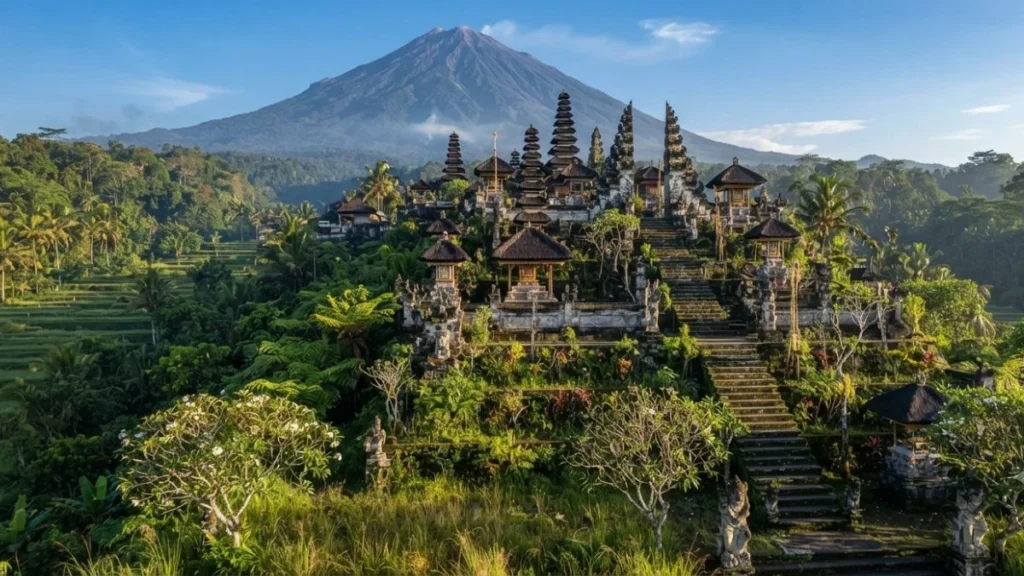
Besakih Temple, the “Mother Temple” of Bali, is the largest and holiest temple complex on the island — more than 80 individual shrines spread across terraced slopes of Mount Agung, with roots dating back to at least the 8th century. It’s also, by a significant margin, the Bali temple most consistently associated with pressure tactics aimed at tourists, well-documented across years of visitor accounts using nearly identical patterns. This guide isn’t here to talk you out of visiting — the temple itself is genuinely spectacular — but going in informed makes the difference between a meaningful visit and one that leaves a bad taste.
Quick Facts
- Location: Besakih Village, Karangasem, East Bali, roughly 1,000 metres up the slopes of Mount Agung
- Distance from Ubud: roughly 2–3 hours by car
- Official entrance fee (2026): IDR 150,000, which includes sarong and sash rental, an official guide, and a short shuttle ride from the parking area
- Hours: 8am–5pm daily, closed entirely during Nyepi
- Parking: IDR 5,000 for scooters, IDR 10,000 for cars
- Best visiting window: 7–9am, dry season (April–October), for clear Mount Agung views before clouds and tour buses arrive
What Besakih Actually Is
Besakih is less a single temple than an entire spiritual complex — over 80 individual shrines across six terraced levels, connected by hundreds of steep stone steps without handrails. The central and most important sanctuary, Pura Penataran Agung, anchors the site, with surrounding temples dedicated to different deities and ancestral clans. For Balinese Hindus, this is the island’s most significant pilgrimage site, and if you happen to visit during a major ceremony, you’ll see the temple functioning as it’s actually meant to — crowded with pilgrims in traditional dress, offerings, and genuine devotion, rather than as a static tourist sight. Several visitors specifically describe this as the most memorable version of a Besakih visit, even with the added crowds.
The setting itself, on Mount Agung’s slopes with valley views stretching toward the coast, is genuinely impressive by any measure — this part of Besakih’s reputation is entirely deserved.
The Pressure Tactics, Honestly Explained
Here’s the part that matters most for a first-time visit: an extraordinarily consistent pattern of complaints, documented across years of independent visitor reviews, describes the same handful of pressure tactics at Besakih, distinct from ordinary opportunistic touting elsewhere in Bali.
The fake “temple is closed” claim. Some unofficial operators near the entrance tell arriving visitors the temple is closed for a ceremony that day, then offer a paid “secret entrance” or alternative access at inflated cost. This is consistently reported as false. Proceed directly to the official ticket counter regardless of what you’re told beforehand.
The donation guestbook. Once inside, some visitors are shown a book listing previous donations, often in the range of IDR 500,000–900,000, with the implication that similar or larger sums are expected. Multiple visitors report visibly edited numbers in these books. Donations at Besakih, like at any Balinese temple, are genuinely optional — there’s no fixed minimum, and you’re free to give a small amount or decline entirely.
The “mandatory” guide upsell. Your official IDR 150,000 entrance ticket already includes a guide. Despite this, unofficial operators at or near the entrance frequently insist a guide is required and not included, pushing an additional fee, sometimes with claims that only “official guides” can access certain areas. Some visitors report being told they can’t proceed further without paying an unofficial guide, which multiple detailed accounts describe as untrue.
End-of-visit tipping pressure. Even with a paid, included guide, some visitors report the guide requesting a tip afterward in a way that felt more demanding than optional, occasionally reacting negatively to a modest amount.
Flowers and offerings pushed into your hands. Vendors near the entrance sometimes hand visitors a flower or small offering unprompted, then request payment once it’s been accepted. Politely declining before taking anything avoids this entirely.
How to Visit Without the Hassle
The advice that comes up consistently across experienced visitors and travel guides is simple and specific: pay only at the official ticket counter, and get a printed ticket. Don’t stop at informal booths or tables before you reach it, regardless of what you’re told about closures or “checking in.” Your entrance fee already includes a sarong and a guide — you don’t need to pay extra for either, no matter what you’re told at the gate. If someone hands you a flower, offering, or anything else you haven’t asked for, decline it before it’s in your hands rather than after. If pressured into a donation, remember it’s genuinely optional; a small amount or a polite decline is entirely acceptable, even if the response from staff feels uncomfortable in the moment. Staying calm, firm, and simply continuing to walk works better than arguing.
Some travelers, after repeated negative experiences, recommend skipping Besakih entirely in favor of Bali’s many other significant temples. That’s a legitimate call to make for yourself — but plenty of others who went in prepared, paid only the official fee, and firmly declined every extra ask describe genuinely enjoying the visit and the setting despite the reputation.
Practical Tips for the Visit Itself
Wear proper walking shoes with real traction — the stone steps are steep, numerous, and lack handrails, and get genuinely slippery during the rainy season (November–March). Bring small cash notes (IDR 10,000–20,000) if you want the flexibility to make small optional donations or tip your included guide without needing to break a large bill. Plan for 1.5 to 2 hours to see a reasonable portion of the complex, and go early — clouds typically roll in over Mount Agung by mid-morning, and the tour bus crowds thicken noticeably after 10am.
FAQ
How much does it cost to enter Besakih Temple?
The official 2026 entrance fee is IDR 150,000, which includes sarong and sash rental, an included guide, and a short shuttle ride from the parking area to the temple entrance.
Do I need to pay extra for a guide at Besakih?
No. A guide is included in the official entrance fee. Unofficial operators near the entrance frequently claim otherwise and push additional paid guides — this isn’t necessary.
Are donations mandatory at Besakih Temple?
No. Donations are optional, regardless of what donation books or staff at the temple may suggest. There’s no fixed minimum amount required to enter or visit.
Is Besakih Temple worth visiting despite the scam reports?
Many visitors who go in prepared — paying only at the official counter and firmly declining unofficial add-ons — describe a genuinely worthwhile visit. The temple’s scale, history, and setting are real; the pressure tactics are avoidable with the right approach.
What’s the best time to visit Besakih Temple?
Early morning, between 7 and 9am, during the dry season (April–October), for the clearest views of Mount Agung before afternoon clouds and tour bus crowds arrive.
Final Thought
Besakih Temple’s reputation as Bali’s most scam-prone sacred site is well earned by the sheer consistency of the reports, but it doesn’t have to define your visit. Pay only at the official counter, know that your ticket already includes a sarong and guide, decline anything pushed into your hands, and the temple’s genuine scale and history can still come through. For temple etiquette that applies here and elsewhere in Bali, our temple etiquette guide and what not to do in Bali cover the broader cultural ground rules worth knowing before any temple visit.