
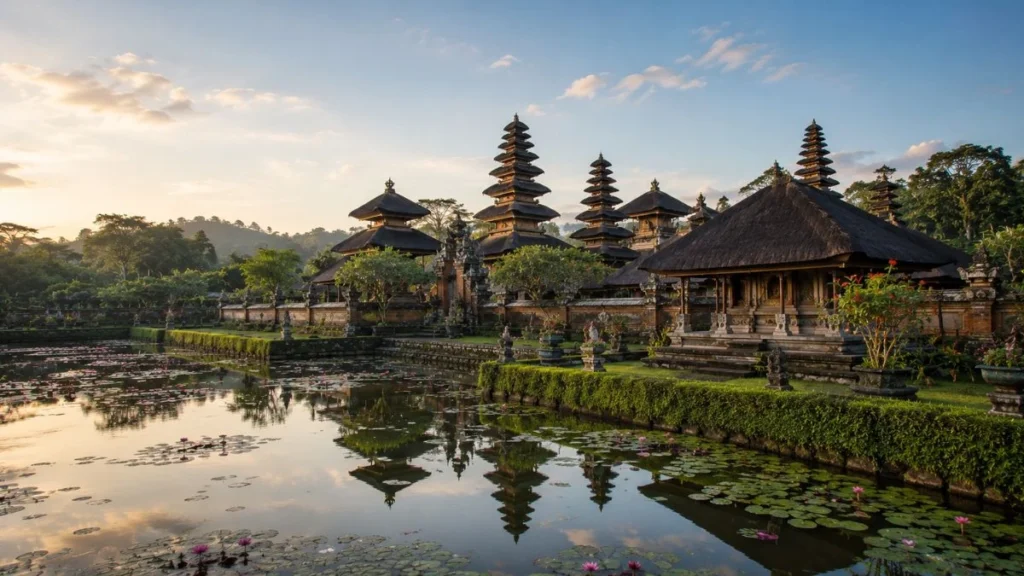
Taman Ayun Temple sits in Mengwi, a quiet stretch of Badung Regency most travelers drive straight past on the way to Tanah Lot or Bedugul, without realizing there’s a genuinely significant UNESCO-recognized royal complex five minutes off the main road. After the pressure tactics at Besakih and the queues at Lempuyang, this is close to the opposite experience — calm, uncrowded, and cheap enough that it barely registers as a line item on a day’s budget.
This guide covers the history behind the temple, what you’ll actually see, and why it’s worth building into a route rather than treating as a footnote.
Quick Facts
- Location: Mengwi, Badung Regency, roughly 17 km from Ubud, about 35–45 minutes by car
- Entrance fee: reported inconsistently across sources, roughly IDR 15,000–30,000 for foreign visitors, sarong included
- Hours: 8am–6pm daily
- Built: 1634 by King I Gusti Agung Putu of the Mengwi Kingdom, as the royal family’s ancestral temple
- UNESCO status: recognized in 2012 as part of the Cultural Landscape of Bali Province, tied to the island’s Subak irrigation system rather than as a standalone listing
- Best time to visit: early morning (8–10am) or late afternoon (4–5:30pm) for softer light and fewer tour groups
A Royal Temple, Not a Public One
Unlike most of Bali’s major sacred sites, which developed as community places of worship, this was originally built exclusively for the royal family of the Mengwi Kingdom — one of nine kingdoms that divided Bali before Dutch colonization consolidated the island. Commoners weren’t permitted inside for centuries. That changed after a 1937 renovation opened the grounds to all Balinese worshippers, and it remains an active site for ancestral and religious ceremonies tied to the former royal lineage today.
The complex sustained real damage in the major 1917 earthquake that reshaped so many of Bali’s older structures, and what stands now reflects careful restoration rather than an unbroken original. Ten meru towers rise across the inner courtyard, each dedicated to a different deity or ancestral spirit — visually similar in style to the meru towers found across Bali’s temples, but here specifically representing generations of Mengwi royalty rather than a general pantheon.
What Makes This Different From Bali’s Other Major Temples
The single most distinctive feature is the setting: a wide moat filled with lotus and water lilies wraps around the temple complex, giving the whole site a genuinely tranquil, garden-like quality that’s rare among Bali’s most historically significant sacred sites. The name itself translates to “Beautiful Garden,” and it’s an accurate description — this reads more as a serene royal park than the busier, more ceremonially active feel of places like Besakih.
The inner sanctum (jeroan) remains reserved for specific ceremonies and isn’t generally open to visitors, but the outer courtyards, gardens, and moat walkways are fully accessible, along with a small on-site museum and gallery covering the temple’s history and the broader Mengwi Kingdom. Most visitors spend 45 minutes to an hour walking the grounds — enough to appreciate the architecture and gardens without needing to rush.
Why It’s Worth the Detour
Because this temple sits well outside the usual Ubud-to-Uluwatu or Ubud-to-Besakih routes most itineraries follow, it’s easy to overlook entirely. But its location, roughly midway between Ubud and Tanah Lot, makes it a genuinely easy add-on if you’re already making that drive — a calm midpoint stop rather than a separate trip requiring its own dedicated day. It also sits along the route toward Bedugul and Jatiluwih if you’re building a longer highland loop.
Crowds here remain noticeably lighter than at Bali’s more famous sites, largely because it doesn’t have a single “must-see” photo moment the way Tanah Lot’s sunset silhouette or Lempuyang’s mirror shot do. What it offers instead is a quieter, more contemplative visit — worth prioritizing if the pressure and crowds at other major temples have worn you down partway through a Bali trip.
Practical Tips
A sarong is provided with your entrance ticket, standard practice at any active Balinese temple, and as with other sacred sites, women who are menstruating are traditionally asked not to enter. Tour groups tend to arrive around midday, so the early morning or late afternoon windows aren’t just about light quality — they’re genuinely the difference between having the gardens mostly to yourself and sharing them with several coach groups at once. There’s minimal shade across the open courtyards, so sun protection is worth bringing even on an overcast day.
FAQ
How much does it cost to visit Taman Ayun Temple?
Reported prices vary by source, typically IDR 15,000–30,000 for foreign visitors, with a sarong included in the fee.
How far is Mengwi from Ubud?
Roughly 17 km, about 35 to 45 minutes by car depending on traffic.
Is Taman Ayun Temple part of a UNESCO World Heritage Site?
Yes, recognized in 2012 as part of the broader “Cultural Landscape of Bali Province” listing, connected to the island’s Subak rice irrigation system rather than as its own standalone site.
Can visitors enter the inner temple sanctum?
No. The inner courtyard (jeroan) is reserved for specific religious ceremonies. Visitors can access the outer courtyards, gardens, and moat walkways, along with a small on-site museum.
Is this temple crowded like Tanah Lot or Uluwatu?
Generally no. It sees noticeably fewer visitors than Bali’s most famous sunset temples, making it a good option if you’re looking for a calmer, less pressured temple visit.
Final Thought
This is the rare Bali temple that rewards visiting precisely because it isn’t famous — a genuinely significant royal site with real UNESCO recognition, minimal crowds, and an entrance fee that barely registers. Build it into a route toward Tanah Lot or Bedugul rather than treating it as a separate destination. For the more heavily visited temples nearby, our Tanah Lot guide and Besakih guide cover what to expect at Bali’s more crowded sacred sites.