
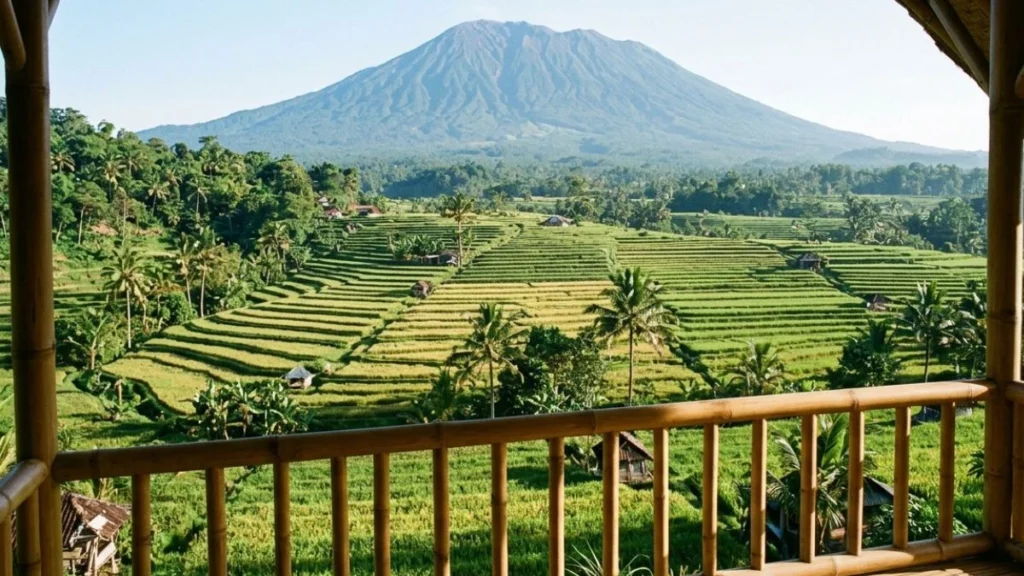
Sidemen eco lodge review: Sidemen Valley has three distinct tiers of eco accommodation — a genuinely old-school riverside eco resort that has been operating sustainably since before it was a marketing term, a mid-range boutique with strong local sourcing, and two luxury resorts where the eco credentials are substantive rather than decorative. This review covers all four honestly.
This sidemen eco lodge review covers the properties worth knowing about in Sidemen Valley — what each one actually delivers, who each one suits, and where the genuine sustainable practice is versus where the language runs ahead of the reality. Sidemen is one of the few areas in Bali where eco accommodation is not primarily a marketing category — the valley’s agricultural character and relative distance from south Bali’s development pressure have produced a cluster of properties that operate with genuine environmental and community investment.
For travellers deciding whether Sidemen is the right area for their Bali base, the best areas to stay in Bali for slow travel covers the area’s character and trade-offs in detail alongside five other Bali bases. This review assumes you have already decided on Sidemen and want to know which property to book.
The Sidemen Valley Accommodation Landscape
Sidemen’s accommodation market in 2026 has four distinct tiers:
Budget family guesthouses — the most numerous and least visible online. IDR 100,000–250,000 per night. Balinese family compounds with simple rooms, no pool, genuine local character. Not covered in this review — covered in the budget accommodation Bali outside Kuta guide.
Mid-range eco lodges — IDR 400,000–1,200,000 per night. Small properties with genuine sustainability practice, local hiring, and valley views. This is the primary focus of this review.
Boutique luxury — IDR 1,200,000–2,500,000 per night. Designed resorts with strong eco credentials and professional service. Covered here.
Ultra-luxury resort tier — IDR 3,000,000+ per night. The Samanvaya and Wapa di Ume territory. Covered briefly for completeness.
Darmada Eco Resort — The Original
Darmada is the oldest eco property in Sidemen and the one most consistently recommended by travellers who have been visiting Sidemen for more than five years. It is run by a Balinese-Dutch couple and sits on the bank of the Unda River at the base of the valley — a location that provides a natural pool fed by the river, audible water throughout the property, and a forest edge that creates shade and wildlife activity in the mornings.
What it delivers: Rooms blending Dutch and Balinese aesthetic in open-air or semi-open configurations, a spring-fed natural pool rather than a chlorinated pool, open-air dining with river and mountain views, and a kitchen that sources from the local market and the property’s garden. The eco practice here is operational rather than marketed — composting, rainwater use, local staff from Sidemen village, and a commitment to the river ecology that the property is built around.
Who it suits: Travellers who want the most direct connection to Sidemen’s natural landscape rather than a polished resort experience. The open-air design means exposure to insects and humidity — a feature for some visitors, a limitation for others. No AC in most rooms; ceiling fans and river air manage the temperature in the valley’s cooler highland climate.
Rate range: IDR 400,000–900,000 per night for rooms, IDR 1,000,000–1,800,000 for villas.
Honest note: Darmada is not the most polished property in Sidemen. The physical infrastructure is older than the luxury resorts below. The tradeoff is authenticity — this property feels embedded in the valley rather than positioned above it.
Magic Hills — Treehouse Eco Luxury
Magic Hills is the property that shifted the perception of what eco accommodation in Sidemen could be. The design uses bamboo architecture extensively — structures built from sustainably harvested bamboo with open-air living areas, elevated walkways through the tree canopy, and a setting that makes the bamboo forest feel like the accommodation rather than the backdrop.
The property sits on a hillside above the valley floor, giving views across the rice terraces to Mount Agung on clear mornings. The construction philosophy — bamboo over concrete, local craft over imported materials, minimal footprint per unit — is structurally integrated rather than applied as a finish.
What it delivers: Open-air treehouse-style accommodation with bamboo construction throughout, an infinity pool with valley view, on-site organic garden supplying the kitchen, and walking distance to local village life. The sustainability practice covers construction materials, energy use (solar supplemented), and local employment.
The trade-off: No AC — the bamboo and elevation design uses natural airflow. This works well from May to October. In the wet season, humidity management in open bamboo structures requires the property’s design to work correctly, which it does — but visitors who need AC for sleep should confirm room specifications before booking.
Rate range: IDR 1,500,000–3,000,000 per night depending on room type and season.
Who it suits: Design-conscious travellers who want the eco architecture experience to be the accommodation itself rather than an add-on.
Camaya Bali — Bamboo and Community Investment
Camaya is a smaller property than Magic Hills with a stronger explicit focus on community development alongside its environmental practice. The accommodation uses bamboo construction in a less dramatic but functionally excellent format — comfortable, well-designed rooms that do not require the theatrical quality of treehouse living to justify their eco credentials.
The property’s community investment is specific and documented: local hiring from Sidemen village at above-minimum wages, a percentage of revenue directed to local school programmes, and sourcing relationships with specific local farmers rather than generic “local sourcing” language. This is the distinction the eco stays Bali honest guide identifies as the marker of genuine practice — specificity rather than generality.
What it delivers: Bamboo accommodation with rice terrace views, community-focused operation, organic garden kitchen, and a quieter, more intimate atmosphere than the larger luxury resorts.
Rate range: IDR 800,000–1,800,000 per night.
Who it suits: Travellers who want eco credentials weighted toward community investment alongside environmental practice, and who prefer a smaller, less resort-like property.
Wapa di Ume Sidemen — The Benchmark for Boutique Luxury
Wapa di Ume ranked sixth among Small and Boutique Hotels in Asia on TripAdvisor’s Travelers’ Choice Best of the Best 2025 — a recognition that reflects several years of consistent quality rather than a single spike. The property occupies a rice terrace setting above the valley with a design that uses local stone, traditional Balinese architectural elements, and open-air dining that frames the terrace views without competing with them.
Sustainability practice: Local stone and timber construction, on-site herb and vegetable gardens supplying the kitchen, local staff and management, and a Subak partnership that maintains the rice terraces on the property as working agricultural land rather than decorative landscaping. The working terraces are the most literal expression of the subak irrigation system as a resort feature that the valley has produced.
What it delivers: Fully air-conditioned rooms with private terrace, infinity pool, spa, fine dining, and the professional service infrastructure of a boutique luxury resort — combined with genuine eco practice that extends to the agricultural land management of the property.
Rate range: IDR 2,500,000–5,000,000+ per night.
Who it suits: Travellers who want the full-service boutique luxury experience with substantive eco credentials and do not want to choose between comfort and sustainability.
Samanvaya — The Most Comprehensively Documented Sustainability
Samanvaya is the newest major property in Sidemen’s luxury tier and the one with the most explicitly documented sustainability practice. The property publishes specific sustainability commitments: complimentary filtered water with refill stations eliminating single-use plastic bottles, energy-efficient lighting, refillable amenity dispensers, on-site herb and vegetable gardens supplying the kitchen, and a boutique featuring handcrafted textiles by local Balinese artisans.
The specificity is what distinguishes Samanvaya’s eco claims from properties that use general language. A guest can verify the filtered water stations, can see the garden, and can buy from the boutique’s documented local artisans. This is the standard the eco stays Bali honest guide identifies as meaningful: claims that can be verified during a stay rather than taken on trust.
What it delivers: Luxury resort experience with spa, pool, fine dining, and the Ananda Spa featuring treatments inspired by traditional Balinese textile arts. The setting is among the most dramatic in Sidemen — a ridge position with rice terrace and Mount Agung views.
Rate range: IDR 3,000,000–6,000,000+ per night.
Who it suits: Travellers seeking maximum luxury in Sidemen who want the eco credentials to be as substantive as the service quality.
The Comparison at a Glance
| Property | Eco Approach | Price Range | AC | Best for |
|---|---|---|---|---|
| Darmada | Operational, embedded | IDR 400k–1.8M | No | Authentic nature experience |
| Magic Hills | Architectural, bamboo | IDR 1.5M–3M | No | Design + eco architecture |
| Camaya | Community investment | IDR 800k–1.8M | Some rooms | Community-focused travel |
| Wapa di Ume | Agricultural, subak | IDR 2.5M–5M+ | Yes | Boutique luxury + authenticity |
| Samanvaya | Documented comprehensive | IDR 3M–6M+ | Yes | Full luxury + verified eco |
The Honest Question to Ask Before Booking Any of These
The right property in Sidemen depends on one question before price: do you want to feel like you are in the valley, or do you want to look at the valley?
Darmada puts you at river level, in the valley floor, surrounded by the agricultural and natural landscape at its most immediate. Magic Hills and Camaya put you on the hillside above the terraces, with views across the valley. Wapa di Ume and Samanvaya put you on the best viewpoints of the valley with the most polished service infrastructure.
None of these is objectively better. They produce different experiences of the same extraordinary landscape.
Ngozi had booked Wapa di Ume on her first Sidemen visit and described it as the most beautiful place she had ever stayed. On her second visit she stayed at Darmada specifically to understand the difference. She said Wapa gave her Sidemen as a view. Darmada gave her Sidemen as a place she was in. She said she would go back to both, in that order, on every subsequent trip — Darmada first to arrive, Wapa at the end as a reward for the week that preceded it.
FAQ
What is the best eco lodge in Sidemen Bali?
It depends on what you mean by best. Darmada is the most authentically embedded in the valley — the oldest eco property in the area with a riverside setting and genuine operational sustainability. Magic Hills delivers the most dramatic eco architecture — bamboo treehouses with Mount Agung views. Wapa di Ume offers the best combination of luxury and substantive sustainability including working rice terraces on the property. Samanvaya has the most explicitly documented sustainability commitments at the luxury end.
Is Sidemen good for eco accommodation?
Yes — Sidemen has one of the strongest concentrations of genuine eco accommodation in Bali. The valley’s agricultural character, relative distance from south Bali’s development pressure, and community orientation have produced properties where sustainability is operationally integrated rather than applied as branding. The contrast with south Bali’s greenwashing-heavy accommodation market is significant.
Do Sidemen eco lodges have air conditioning?
It varies by property and tier. Darmada and most of Magic Hills’ accommodation operates without AC, using natural airflow and the valley’s highland climate for temperature management. This works well in the dry season. Wapa di Ume and Samanvaya are fully air-conditioned throughout. Camaya has some rooms with AC and some without. Confirm AC availability before booking if it is a requirement.
How far is Sidemen from Ubud?
Approximately 45km east of Ubud — roughly one to 1.5 hours by car or scooter via Klungkung. The drive is scenic in its final section through the Karangasem highlands. Sidemen is within reach of Tirta Gangga (15 minutes north) and Candidasa (45 minutes south), making it a practical base for East Bali exploration.
What is the price range for eco accommodation in Sidemen?
Budget family guesthouses from IDR 100,000–250,000 per night. Mid-range eco lodges (Darmada, Camaya) from IDR 400,000–1,800,000. Boutique eco luxury (Magic Hills, Wapa di Ume) from IDR 1,500,000–5,000,000. Ultra-luxury (Samanvaya) from IDR 3,000,000–6,000,000+. All figures are approximate and vary by season and room type.