
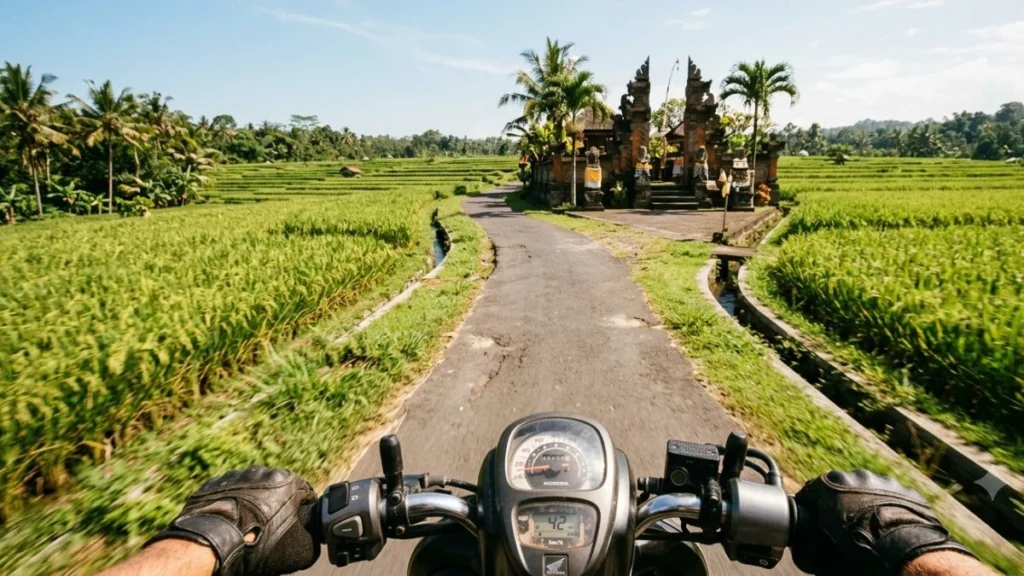
Renting a motorbike in Bali tips: Three things determine whether your scooter rental in Bali is safe and legal: a valid International Driving Permit (IDP) with motorcycle endorsement, travel insurance that explicitly covers motorbike accidents, and a pre-rental damage inspection with photographs. All three can be arranged before you leave home. None of them are optional if you want to be covered when something goes wrong.
These renting a motorbike in bali tips start with the most important point in the guide: riding without an IDP does not just risk a police fine — it voids your travel insurance. If you crash, are hospitalised, or require emergency evacuation without a valid motorcycle licence and IDP, your insurance provider will decline the claim. Medical bills in Bali can run to tens of thousands of USD for serious injuries. Emergency evacuation to Singapore is more. This is the context that makes every other tip on this page matter.
A recent rumour circulating on social media claimed Bali had banned foreigners from renting motorbikes entirely. This is false. As of April 2026, no such ban exists. The rules around riding legally have not changed — an IDP remains the requirement, police checkpoints remain active, and the consequences of riding without documentation remain the same as they have been.
For the broader picture of transport options in Bali including when a scooter is the right choice versus a private driver or app-based transport, the how to get around Bali without a tour guide covers all six options honestly.
The Three Documents You Need Before You Ride
1. Your home country driving licence with motorcycle endorsement Most countries issue a licence that either covers motorcycles automatically up to a certain engine size or requires a separate endorsement. Check your licence before leaving home — if it does not include motorcycle authorisation, you are not legally permitted to ride in Bali regardless of other documents.
2. An International Driving Permit (IDP) The IDP is the document that makes your home country licence valid in Indonesia. It is not a separate licence — it is a translation document that accompanies your home licence. The IDP is obtained from the relevant automobile association in your home country before departure: AAA in the US (USD 20), the AA or RAC in the UK (GBP 6), NRMA in Australia (AUD 35–55).
Processing takes 1–2 weeks by mail or can be done in person at an AA/AAA office. It cannot be obtained after you arrive in Bali. Plan this before your trip.
The IDP must be for motorcycle riding specifically — check that your home licence’s motorcycle endorsement carries over to the IDP’s motorcycle category.
3. Travel insurance with explicit motorcycle coverage This is the one that catches the most people. Standard travel insurance policies frequently exclude motorcycle accidents, exclude motorcycles above a certain engine size (typically 50cc or 125cc), or exclude riding without a valid licence. Read the fine print of your policy specifically for motorcycle coverage before leaving home.
Policies confirmed to cover motorcycle riding in Bali include World Nomads (standard and explorer plans both cover scooters with a valid licence), SafetyWing (covers motorcycles under 125cc with a valid licence), and RACV/NRMA Travel Insurance for Australian travellers. Confirm the specific engine size covered by your policy — most standard Bali rentals are 110–150cc automatics.
Choosing the Right Scooter
Bali rental shops offer three common scooter types:
Honda Scoopy / Vario (110–125cc) — the standard automatic scooter, the most widely available, the easiest to ride for visitors with limited scooter experience. Low seat height, light handling, adequate for south Bali traffic and most central Bali roads.
Yamaha NMax (155cc) — a larger, heavier automatic with more power and better highway stability. Better choice for longer East or North Bali circuits where road speeds are higher. Slightly more expensive to rent. Requires more confidence to handle in tight urban traffic.
Honda Beat (108cc) — the smallest and lightest of the common options. Easiest for new riders in slow urban traffic. Less suitable for the steeper mountain roads in East and North Bali.
For most visitors using a scooter for daily movement around a single area — Canggu, Ubud, Sanur — any standard automatic is adequate. For the East Bali coastal road circuit or North Bali highland routes, the NMax’s additional stability is worth the slightly higher daily rate.
Avoid manual motorbikes unless you are experienced with manual transmission. Bali’s traffic does not provide the controlled environment that learning a clutch-based scooter requires.
What to Check Before Riding Away
This is the step most damage scam victims skip. Before taking the scooter:
Photograph every surface. Front, back, both sides, the undercarriage if accessible. Photograph any existing scratch, dent, crack, or mark — no matter how minor. Send all photographs to yourself immediately to create a timestamp. This is the documentary evidence you need if the rental shop claims you caused pre-existing damage on return.
Test the brakes. Both front and rear. The test takes ten seconds — ride slowly and apply each brake separately. A brake that feels soft or delayed is a brake that needs attention before you take the scooter onto a road.
Test the horn and lights. Horn: mandatory for Bali traffic. Lights: essential for tunnels, mountain roads, and any riding that extends to dusk.
Check the tyres. Press your thumb into the tyre sidewall. If it feels soft, the tyre is low on pressure. Under-inflated tyres on Bali’s wet roads are a significant accident risk.
Get the rental shop’s phone number and confirm roadside assistance. Reputable rental shops provide a contact number for breakdowns and can retrieve the scooter or bring a replacement if you have a mechanical issue on the road.
Never Leave Your Passport as a Deposit
This is non-negotiable. Some rental shops ask for a passport as security deposit. Do not agree to this under any circumstances.
Your passport is your most important travel document. A shop holding your passport has leverage over you — if you dispute a damage claim, they can refuse to return your passport until you pay. This situation is entirely avoidable: reputable rental shops accept a cash deposit (IDR 200,000–500,000) or a photocopy of your passport instead.
If a rental shop insists on holding the original passport, walk away and find a different operator.
Police Checkpoints: What Happens and How to Handle It
Police checkpoints specifically targeting unlicensed riders are active throughout Bali’s tourist corridors — Canggu, Seminyak, Ubud, and roads approaching major temples. The checkpoint process:
An officer will flag you to stop and ask to see your licence and IDP. If you have both and they are valid for motorcycle riding, the process takes under two minutes. You show the documents, they record or photograph them, you ride on.
If you do not have an IDP, the officer will typically ask for a payment on the spot — effectively an unofficial fine. The amount is negotiable but commonly IDR 50,000–200,000. This is not an official government fine — it is a discretionary payment. Paying it resolves the immediate situation but does not address the underlying problem: you are still riding without valid documentation and your insurance is still void.
The correct approach: obtain the IDP before leaving home. The cost and effort are minimal. The protection it provides is not.
Daily and Monthly Rates in 2026
Daily rental: IDR 70,000–100,000 for a standard automatic (Scoopy, Vario, Beat). IDR 100,000–150,000 for a larger automatic (NMax, PCX). Rates at the lower end of this range are from street-side shops without much documentation or insurance provision. Rates at the upper end typically include basic insurance and better-maintained bikes.
Monthly rental: IDR 800,000–1,500,000 for a standard automatic. A significant discount over daily rates — if you are staying more than two weeks, negotiate a monthly rate.
Fuel: Pertamina petrol stations charge IDR 10,000–11,800 per litre. Most shops expect the scooter returned with a full tank. The cost of filling a scooter tank from empty is IDR 25,000–35,000.
Roadside fuel (eceran): Bottled fuel sold by roadside vendors in yellow Absolut vodka bottles is available throughout Bali at IDR 12,000–15,000 per bottle (approximately one litre). It is the same Pertamina petrol sold in a recycled container. Useful in remote areas where Pertamina stations are far.
The Roads You Need to Know About
South Bali (Canggu, Seminyak, Kuta): Heavy traffic, frequent congestion, many inexperienced riders. The highest-risk riding environment for scooter accidents in Bali — not because of road quality but because of traffic density and the mix of vehicle types and skill levels. New riders should avoid peak hour (8–10am and 5–7pm) until confident.
Ubud and central Bali: Narrower lanes, steeper hills, more pedestrian activity. The Campuhan ridge area involves a steep decline on wet days that requires engine braking. The road north toward Tegallalang is straightforward. The descent into the Ayung River gorge is steep and narrow.
East Bali (Sidemen, Tirta Gangga, Amed coastal road): The most demanding scooter riding on this guide’s recommended circuits. The Ujung to Seraya coastal road is single-lane, steep, and exposed — daylight and dry conditions only. The mountain roads between Sidemen and Tirta Gangga have significant gradients and blind corners.
North Bali (Munduk approach from Bedugul): Steep mountain road with hairpin bends. The approach to Munduk from the south requires confident braking on descent. The views from this road are among the best available from a scooter seat in Bali.
The Honest Assessment: Is Renting a Scooter Right for You?
Scooters are the right transport for experienced riders in Bali. The freedom they provide — stopping at a roadside warung, turning down a lane not on any map, reaching temple roads that no car can access — is genuinely transformative for a Bali trip.
They are not the right transport for visitors who have never ridden a scooter in traffic, visitors who are not comfortable with the road conditions described above, or visitors who cannot obtain a valid IDP before departure.
The pressure to rent a scooter in Bali is strong — almost everyone else seems to be on one, the roads look manageable from a taxi window, and the rental cost is IDR 70,000 per day. None of these facts change the accident statistics, the voided insurance risk, or the reality that Bali’s roads require more competence and attention than they appear to from a stationary position.
Private drivers and Grab or Gojek cover all the essential transport needs in south and central Bali for visitors who are not ready for a scooter. The how to get around Bali without a tour guide covers both in detail.
Jess had rented scooters throughout Southeast Asia for three years before arriving in Bali. She obtained her IDP in Melbourne before the trip, verified her World Nomads policy covered the Honda Vario she planned to rent, photographed the entire bike before riding away from the shop on her first morning, and spent the next ten days covering ground that would have cost four times as much and taken twice as long by private driver. She had one checkpoint stop on the road north of Ubud. The officer looked at her IDP, nodded, handed it back, and waved her through. Total duration: ninety seconds.
FAQ
Do I need an International Driving Permit to rent a scooter in Bali?
Yes. An International Driving Permit (IDP) with motorcycle endorsement is the legal requirement for riding a scooter in Indonesia. Police checkpoints in tourist areas actively check for it. More importantly, riding without a valid IDP and home country motorcycle licence voids your travel insurance — meaning any accident, injury, or medical evacuation costs fall entirely on you. Obtain your IDP from your home country’s automobile association before leaving. It cannot be obtained in Bali.
Does travel insurance cover motorbike accidents in Bali?
It depends entirely on your specific policy. Many standard travel insurance policies exclude motorcycle accidents, exclude motorcycles above a certain engine size, or exclude riding without a valid motorcycle licence. Read the fine print specifically for motorbike coverage before leaving home. World Nomads, SafetyWing, and NRMA/RACV travel policies explicitly cover scooters with a valid licence — but confirm engine size coverage against the bike you plan to rent.
How much does it cost to rent a motorbike in Bali in 2026?
Daily rates for a standard automatic scooter (Honda Scoopy, Vario, or Beat) run IDR 70,000–100,000 per day. Larger automatics (NMax, PCX) cost IDR 100,000–150,000 per day. Monthly rates for long stays are IDR 800,000–1,500,000 — a significant discount over daily rates for stays of two weeks or longer. Fuel costs approximately IDR 25,000–35,000 to fill a tank from empty.
Should I leave my passport as a deposit when renting a scooter in Bali?
Never. A rental shop holding your original passport has leverage over you in any dispute — particularly if they claim you caused damage to the scooter on return. Reputable rental shops accept a cash deposit of IDR 200,000–500,000 or a photocopy of your passport. If a shop insists on holding the original, find a different operator.
What scooter model should I rent in Bali?
For daily movement around a single area (Canggu, Ubud, Sanur), any standard automatic — Honda Scoopy, Vario, or Beat — is adequate. For longer circuits in East or North Bali where road speeds are higher and gradients more demanding, the Yamaha NMax (155cc) offers better stability. Avoid manual transmission motorbikes unless you are experienced with clutch-based riding.