
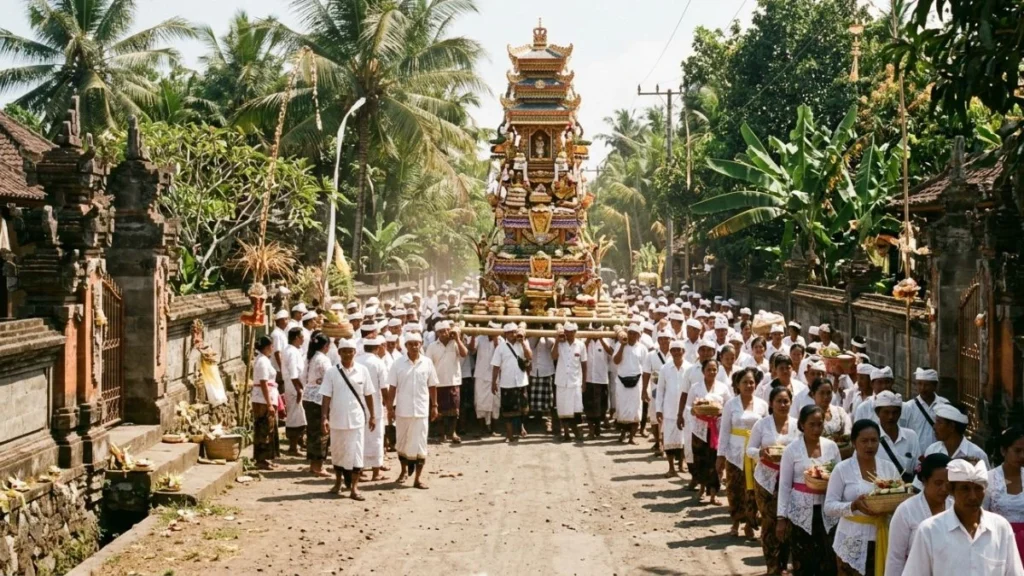
Balinese cremation ceremony photography guide: Photography at a Ngaben is permitted — the procession on public roads, the cremation tower, the general ceremony atmosphere — but with specific limits that most visitors who raise a camera do not know. The line between respectful documentation and intrusion is specific, and crossing it is easy to do without realising.
This balinese cremation ceremony photography guide covers what is appropriate to photograph at a Ngaben, what is not, what the 2025 regulatory framework says about photography at sacred ceremonies, and the practical situations where the right choice is to put the camera away entirely. The cremation ceremony in Bali is not a performance. It is a ritual for the benefit of the deceased’s soul and the family conducting it. Understanding that distinction before raising a camera produces fundamentally different photography — and a fundamentally different experience of the ceremony.
For the full context of what Ngaben is and what happens during the ceremony, the Balinese cremation ceremony guide covers the ritual structure, spiritual logic, and how to attend respectfully. This guide focuses specifically on the photography dimension.
What Changed in 2025: The Regulatory Context
Governor’s Circular Letter SE No. 7/2025 explicitly prohibits inappropriate photography at religious sites and during ceremonies. The circular does not define “inappropriate” with surgical precision — which means the interpretation defaults to community expectation rather than a fixed rulebook. What the regulation establishes is that photography at Balinese ceremonies is not an unconditional right, and that violations can result in being asked to leave and, in serious cases, reported to the tourism police.
In practice, this means the social accountability that previously operated informally — a community member approaching a visitor who was photographing too aggressively and asking them to stop — now has a formal regulatory backing. The direction of travel is toward more, not less, enforcement of respectful conduct at ceremonies.
The Procession: Generally Appropriate to Photograph
The Ngaben procession moves through public roads. When the bade (cremation tower) is being carried through a village lane, with dozens or hundreds of community members in ceremonial dress, gamelan music, and the general public lining the street — this is photographable from a public position.
What works:
- Wide and medium shots from the roadside as the procession passes
- The bade itself — the tower’s scale, decoration, and movement
- The general atmosphere: crowds, offerings, ceremonial dress
- The lembu (animal-shaped coffin) at the cremation site from a public position
What does not work:
- Positioning yourself in front of the procession to get a better shot — you are blocking the ceremony
- Moving into the centre of the procession to photograph from within it
- Photographing individuals in the procession at close range without acknowledgment — these are family members, not performers
- Using continuous burst shooting or aggressive camera movement near the family
The distinction: the procession is a public event on a public road. It is not a staged spectacle for documentation. Treating it as one — moving aggressively for better angles, inserting yourself into the flow for closer shots — is the behaviour the Governor’s Circular addresses.
The Family: The Most Sensitive Subject
Ngaben is a family ceremony. The people present are bereaved — even if the emotional register looks different from Western funeral expectations, the family is performing a profound spiritual obligation for someone they loved. Photographing the family requires specific care:
Do not photograph individuals in obvious grief. The Balinese belief that death is a liberation rather than a loss does not eliminate the emotional weight of the ceremony for family members. A family member in a private moment of emotion is not a subject for documentation.
Do not photograph the body or the immediate funeral preparations. The body before cremation is being prepared in a ritual context. This is the most private and most sacred element of the ceremony.
Do not photograph children in the family without acknowledgment. Children participating in the ceremony — carrying offerings, following the procession — are part of a ritual, not a photographic opportunity.
Ask or acknowledge before photographing identifiable individuals. This applies at every ceremony, not just Ngaben. A gesture toward your camera and a questioning expression, met with a nod, is sufficient. The gesture matters more than its format.
The Cremation Site: Where the Camera Goes Down
The moment the body arrives at the cremation site and the fire ritual begins, photography should stop or become significantly more restrained.
The active fire ritual — the pedanda priest’s prayers, the specific moments of the fire being set, the family’s final prayers — is the innermost part of the ceremony. In Balinese temple spatial terms, this is the jeroan equivalent: the most sacred space of the event.
At this moment, the appropriate position is: camera down, standing quietly at a respectful distance, observing without documenting. Some families are comfortable with distant photography of the fire itself — the general scene, the smoke, the bade or lembu burning. If you are uncertain, the default position is no photography.
The families and community members present will behave as a guide — if people nearby are not raising cameras, that is meaningful information. If community members approach and ask you to stop photographing, stop immediately and without discussion.
Drone Photography: Not Appropriate
Drone use at or near a Ngaben is not appropriate under any circumstances. The Governor’s Circular addresses drones at sacred sites. Beyond the regulatory question, a drone hovering above a cremation ceremony is an intrusion on the space and sound of the ritual — the noise alone is disruptive, and the overhead perspective removes the ceremony from its human scale in a way that is disrespectful regardless of the images produced.
Drone photography in Bali requires a permit under Indonesian civil aviation rules. Drones at religious ceremonies without explicit family permission are a violation of both regulatory and cultural expectations.
What “Respectful Distance” Actually Means
The phrase “respectful distance” appears in almost every Ngaben etiquette guide and is almost never defined specifically. A practical definition:
At the procession: Far enough that you are not physically impeding the movement of participants or being pushed by the crowd around them. The road margin, not the road centre.
At the cremation site: Far enough that you are not standing among the immediate family and ceremonial participants. The outer edge of the gathered crowd, not the inner ring around the fire.
For photographs: Far enough that you are using a zoom lens to document rather than a wide lens that requires physical proximity to the subject.
The test: if moving to get your shot requires you to push, step around, or physically manoeuvre through family members or ceremonial participants, the shot is not worth taking.
The Photographs That Are Actually Worth Taking
The Ngaben photographs that have lasting quality are almost never the ones taken aggressively at close range. They are:
The bade at scale — a wide shot that captures the tower’s height relative to the street and the people carrying it. This requires distance, not proximity.
The ceremony atmosphere — the crowd, the gamelan musicians, the smoke, the offerings arranged at the road’s edge. These are available from a public position without intruding on the family.
Incidental moments — an old woman placing a final offering, children watching the procession from a wall, a priest’s hands during prayer. These require patience and a long lens, not physical proximity.
The aftermath — after the fire, the smoke, the returning community. The quieter moments after the peak of the ceremony are often more photographically interesting and less contested.
The photographs that look most impressive in the moment — tight close-ups of the family, photographs from inside the procession, dramatic fire shots from the cremation site — are the ones most likely to have been taken at the cost of someone’s private experience of a significant ritual.
The Practical Checklist Before You Raise Your Camera
At the procession: ✓ Am I on the road margin, not in the centre of the procession? ✓ Am I using distance and zoom rather than physical proximity for close shots? ✓ Am I avoiding photographing individuals in private moments of grief? ✓ Have I acknowledged family members before photographing them at close range?
At the cremation site: ✓ Has the active fire ritual begun? If yes — camera down. ✓ Am I standing at the outer edge of the crowd, not among the immediate family? ✓ Are other people nearby raising cameras? If not — that is meaningful. ✓ Has anyone indicated they prefer no photography? If yes — camera stays down.
General: ✓ Is a community member looking at me in a way that suggests discomfort? If yes — stop and reassess. ✓ Would I photograph this moment at a funeral in my own country? If not — do not photograph it here.
Elias had attended three Ngaben ceremonies in Ubud before he stopped bringing his DSLR to the fourth. The first three had produced photographs he was proud of technically. The fourth — without a camera, sarong on, standing quietly at the edge of the crowd for two hours — produced nothing he could show anyone. He said it was the most complete experience of the four, and that the absence of the camera had removed the mediation between him and what he was watching. He could not explain exactly what changed. He said the ceremony had felt like something that was happening rather than something he was documenting.
FAQ
Is photography allowed at a Balinese cremation ceremony?
Yes, with specific limits. Photography of the procession from a public road position, the cremation tower, and the general ceremony atmosphere is generally appropriate from a respectful distance. Photography of the active fire ritual at close range, the body before cremation, identifiable family members in private moments, and any use of drones is not appropriate. Governor’s Circular SE No. 7/2025 formally addresses photography at sacred ceremonies — violations can result in being asked to leave or reported to the tourism police.
Can I use a drone at a Ngaben ceremony in Bali?
No. Drone use at or near a Balinese cremation ceremony is not appropriate and is addressed by the 2025 Governor’s Circular on visitor conduct at sacred sites. Beyond the regulatory issue, drone noise is disruptive to the ceremony’s acoustic environment. Drone photography in Bali requires a permit under Indonesian civil aviation law. Drones at religious ceremonies without explicit family permission violate both regulatory and cultural expectations.
What should I do if a family member asks me to stop photographing at a Ngaben?
Stop immediately, without discussion or negotiation. Lower or put away your camera and acknowledge the request with a nod. Do not attempt to justify the photography or explain your intentions. The family’s preference for their ceremony takes precedence over any visitor’s photographic interest.
What is the most respectful photography position at a Ngaben procession?
The road margin — not the road centre. Far enough from the procession that you are not physically impeding movement or standing among participants. Close enough to observe but using zoom rather than proximity for detailed shots. Observe how other people nearby are behaving and follow the more conservative standard of those present.
Should I photograph a Ngaben if I was not invited by the family?
Village and community Ngaben ceremonies on public roads are observable by visitors who happen to be present. Photography of the public elements — the procession, the general atmosphere — is acceptable from a respectful public position. Photography of the private elements — the family’s immediate ceremony, the body, the fire ritual — is not appropriate regardless of whether you were invited. If you are uncertain about any specific moment, the default is to not photograph it.