
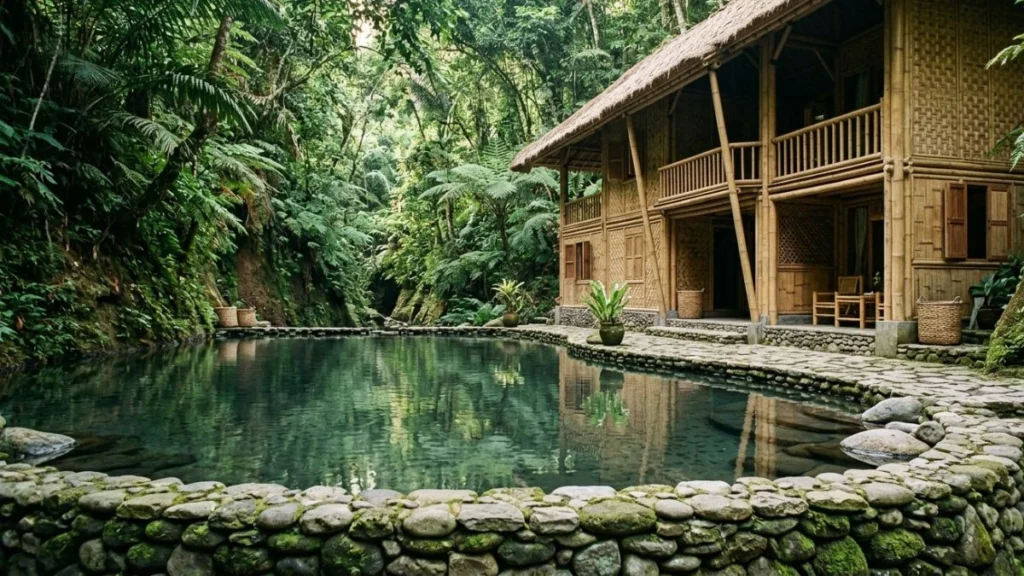
Best eco resort Bali Ubud: The Ubud area has the highest density of genuine eco accommodation in Bali — partly because the cultural and environmental values of the region attract properties that mean it, and partly because the proximity to Bali’s most active conservation and wellness communities creates accountability that makes greenwashing harder to sustain. This guide covers the properties worth booking and what distinguishes them from the ones that use the same language with less to show for it.
Finding the best eco resort Bali Ubud requires the same due diligence framework that applies to eco accommodation anywhere in Bali: specific, verifiable claims over general language, documented sustainability practice over marketing assertions, and a clear understanding of what each property actually delivers at each price point. The Ubud area has more genuinely sustainable accommodation than any other part of Bali — it also has more properties using sustainability as a branding strategy without the infrastructure to back it.
The eco stays Bali honest guide establishes the framework for assessing any eco property — what to ask, what to verify, and what the markers of genuine practice look like. This guide applies that framework specifically to the Ubud area properties worth knowing about in 2026, from the budget tier through to the luxury end.
What Makes the Ubud Area Particularly Strong for Eco Accommodation
Three factors combine to make the Ubud area Bali’s strongest eco accommodation cluster:
Ayung River gorge and surrounding forest. The topography around Ubud — river gorges, jungle ridges, and rice terrace valleys — creates natural settings where low-impact architecture and ecological integration are structurally possible in ways that flat coastal areas cannot replicate. Properties like Bambu Indah and the Capella tented resort use this topography as the foundation of their environmental practice, not just their aesthetics.
Green School Bali’s influence. Green School, founded in 2008 by John and Cynthia Hardy on the banks of the Ayung River, has created a gravitational effect for sustainability-oriented businesses in the Ubud area. Bambu Indah, founded by the same family, is the most direct expression of this influence, but the broader community of Green School families, alumni, and affiliated businesses has raised the bar for what sustainable practice means locally.
Accountability through community. Ubud has a large population of long-term residents — expats, wellness practitioners, environmental advocates — who scrutinise sustainability claims and produce the word-of-mouth accountability that makes greenwashing more costly here than in south Bali’s resort corridor.
Bambu Indah — The Benchmark
Bambu Indah is the most cited eco property in the Ubud area and the one against which others are measured. It sits on the Ayung River gorge in Sayan, 4km west of central Ubud, and was built by John and Cynthia Hardy using a design philosophy that treats environmental integration as the primary architectural driver rather than an add-on.
The accommodation: Restored antique Javanese joglo houses, bamboo villas, and open-air tree houses set on the gorge edge, each designed as a distinct structure rather than replicated room type. The Tree House sits between two mature banyan trees. The crescent-shaped bamboo house follows the river contour. No two units are identical.
The sustainability practice:
- Spring-fed natural swimming pools — no chlorine, no groundwater pumping
- On-site organic garden supplying the kitchen
- Rice paddy on the property producing Bambu Indah’s own rice
- Waste composting system
- All-natural, chemical-free bath products
- Local craft and material sourcing throughout the construction and operation
The kitchen: The Warung at Bambu Indah sources ingredients primarily from the property’s own farm and local Balinese suppliers. The menu changes based on what is available. Day passes for the pools and restaurant are available — worth knowing if you want the experience without the overnight rate.
The honest note: Bambu Indah is not cheap. Rates start around USD 250–350 per night for the lower-end structures and reach USD 500–800 for the signature bamboo villas. It is also not the most polished property in terms of service consistency — the environmental ethos is sometimes prioritised over the hotel infrastructure expectations that guests at this price point bring from other properties. Guests who understand this in advance consistently describe their stay as exceptional. Guests who arrive expecting luxury hotel service sometimes find it falls short.
Who it suits: Travellers who want the most complete expression of sustainable architecture and ecological operation in Ubud, and who value the environmental and design achievement over conventional luxury polish.
Capella Ubud — Glamping With Genuine Credentials
Capella Ubud occupies a different tier from Bambu Indah — it is a five-star luxury resort that happens to use tented accommodation rather than permanent structures. The tents are large, architect-designed structures with private salt water pools, hardwood decks, and full climate control. The resort was named the No. 1 Best Hotel Brand in the World by Travel + Leisure.
The sustainability practice:
- Tented structures rather than concrete buildings — lower permanent footprint on the jungle hillside
- Rainforest location preserved rather than cleared for development
- Daily cultural programming connecting guests to Balinese traditions, ceremonies, and craft
- Award-winning al fresco restaurants with local ingredient sourcing
The honest note: Capella is the most expensive property on this list by a significant margin — rates typically USD 600–1,200+ per night. The sustainability practice is genuine but the primary product is luxury glamping rather than environmental immersion. Guests who arrive wanting the most luxurious experience available in the Ubud jungle will not be disappointed. Guests who arrive wanting the most immersive eco experience should look at Bambu Indah or Sarinbuana instead.
Who it suits: Couples and honeymooners who want luxury jungle accommodation with legitimate eco credentials and world-class service.
Sarinbuana Eco Lodge — The Most Complete Eco Operation at Mid-Range
Sarinbuana sits on the slopes of Mount Batukaru in Tabanan regency — technically outside the Ubud administrative area but within the broader Ubud-area slow travel circuit and consistently grouped with Ubud eco accommodation by visitors doing the comparative research. It is included here because it represents the strongest eco operation available at a genuinely mid-range price.
The accommodation: Six bungalows in a permaculture garden on the mountain slope at approximately 800 metres elevation. The temperature is noticeably cooler than Ubud itself. Views across the jungle to the coast on clear days.
The sustainability practice:
- Permaculture garden supplying almost all food to the kitchen
- Rainforest trekking led by local guides whose families live in the adjacent village
- Local hiring from the surrounding Wongaya Gede village community
- Closed-loop composting returning organic waste to the garden
- No single-use plastics throughout the operation
The rate: USD 80–120 per night including breakfast — significantly more accessible than Bambu Indah or Capella while delivering more comprehensive eco practice than either in terms of food system integration and community employment.
Who it suits: Eco-conscious travellers on a mid-range budget who want the most complete sustainable operation available in the Ubud-area circuit, and who are comfortable with a slightly longer drive from central Ubud’s restaurant and cultural scene.
Swasti Eco Cottages — Best Budget Eco Option Near Ubud
Swasti is on Jalan Bisma, one of the lanes that runs north from central Ubud with valley views — within walking distance of the town centre. The property has been operating with a genuine eco commitment for over a decade: an organic garden, solar water heating, local material construction, and a kitchen that sources from local farms.
The accommodation: Simple cottages in a garden setting, no pool, AC available, rice field and valley views from the grounds. Not the design-forward aesthetic of Bambu Indah — this is comfortable, functional eco accommodation rather than architectural statement.
The rate: USD 50–90 per night — the most accessible price point among eco-certified properties within walking distance of central Ubud.
Who it suits: Budget to mid-range eco-conscious travellers who want genuine sustainability practice in a central Ubud location.
Floating Leaf Eco Retreat — For Wellness + Eco Combined
Floating Leaf sits in Berawa, Canggu — again, not strictly Ubud but within the radius that visitors comparing Ubud-area eco options typically consider. It is included because it occupies a specific niche: eco accommodation specifically designed around Balinese wellness practices.
The sustainability practice: Reclaimed wood and natural material construction, organic farm-to-table food, solar energy supplementation, zero single-use plastic policy, and a programme structure centred on traditional Balinese healing, yoga, and meditation.
Who it suits: Travellers specifically seeking a wellness retreat with genuine eco credentials rather than a resort that adds wellness programming to a conventional operation.
The Comparison
| Property | Location | Rate (USD/night) | AC | Eco Standout Feature |
|---|---|---|---|---|
| Bambu Indah | Sayan, Ubud | USD 250–800 | Some units | Architecture + natural pools + farm |
| Capella Ubud | Ubud jungle | USD 600–1,200+ | Yes | Tented luxury, jungle preservation |
| Sarinbuana | Mount Batukaru | USD 80–120 | No | Permaculture food system, local hiring |
| Swasti Eco Cottages | Jalan Bisma, Ubud | USD 50–90 | Yes | Central location, organic garden, accessible price |
| Floating Leaf | Berawa, Canggu | USD 150–300 | Yes | Wellness + eco combined |
The Honest Question to Ask Before Booking Any of These
Beyond the eco credentials, one question determines the right property from this list: what is the primary reason you are coming to Ubud?
If the answer is the natural environment and sustainable architecture, Bambu Indah. If the answer is luxury and the most unique accommodation experience available, Capella. If the answer is a working eco operation at a price that allows a longer stay, Sarinbuana. If the answer is central Ubud access with genuine eco practice, Swasti.
The eco credentials of all five properties are real. The differences are in design orientation, price, location, and what kind of experience each one is actually optimised to deliver.
Marta had compared twelve eco properties in Ubud before deciding on Bambu Indah, primarily because the natural swimming pools appeared in every positive review. She arrived and found that the pools, the rice paddy visible from the breakfast table, the hand-built bamboo structure of her room, and the absence of anything that felt like a hotel — no lobby, no reception counter, no identical corridors — produced a sustained sense of being somewhere specific rather than somewhere designed to resemble somewhere specific. She stayed four nights and said on departure that she had not once felt like a guest at a property. She had felt like a visitor in a place.
FAQ
What is the best eco resort near Ubud Bali in 2026?
Bambu Indah in Sayan is the most comprehensively sustainable eco resort in the Ubud area — natural spring-fed pools, on-site organic farm, antique Javanese and bamboo architecture, and an ecological operation built from the ground up rather than applied as branding. For luxury glamping, Capella Ubud delivers world-class service in a tented jungle setting. For the most complete eco operation at mid-range prices, Sarinbuana Eco Lodge on Mount Batukaru is the strongest option within the Ubud-area circuit.
Is Bambu Indah worth the price?
For travellers who value sustainable architecture, ecological integration, and a genuinely distinct property design over conventional luxury hotel service, yes. The rates (USD 250–800 per night) reflect a property that has invested significantly in sustainable construction and operation rather than in service infrastructure. Guests who arrive expecting the service consistency of a conventional luxury hotel sometimes find it falls short; guests who arrive understanding the property’s priorities consistently rate it among the best stays of their Bali trip.
Are there budget eco resorts near Ubud?
Swasti Eco Cottages on Jalan Bisma is the most accessible eco-certified property within walking distance of central Ubud at USD 50–90 per night. Sarinbuana Eco Lodge on Mount Batukaru operates at USD 80–120 per night with a more complete eco operation than most properties at that price. Both represent genuine sustainability practice rather than eco branding.
What makes an eco resort in Ubud genuinely sustainable?
The markers that distinguish genuine eco practice in Ubud accommodation: a working organic garden or farm supplying the kitchen, natural water systems (spring-fed pools or rainwater collection) rather than groundwater pumping, local material and craft construction, documented local hiring, and specific answers to specific questions about waste management and energy use. Properties that can answer these questions specifically rather than generally are more credible than those that cannot.
How far is Bambu Indah from central Ubud?
Approximately 4km west of central Ubud in Sayan, reached by the road that passes over the Campuhan Bridge and through Penestanan. By scooter, the drive takes about 10 minutes. On foot, the route involves the Campuhan Ridge Walk path and takes approximately 40–50 minutes. The Bambu Indah shuttle service runs between the property and central Ubud at scheduled times.