
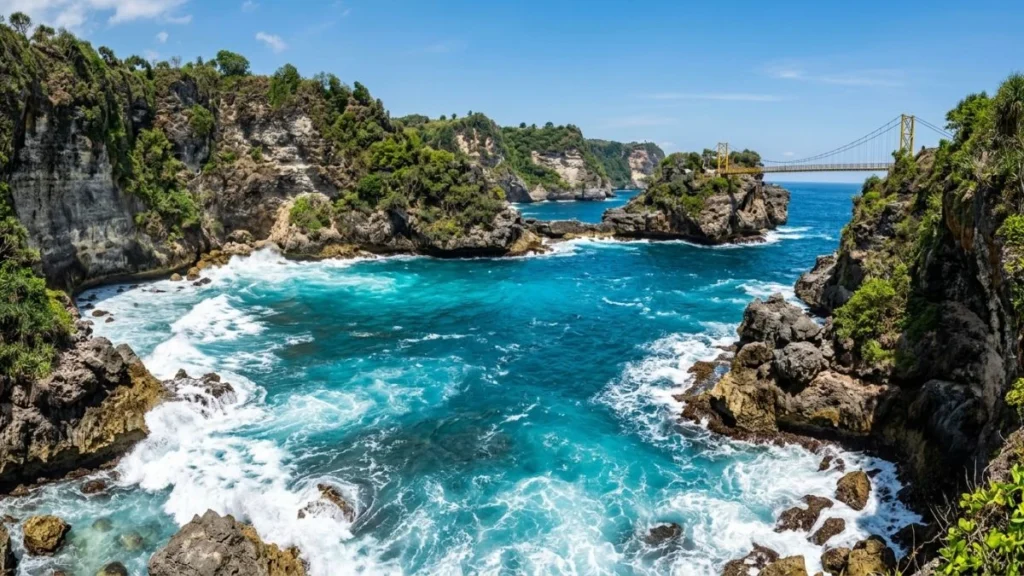
Nusa Ceningan is the smallest of the three Nusa islands off Bali’s southeast coast, and getting there is part of what keeps it quieter than its neighbours — there’s no direct boat or bridge from mainland Bali at all. You reach it in two steps: a fast boat from Sanur to Nusa Lembongan, then a short scooter or walk across the bright yellow suspension bridge into Ceningan itself. That extra step filters out a meaningful chunk of day-trippers, and it’s a big part of why Ceningan still feels calmer than Lembongan or Nusa Penida.
This guide covers what Nusa Ceningan actually offers once you’re there — including a genuinely important safety note about its most photographed spot — plus how to get there, get around, and whether it’s worth a standalone visit or better paired with Lembongan.
Quick Facts
- How to get there: fast boat from Sanur Harbour to Nusa Lembongan (25–35 minutes), then cross the Yellow Bridge by scooter or foot (about 2 minutes)
- Distance from Ubud: roughly 23 km direct, but factor in the drive to Sanur plus the boat crossing — plan for 2 to 2.5 hours total door to door
- Scooter rental: around IDR 70,000–120,000 per day, rented on Lembongan before crossing
- Recommended time: one full day covers the highlights; one to two nights if you want the island at its own pace
- Cash situation: carry cash — ATMs are scarce and most places don’t take cards
The Yellow Bridge: An Attraction in Its Own Right
The bridge connecting Lembongan and Nusa Ceningan has become an attraction on its own — narrow, painted bright yellow, built for scooters and pedestrians rather than cars, with startlingly clear turquoise water visible in the channel below. It’s genuinely worth crossing slowly rather than just passing over it as a formality; early morning light before it gets flat is when it photographs best. Worth knowing: the bridge partially collapsed in bad weather in 2016, with several fatalities, and has since been fully rebuilt — a new, wider 400-metre bridge for cars and logistics began construction in 2026, though the original yellow bridge remains open for scooters and pedestrians in the meantime.
Blue Lagoon: Look, Don’t Swim
Blue Lagoon is Nusa Ceningan’s signature sight and the reason most people make the trip — a cove of genuinely striking, almost artificially blue water framed by limestone cliffs on the island’s western side. Here’s the part that matters more than the photo: this is a viewpoint, not a swimming spot. The currents inside the lagoon are dangerously strong, waves crash hard against the cliffs, and the old access ladder down to the water has been removed. Multiple recent visitor accounts describe underestimating the water here and getting caught in conditions stronger than they expected — treat the warnings seriously rather than as overcautious signage.
If you want to actually get in the water, that’s what Mahana Point is for, a short drive further along the coast.
Mahana Point: Where the Actual Cliff Jumping Happens
Mahana Point, on Ceningan’s southwest tip, is the island’s managed cliff-jumping spot — platforms at roughly 5 and 14 metres, staff on-site monitoring conditions, and a proper ladder for climbing back out, unlike the unsupervised jump points people sometimes attempt near Blue Lagoon itself. Jump fees run around IDR 50,000. The one rule that matters: only jump at high tide, never at low tide, and check with staff before you commit — conditions here change quickly, and the water depth at low tide isn’t enough to jump into safely.
There’s a restaurant and bar right on the cliffs, so it’s a genuinely pleasant place to spend a few hours even if jumping isn’t your thing — order a coconut, watch the tide, and decide later.
Seaweed Farming: Nusa Ceningan’s Actual Industry
Away from the cliff photo spots, the channel between Lembongan and Ceningan is lined with seaweed farms, and it’s worth understanding that this — not tourism — is still the primary industry for many local families here. Farmers head out onto the water around sunrise and just before sunset to tend their crops, and watching this from the road or the water is one of the quieter, more grounding things to do on the island. Keep a respectful distance if you’re photographing — this is someone’s working day, not a staged scene.
Getting Around Nusa Ceningan
The island is small enough to walk across in under two hours, but hilly enough that a scooter makes the day considerably easier. Roads are narrow, mostly well-surfaced, and largely free of cars — rent a scooter on Lembongan before crossing the bridge if you’re visiting for the day, or arrange one through your accommodation if you’re staying overnight on Ceningan itself. There are no taxis in the conventional sense here, so sort your transport before you arrive rather than assuming you’ll figure it out on the ground.
Nusa Ceningan vs. Lembongan vs. Nusa Penida
If you’re trying to decide how much time to allocate across the three islands: Ceningan is the smallest and quietest of the trio, Lembongan is the better all-rounder if you want a multi-day stay with more restaurants and infrastructure, and Nusa Penida is the most dramatic in terms of scenery, with the bigger cliffside viewpoints most people picture when they imagine “Nusa Islands.” The ideal trip genuinely uses all three together, with Ceningan as a half-day or full-day add-on from a Lembongan base rather than a separate island crossing.
FAQ
Can you get to Nusa Ceningan directly from Bali?
No. There’s no direct boat or bridge from mainland Bali. You take a fast boat from Sanur to Nusa Lembongan first, then cross the Yellow Bridge into Ceningan by scooter or on foot.
Can you swim in the Blue Lagoon on Nusa Ceningan?
No. The currents are dangerously strong and the access ladder has been removed. Blue Lagoon is a viewpoint for photos — Mahana Point nearby is the managed, safer spot for actually getting into the water.
How much does cliff jumping cost at Mahana Point?
Around IDR 50,000 per jump. Only jump at high tide, and always check current conditions with staff on-site before committing.
How long do you need to visit Nusa Ceningan?
One full day covers the main highlights comfortably. One to two nights lets you experience the island at its own slower pace, particularly if you want to see the seaweed farmers at work around sunrise or sunset.
Is Nusa Ceningan worth visiting separately from Nusa Lembongan?
Not really as a standalone trip — the two islands are a two-minute bridge crossing apart, and most visitors base themselves on Lembongan and treat Ceningan as a half-day or full-day add-on rather than a separate destination.
Final Thought
Nusa Ceningan rewards the extra step it takes to get there — a two-minute bridge crossing keeps it quieter than its more accessible neighbours, and the trade-off is worth it if slow, small, and genuinely local still matters to you more than convenience. For the fuller picture of the Nusa Islands, our Nusa Penida vs Nusa Lembongan day trip guide covers how to plan the rest of the trip, and if beaches are the priority, our best beaches in Bali for slow travellers guide rounds out the options beyond the main island.