
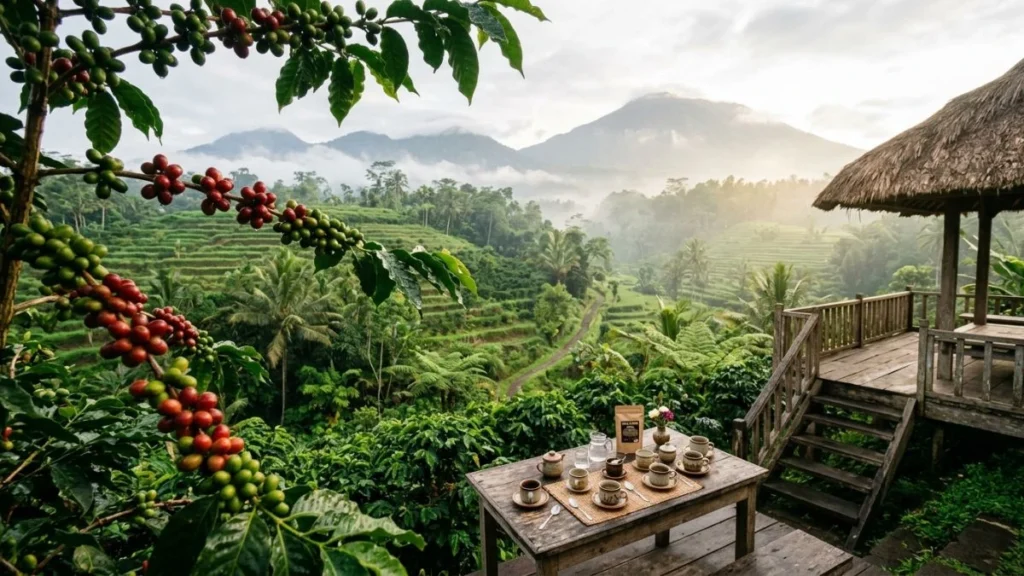
Nearly every road trip toward Tegalalang, Tampaksiring, or Kintamani passes at least one coffee plantation offering free tastings and a cup of kopi luwak Bali for around IDR 50,000. It’s an easy, scenic stop, and most tour drivers treat it as a default addition to the itinerary. What almost nobody tells you beforehand is what’s actually happening at the civet enclosure you’ll walk past on the way to the tasting terrace.
This isn’t a “skip it entirely, it’s all bad” guide, and it isn’t a “don’t worry about it” one either. It’s the honest middle: what kopi luwak Bali actually involves at most tourist-trail plantations, why the ethics are more complicated than a single Instagram photo suggests, and where to go if you want the coffee experience without the caged animal.
Quick Facts
- What it is: coffee beans that have passed through a civet’s digestive system, prized for a smoother, less bitter flavor
- Where most tourists encounter it: the Tegalalang–Tampaksiring–Kintamani plantation belt north of Ubud
- Typical cost: free tasting tray of 10–14 coffees/teas, kopi luwak itself around IDR 50,000 per cup
- The honest issue: the majority of kopi luwak on Bali’s tourist circuit comes from caged, force-fed civets, not wild-foraging ones
- Ethical alternative: Eco Bike Coffee, up in the Kintamani highlands, runs coffee tours with zero civet cages
What Actually Happens at Most Plantation Stops
The plantations lining the road between Ubud and Kintamani follow a near-identical format: free entry, a short guided walk through coffee, cacao, and spice plants, a stop at civet enclosures where you can watch (and sometimes feed) the animals, then a free tasting tray of flavored coffees and teas before you’re led past a gift shop on the way out. It’s genuinely pleasant as an experience — the setting is usually a nice jungle valley, the guides are friendly, and the free tastings are a low-pressure way to sample Balinese coffee culture.
The part that changes how most people feel about it is the civets themselves. Documented reporting on kopi luwak Bali, going back to a widely cited 2013 BBC investigation and echoed consistently in visitor reviews since, describes the animals at these display plantations kept in cages barely larger than their own bodies, fed coffee cherries indiscriminately regardless of ripeness, and showing visible signs of stress. Civets are naturally shy, solitary, nocturnal animals — being caged near other civets and constantly handled by tourists runs against nearly everything about how they’d normally live.
This matters ethically, and it also matters practically: the selective foraging that makes kopi luwak distinctive in the first place — wild civets choosing only the ripest cherries — disappears entirely under caged, force-fed conditions. Several plantation owners and reviewers are candid about this trade-off once asked directly: the civets are largely there for display and photos, not because what’s in your cup that day genuinely passed through them.
Is Any Kopi Luwak Bali Actually Wild-Sourced?
Wild civets genuinely do live and forage in the Kintamani highlands, and wild-processed kopi luwak is a real thing — it’s just very hard to verify on the spot at a tourist plantation. Farmers in the region have historically treated civets as pests that raid coffee crops rather than livestock to farm, which complicates the idea of a large-scale “wild” supply chain feeding tourist-facing cafes. If a plantation can describe specifics — where on the property civets forage, how beans are collected and cleaned — that’s a better sign than a vague “from the forest nearby.” Visible caging alongside vague sourcing answers is the combination worth treating as a red flag.
If genuinely wild-sourced kopi luwak matters to you, the more reliable route is buying from a verified supplier with documented traceability before you travel, rather than trusting provenance at a roadside kiosk where there’s no way to confirm what you’re being told.
The Alternative: Skip the Cup, Not the Coffee Culture
You don’t have to skip Balinese coffee entirely to avoid the caged-civet question. Up in the Kintamani highlands, Eco Bike Coffee runs a plantation experience built entirely around coffee growing, roasting, and tasting — with no kopi luwak offered at all, and no civet enclosures on-site. It comes with the same highland views over Mount Batur, Mount Abang, and Lake Batur that draw people to the tourist-trail plantations in the first place, plus e-bike tours through the surrounding countryside and the option to stay overnight in one of their cabins.
If you do stop at one of the more common tourist plantations along the Tegalalang or Tampaksiring route, the free tasting tray itself is genuinely worth trying regardless of what you decide about the luwak cup — just know you can decline the civet coffee specifically without missing the rest of the experience, and no reputable plantation will push hard once you say no.
What to Do Instead If You’d Rather Skip Coffee Plantations Entirely
If the whole format doesn’t appeal, Bali’s highland scenery is available without a plantation stop at all. The Jatiluwih rice terraces, Sidemen Valley, and Ubud’s Campuhan Ridge Walk all offer the same green, elevated views that plantation terraces are often selling alongside the coffee — without a civet enclosure anywhere on the route.
FAQ
Is kopi luwak in Bali always unethical?
Not in every single case, but the majority of what’s served at tourist-trail plantations comes from caged, force-fed civets rather than wild-foraging ones. Genuinely wild-sourced kopi luwak exists but is difficult to verify on-site.
Can I visit a coffee plantation in Bali without seeing caged civets?
Yes. Eco Bike Coffee in the Kintamani highlands runs coffee tours and tastings with no kopi luwak or civet enclosures at all, and there are other plantations that will let you skip the civet section if you ask.
How much does kopi luwak cost in Bali?
Around IDR 50,000 per cup at most tourist plantations, usually offered as an optional add-on after a free tasting tray of other coffees and teas.
Do I have to buy kopi luwak if I visit a plantation?
No. Most plantations offer a free tasting tray of regular coffees and flavored drinks, and you can decline the civet coffee specifically without any pressure to reconsider.
Are civets endangered?
Common palm civets aren’t broadly endangered, though certain related species face “vulnerable” status on conservation lists, and welfare concerns around caging apply regardless of a species’ overall population numbers.
Final Thought
Kopi luwak Bali is one of those experiences where the marketing and the reality genuinely diverge, and knowing that before you go changes what you choose to support once you’re standing in front of the cages. Try the free tasting tray, skip the cup if it doesn’t sit right with you, or head to a farm that’s cut the civet out of the equation entirely. For more on the highland scenery this whole plantation belt is built around, our guides to Kintamani and Bali water temples beyond Ubud cover what else fits into the same day.