
Best beaches in Bali for slow travellers: The beaches that reward slow travel in Bali are almost all east of Sanur or north of Canggu. They are not the ones on every itinerary. They are the ones where the fishing boats are still the primary users of the beach in the morning, the ones where you can spend two hours in the water without sharing the space with a hundred other people, and the ones where the surrounding area gives you something to explore beyond the sand itself.
The best beaches in Bali for slow travellers are a different list from the best beaches in Bali overall — not because the famous beaches are not beautiful, but because slow travel requires a beach that integrates with the surrounding area rather than being the destination in itself. Kuta and Seminyak are exceptional beach strips for what they are. What they are is not slow travel.
This guide covers the beaches that work for visitors spending multiple days or weeks in the same area — where the beach is part of a larger landscape of village life, local fishing culture, and the kind of unhurried daily rhythm that slow travel is specifically oriented toward experiencing.
For the areas these beaches sit within, the best areas to stay in Bali for slow travel covers the full accommodation and character picture. This guide focuses specifically on the beach experience within those areas.
What Makes a Beach Work for Slow Travel
A beach for slow travel has three characteristics that the main tourist beach strips do not:
Low commercial density on the beach itself. Fewer vendors, fewer sun lounger operations, fewer organised activities competing for your attention. The beach is space to be in, not a service delivery environment.
A surrounding area worth spending time in. The beach is a component of the place, not the entire reason for being there. Amed has the snorkeling and the fishing village. Pasir Putih has the forest walk. Lovina has the dolphin boats and the North Bali character. Each beach connects to something larger.
Practical accessibility without a tour. Slow travel beaches are reachable independently by scooter or on foot from accommodation within the area. They do not require a day-trip booking or a guided transfer.
Jemeluk Bay, Amed — The Shore-Entry Snorkeling Benchmark
Jemeluk is the beach in Amed’s string of bays that has the most to offer beyond the sand itself. The coral garden starts where the sand ends — in 2–3 metres of water — and extends outward in a gradual descent to 15–18 metres. The marine life is consistent: varied reef fish, occasional turtles in the shallower sections, and enough coral density to reward repeated visits at different times of day. The light in the morning is different from the afternoon. The water surface before 8am is different from the surface when the day heats up.
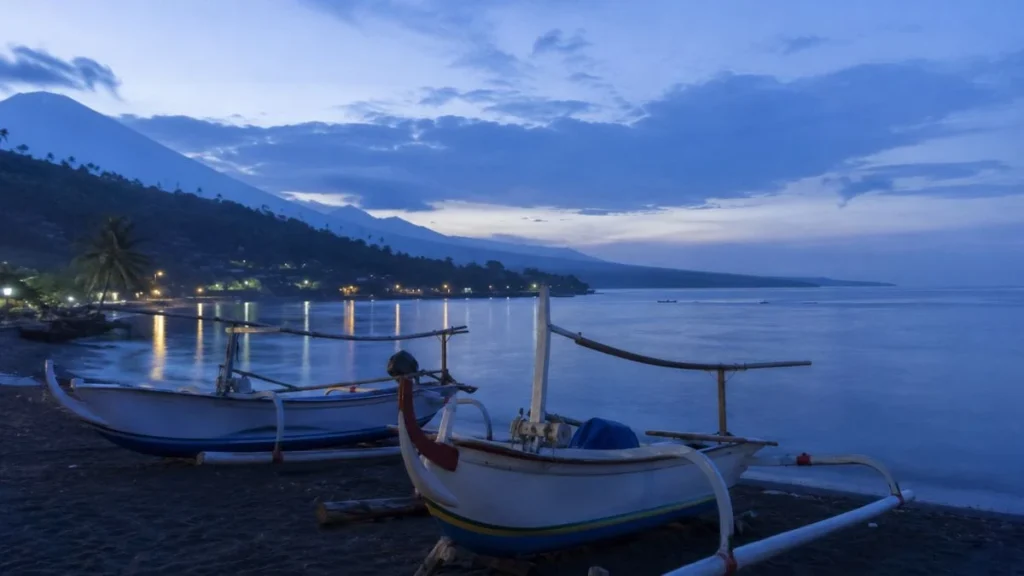
The beach itself is black volcanic sand — the same dark sand characteristic of all of Amed’s bays. Jukung outrigger fishing boats are pulled up on the shore each morning before the fishermen head out and each evening when they return. The village above the beach is where the accommodation, warungs, and daily life are concentrated. The beach and the village are not separated by a commercial strip — they are the same space.
A slow traveller spending four or five nights in Amed will find that Jemeluk at 6:30am on day one and Jemeluk at 6:30am on day four are genuinely different experiences — the familiarity accumulates, the specific reef features become recognisable, and the whole experience changes from exploration to something closer to routine. That accumulation is the point.
Best for: Snorkeling, morning swims, watching the fishing boats. Entrance fee: None. Best time of day: Before 9am or after 4pm.
Pasir Putih (Virgin Beach), East Bali — The White Sand Outlier
Pasir Putih — “White Sand” in Indonesian — is the one white sand beach in East Bali, which makes it immediately distinctive in a coastal area dominated by black volcanic sand and stone. It sits in a small bay south of Candidasa, reached by a 10–15 minute dirt track through coconut palm forest from the road. The forest walk itself is worth noting — it is one of the few beach approaches in Bali that involves genuine natural cover rather than a car park.
The beach is a gentle curve of white sand backed by coconut palms with no commercial development of note. A handful of small food and drink operations sit at the back of the beach. There is no beach club infrastructure, no sun lounger operation, and no vendor density beyond a reasonable level.
The water is calmer than most south Bali beaches — the bay’s eastern orientation shelters it from the southwest swells that make south Bali’s surf beaches unsuitable for swimming. Swimming and floating here are genuinely pleasant without the reef concerns that affect snorkeling beaches.
Best for: Relaxed swimming, day trips from Candidasa or Sidemen, the approach walk. Entrance fee: IDR 15,000 per person, plus parking. Best time of day: Morning. By midday the beach receives day-trippers from Candidasa; before 10am it is significantly quieter.
Lovina, North Bali — Long, Empty, and Unhurried
Lovina is the collective name for a stretch of small villages along North Bali’s coast — Kalibukbuk is the most developed section; the beaches run several kilometres in both directions from it. The beach itself is black volcanic sand, fine-grained, with calm water — the north coast is sheltered from the south’s swells and lacks the surf energy that characterises south and west Bali’s coast.
What Lovina offers is length and emptiness. Even in high season, stretching 200 metres east or west of the main village puts you on stretches of beach with minimal other visitors. The morning atmosphere — fishing boats departing and returning, black sand in the early light, the silhouette of the north coast mountains behind — is genuinely peaceful in a way that south Bali’s beach corridor cannot replicate.
The dolphin watching boats are Lovina’s primary tourism draw. They depart before dawn, reach the dolphin grounds offshore, and return by 8am. The boats are numerous and the experience is conducted at pace — not slow travel in itself. But the beach before and after the boats return, when the tourism activity quiets and the local fishing day gets underway, is the version of Lovina that slow travellers come for.
Best for: Long walks, empty stretches, morning atmosphere. Entrance fee: None. Best time of day: Before 8am and after 4pm.
Medewi, West Bali — The Surf Beach That Has Kept Its Character
Medewi is a surf beach on Bali’s west coast, approximately 1.5 hours from Seminyak. The wave is a long, slow left-hander — one of the best beginner-to-intermediate surf waves in Bali for those who want a manageable ride rather than the power of Uluwatu. The beach itself is black pebble and coarse sand rather than fine volcanic sand — not ideal for lying on, excellent for the low-impact walking the shoreline requires.
What keeps Medewi in this list is character preservation. The fishing village behind the beach has survived tourism without the level of commercial transformation that has altered most surf beach communities in south Bali. The palm-studded coastline running north and south of the break, the rice paddies visible inland, and the general absence of beach club infrastructure make Medewi feel like a beach with a past that is still legible.
For surfers, the wave is the primary draw. For non-surfers, the appeal is the surrounding area and the North Bali coast road that connects Medewi to Tanah Lot (45 minutes south) and Negara (30 minutes north) — a coastal circuit that rewards a full day of slow driving.
Best for: Beginner surf, coastal character, the west Bali road circuit. Entrance fee: Small parking fee. Best time of day: Morning for surf; any time for walking.
Bingin Beach, Bukit Peninsula — The Cliff Cove That Requires Effort
Bingin is one of several small beaches on the Bukit Peninsula’s western face — reached by descending a steep concrete staircase from the cliff above, which takes approximately 15 minutes each way. The beach is a narrow arc of sand between the base of the limestone cliff and the Indian Ocean, with a specific left-hand reef break that draws serious surfers and a cluster of simple cliff-side bungalows that draw long-stay visitors who want the most dramatic coastal setting available in south Bali without the Seminyak price point.
The surf at Bingin is not for beginners. The reef is shallow and the wave is powerful. What Bingin offers to non-surfers is the physical character of the location — the cliff walls, the rock pools exposed at low tide, the sound of the ocean at full volume in a contained space — and the relative effort required to reach it, which filters out the casual visitor demographic that makes Kuta and Seminyak’s beaches crowded.
Long-stay visitors in the cliff-side bungalows describe the daily routine of descent and ascent as part of the experience rather than an inconvenience. The physical relationship with the landscape that the staircase imposes is something Seminyak cannot offer regardless of the view.
Best for: Surf watching, tide pools, dramatic cliffs, long-stay seclusion. Entrance fee: None, but parking fee at the top. Best time of day: Low tide for rock pool access; morning for clearest water.
Sanur Beach — The Most Overlooked Calm Beach Near Ubud
Sanur does not have the dramatic quality of Bingin, the snorkeling of Jemeluk, or the emptiness of Lovina. What it has is a 4km beachfront promenade with calm, swimmable water, consistent morning kite-surfing activity, a functioning local community behind the beachfront, and a pace that is genuinely different from south Bali’s surf and beach-club coast.
The water at Sanur is protected by an offshore reef that keeps it consistently calm — swimmable for anyone at any time of year without the undertow concerns of Kuta or the swell-exposure of Seminyak. The morning market that operates on the Bypass road behind the beach before 8am, combined with a promenade walk and a swim, produces a complete slow morning that Kuta’s beach strip cannot.
For slow travellers based in Sanur, the beach is a functional daily amenity rather than a destination to plan around. That is the highest compliment available for a beach in a slow travel context.
Best for: Daily swimming, morning walks, families. Entrance fee: None. Best time of day: Before 9am.
Kedungu, West Bali — The Emerging Alternative
Kedungu is a small surf village on Bali’s southwest coast, approximately 30 minutes west of Canggu toward Tanah Lot. It is not yet on most visitor itineraries, which is why it appears here. The beach has a consistent surf break, a growing community of long-stay visitors who have followed the standard pattern of Canggu overflow, and — for now — the combination of functioning infrastructure and low commercial density that slow travellers specifically seek.
The rice paddies that line the coastal road approaching Kedungu are still agricultural land rather than villa developments. The village itself has enough cafés and accommodation to support independent visitors without the service density that removes the sense of being somewhere specific. This is the version of Bali’s surf-beach character that Canggu represented approximately eight years ago.
The honest note: Kedungu is growing. The trajectory is toward more development, not less. Visiting it now versus in three years is a genuinely different proposition, which is why it appears here in 2026 rather than as a stable permanent recommendation.
Best for: Surf, slow living, the pre-development version of a Bali coastal village. Entrance fee: None. Best time of day: Morning — arrival before 9am while the village is quiet.
The Summary: Beach by Situation
| Beach | Best for | Area | Crowd level |
|---|---|---|---|
| Jemeluk (Amed) | Shore-entry snorkeling | East Bali | Low |
| Pasir Putih | White sand swimming | East Bali | Low–moderate |
| Lovina | Empty stretches, morning | North Bali | Very low |
| Medewi | Beginner surf, character | West Bali | Low |
| Bingin | Dramatic cliff setting | Bukit Peninsula | Moderate |
| Sanur | Calm swimming, daily use | South Bali | Moderate |
| Kedungu | Emerging slow travel | West of Canggu | Low (for now) |
What This List Leaves Out Deliberately
Kuta, Legian, Seminyak, and Nusa Dua are not on this list. All four are legitimate beach experiences for what they are. None of them are slow travel beaches — they are beach club, surf school, and resort-strip beaches whose character is defined by the commercial activity rather than the landscape itself.
Nusa Penida’s beaches — Kelingking, Crystal Bay, Diamond Beach — are spectacular and appear in every Bali beach list. They are not on this list because they are day-trip destinations rather than beaches that integrate with a surrounding area for a multi-day slow travel stay. They are worth visiting; they are not slow travel beaches.
FAQ
What is the best beach in Bali for swimming safely?
Sanur has the calmest, most consistently swimmable water in Bali — protected by an offshore reef that eliminates the undertow and swell concerns of south and west Bali’s surf-facing beaches. Pasir Putih (Virgin Beach) in East Bali is the best white-sand swimming beach outside the main tourist corridor. Lovina in North Bali has calm water along its entire stretch.
Which Bali beach is least crowded in 2026?
Lovina in North Bali maintains the lowest crowd density of any beach with reasonable accommodation infrastructure — quiet even in high season, with long stretches of black sand that receive minimal visitor traffic. Jemeluk in Amed is quiet outside of midday during peak season. Kedungu west of Canggu is currently the least crowded surf beach in south-central Bali with functioning visitor infrastructure.
Are there white sand beaches in East Bali?
Yes — Pasir Putih (Virgin Beach) near Candidasa is the primary white sand beach in East Bali, accessible via a 10–15 minute forest track from the main road. Entry costs IDR 15,000 per person. It is the exception in an area dominated by black volcanic sand and coarse stone beaches.
Is Amed good for snorkeling without a boat?
Yes. Jemeluk bay in Amed offers shore-entry snorkeling directly from the black sand beach — the coral garden starts in 2–3 metres of water with no boat, no operator, and no booking required. Snorkeling equipment rents for IDR 50,000–75,000 per day from several operators on the beach. The water is clearest in the morning before 10am.
What beach in Bali is best for slow travellers who want to stay more than a week?
Amed offers the most complete slow travel beach experience for a multi-week stay — the combination of Jemeluk’s snorkeling, the fishing village character, the quiet evening beachfront, and the connections to East Bali’s broader cultural and natural landscape produces an experience that deepens over multiple days in a way that a single-destination beach visit cannot. Sanur is the best south Bali option for functional daily beach access over a longer stay.