
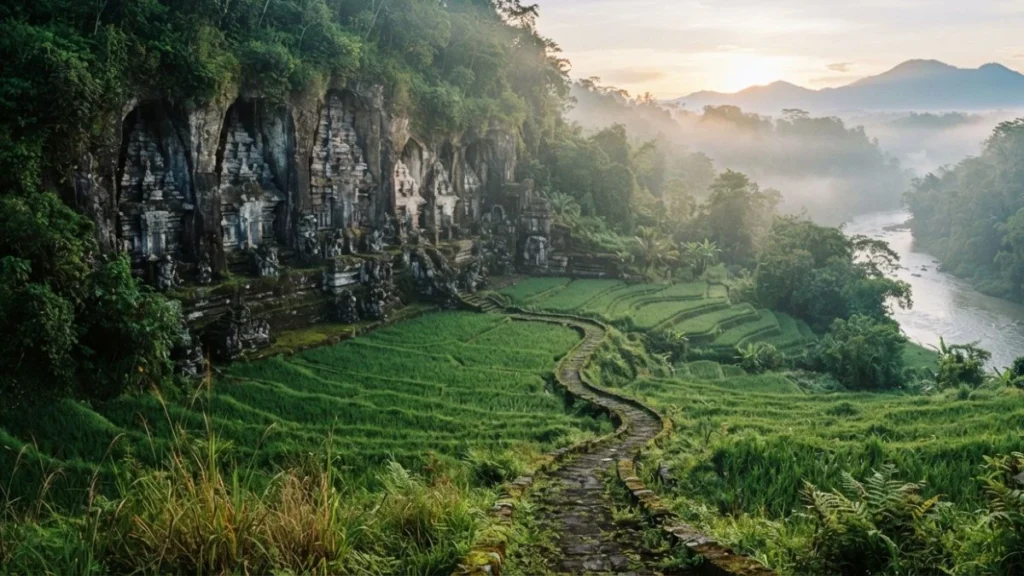
Gunung Kawi Temple in Tampaksiring is one of Bali’s most striking ancient sites — ten shrines, each roughly 7 metres tall, carved directly into a river valley cliff face in the 11th century, rather than built as freestanding structures the way most Balinese temples are. It’s genuinely one of the island’s oldest and most significant archaeological complexes, and also one where a naming mix-up trips up a fair number of first-time visitors before they even arrive.
This guide covers the history behind the shrines, what the visit actually involves (300-plus steps included), and the honest clarification on which “Gunung Kawi” you’re actually looking for.
Quick Facts
- Location: Tampaksiring village, roughly 30–40 minutes northeast of Ubud
- Entrance fee: reports range from IDR 20,000–50,000 for adults, IDR 20,000–25,000 for children, sarong and sash typically included
- Hours: generally 8am–6pm daily (some sources list 7am–5pm — confirm on arrival)
- The climb: over 300 stone steps down into the valley, and the same steps back up
- Time needed: 1–1.5 hours, more if you’re combining it with Tirta Empul nearby
- Watch for confusion: Gunung Kawi Tampaksiring (the ancient cliff shrines) is a completely different site from Gunung Kawi Sebatu (a calmer water temple 10–15 minutes away) — make sure your navigation app has the right one
Two Different Temples Share the Same Name
Before anything else, this is worth clearing up: “Gunung Kawi” refers to two genuinely different places in this part of Bali. Gunung Kawi Tampaksiring, the site this guide covers, is the dramatic archaeological complex with ten rock-cut shrines carved into a cliff face along the Pakerisan River. Gunung Kawi Sebatu, roughly 10 to 15 minutes away, is an entirely different, much calmer water temple with koi ponds, holy spring pools, and its own melukat purification area. They’re both worth visiting for different reasons, but they are not the same stop — double-check which one you’ve entered into your map before setting off, since the wrong one will leave you confused about why the “ancient carved shrines” everyone talks about aren’t there.
What Gunung Kawi Temple Actually Is
Gunung Kawi Temple was carved into the valley walls sometime in the 11th century, most likely commissioned to honor King Anak Wungsu, who ruled central and eastern Bali from roughly 1050 to 1080 AD, and possibly his father King Udayana and the broader Warmadewa dynasty. Local tradition holds that the first group of five shrines was built for the king himself, with the remaining shrines dedicated to his queens, who according to custom followed him in ceremonial death. The exact history remains genuinely debated among historians — inscriptions found at the site complicate a fully confirmed timeline — but the scale and craftsmanship of the shrines are not in question.
The site’s name translates roughly to “Mountain of Poets,” and local legend offers a more colorful origin story: that the giant Kebo Iwa carved the shrines with his own fingernails in a single night. Whichever explanation you find more compelling, the shrines themselves were rediscovered by Dutch archaeologists only in 1920, despite having stood for roughly 900 years prior.
The Walk Down (and the Walk Back Up)
Getting to Gunung Kawi Temple means descending a long stone staircase — reports vary, but expect somewhere over 300 steps — through a genuinely scenic corridor of terraced rice fields, small stalls, and jungle before reaching the river valley floor. It’s a beautiful walk, and also a real physical commitment: the return climb in Bali’s heat and humidity catches people off guard more than the descent does. If you have knee problems or limited mobility, this site requires honest self-assessment before you commit, since there’s no shortcut or alternate route once you’re partway down.
At the bottom, a bridge crosses the Pakerisan River connecting the two main groups of shrines — four on one side, five on the other — with a tenth shrine set apart to the south that many visitors miss entirely without a guide pointing it out. Behind the main shrine complex, meditation caves once used by monks and pilgrims during the pre-Hindu period are also worth seeking out rather than skipping past.
Crowds and Timing
Compared to nearby Tirta Empul, which draws large crowds for its melukat ritual, Gunung Kawi Temple generally stays noticeably calmer, even though both sites sit within the same small area. Early morning remains the best window if you want the valley to yourself, but even a mid-morning arrival alongside a tour group or two isn’t the ordeal it can be at busier sites — most tour groups move through relatively quickly, leaving the valley to independent visitors once the buses depart.
Pairing It With Nearby Sites
Gunung Kawi Temple sits less than a kilometre from Tirta Empul, making the two a natural pairing for a single outing — most visitors combine them, along with a stop at the Tegalalang rice terraces on the way back toward Ubud. If you want a gentler contrast after the stairs here, Gunung Kawi Sebatu’s calmer gardens and pools make a good next stop, provided you keep clear in your head that it’s a different site rather than “the easier way to see the same thing.”
FAQ
Is Gunung Kawi Temple the same as Gunung Kawi Sebatu?
No. Gunung Kawi Tampaksiring is the ancient rock-cut cliff shrine complex covered in this guide. Gunung Kawi Sebatu is a separate, calmer water temple about 10–15 minutes away. Double-check your navigation app before heading out.
How many steps does it take to reach Gunung Kawi Temple?
Over 300 stone steps down into the valley, and the same number back up. It’s manageable for most fitness levels but a genuine physical commitment, especially in Bali’s heat.
How much does it cost to visit Gunung Kawi Temple?
Reports vary, generally IDR 20,000–50,000 for adults and IDR 20,000–25,000 for children, with a sarong and sash typically included in the fee.
How does Gunung Kawi Temple compare to Tirta Empul for crowds?
Gunung Kawi Temple is generally calmer, even though both sites sit close together in Tampaksiring. Tirta Empul draws larger crowds, particularly for its melukat ritual.
How long should I plan for a visit?
Around 1 to 1.5 hours at Gunung Kawi Temple alone, more if you’re pairing it with Tirta Empul or the Tegalalang rice terraces the same day.
Final Thought
Gunung Kawi Temple rewards the climb — both directions of it — with one of Bali’s most genuinely dramatic ancient sites, carved directly into the landscape rather than sitting on top of it. Just make sure you’re headed to the right “Gunung Kawi” before you set off. For the water temple nearby that shares its name, and the rest of Tampaksiring’s sacred sites, our Bali water temples beyond Ubud guide covers Tirta Empul in full, and our Goa Gajah guide rounds out the area’s other ancient cave and temple sites.