
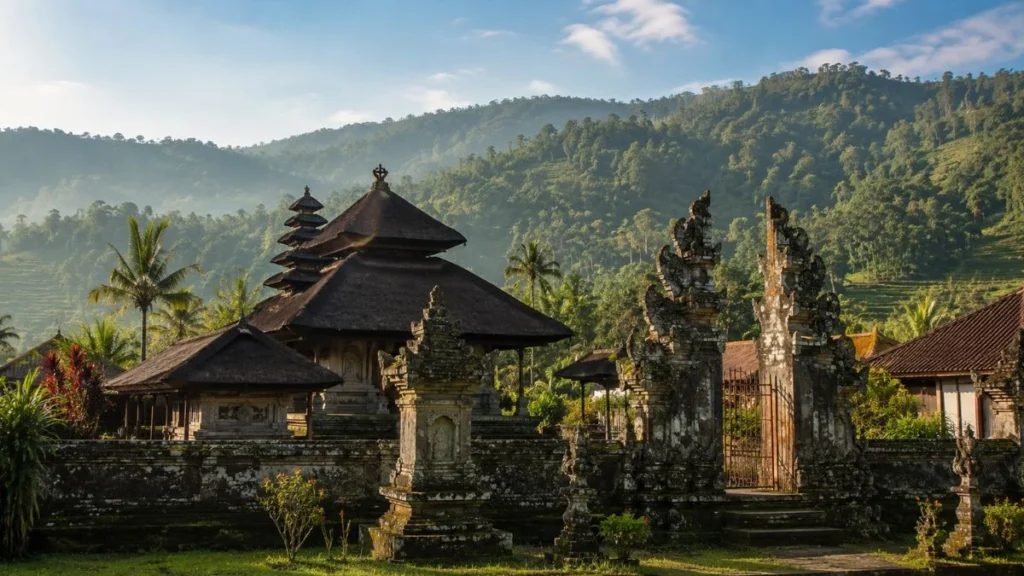
Blimbingsari village, tucked into the hills of West Bali’s Jembrana Regency, is one of the most genuinely unexpected places on the island — a Balinese Christian community whose central church was rebuilt after a 1971 earthquake to look almost indistinguishable from a Hindu temple, complete with split gates, tiered meru-style roofing, and stone carving in the same tradition found at Bali’s most sacred Hindu sites. Locals call it Pura Gereja, the Temple Church, and it’s earned recognition from the World Council of Churches as one of the most architecturally unique churches anywhere.
This is a genuine detour, not a quick stop, and worth being upfront about that before you plan around it. But if you’re already exploring far West Bali, or specifically chasing the kind of cultural discovery that doesn’t show up on a standard Ubud itinerary, Blimbingsari delivers something you won’t find anywhere else on the island.
Quick Facts
- Location: Jembrana Regency, West Bali, roughly 25 km southeast of Gilimanuk (the ferry port to Java)
- Distance from Ubud: a genuine detour — realistically 3 to 3.5 hours by car, given its position at the far western end of the island
- What makes it unique: a Christian village where the central church, rebuilt after a 1971 earthquake, was deliberately designed in Balinese Hindu temple architectural style
- Best paired with: a West Bali National Park trip, Menjangan Island diving/snorkeling, or a broader Jembrana Regency loop, rather than a standalone day trip from Ubud
- Village tour packages: typically include trekking, a village tour, farm and conservation activities, and cycling, arranged directly through the village
How a Christian Village Ended up in Hindu Bali
Blimbingsari’s origin story is genuinely distinct from anywhere else on the island. The village was established for Balinese converts to Christianity, settled in what was then considered dense, uninhabitable jungle — a permanent home built against real odds by a community that needed one after facing rejection elsewhere on a Hindu-majority island. What makes the village so visually striking today is the deliberate choice, after the original church was destroyed in a 1971 earthquake, to rebuild it not as a conventional Western-style church but in full Balinese architectural language: split gates, ornate stone carving, and a soaring roof structure that echoes the meru towers found at Hindu temples across Bali. Unless you notice the crosses on the roofline or the signage, it’s genuinely easy to mistake the building for a Hindu temple at first glance.
This isn’t just architectural borrowing for its own sake. The blending runs through the community’s actual practice — congregants sometimes wear ceremonial clothing similar to that worn at Hindu temple ceremonies, and services are accompanied by gamelan, the traditional Balinese percussion ensemble typically associated with Hindu ritual and dance. It’s a genuine cultural fusion rather than a stylistic gesture, and it’s part of why the village has drawn growing interest from travelers curious about a side of Bali rarely covered in typical itineraries.
What There Is to Actually Do
Beyond visiting the church itself, Blimbingsari runs a small set of structured village tour packages: guided walks through surrounding tropical forest trails past old-growth trees, a general village tour covering daily community life, a farming and local conservation package where visitors can take part in planting alongside residents, and a cycling tour through the cool, green countryside. For those extending further, package tours from the village sometimes include a trip to Menjangan Island within West Bali National Park, known for some of the clearest snorkeling and diving water in the region.
The village itself is genuinely agricultural — Jembrana’s western hills produce cacao, coconut, and a range of tropical fruit, and much of the surrounding land remains working farmland rather than anything built around tourism.
The Honest Distance Trade-off
This is worth stating plainly: Blimbingsari sits close to Gilimanuk, near Bali’s westernmost point, which puts it firmly outside any reasonable single-day loop from Ubud. Realistically, this is a stop for travelers already making their way toward West Bali National Park, Menjangan Island’s dive sites, or the Java ferry crossing — not a detour to bolt onto an Ubud-based itinerary casually. If a genuinely unusual cultural discovery matters more to you than convenience, and you’re already planning time in far West Bali, it’s a worthwhile and quite remarkable stop. If your trip is centered entirely around Ubud and South Bali, it’s fair to treat this as a “someday” rather than a “this trip” destination.
Visiting Respectfully
Blimbingsari remains an active, practicing community, not a museum exhibit — the church holds real services, and the village functions as an ordinary Balinese farming town that happens to have an extraordinary building at its center. Dress modestly, ask before photographing people directly, and treat a visit during active worship with the same respect you’d bring to any religious site, regardless of the fact that it’s a Christian rather than Hindu building.
FAQ
How far is Blimbingsari from Ubud?
Realistically 3 to 3.5 hours by car, since the village sits near Gilimanuk at Bali’s far western end. It’s not a practical single-day trip from Ubud on its own.
Why does the church look like a Hindu temple?
After the original church was destroyed in a 1971 earthquake, the community rebuilt it deliberately in Balinese Hindu architectural style — split gates, tiered meru-style roofing, and traditional stone carving — while remaining a functioning Christian church, reflecting a genuine cultural blend rather than a design gimmick.
What can you actually do in Blimbingsari?
Guided village tours, forest trekking, farming and conservation activities, and cycling tours through the surrounding countryside, often arranged directly through the village. Some packages extend to nearby Menjangan Island for snorkeling or diving.
Is Blimbingsari worth visiting?
If you’re already traveling through far West Bali toward Gilimanuk, West Bali National Park, or Menjangan Island, yes — it’s a genuinely unusual and memorable stop. If your trip is Ubud or South Bali-centered, the distance makes it a harder case to justify as a standalone destination.
Is it appropriate for tourists to visit an active church community?
Yes, the village welcomes visitors, but treat it as you would any active place of worship — dress modestly, be mindful during services, and ask before photographing residents directly.
Final Thought
Blimbingsari is one of the more genuinely surprising cultural discoveries left in Bali — a living demonstration that the island’s identity isn’t as singular as most travel content suggests. It demands real distance and effort to reach, but for travelers already exploring far West Bali, it’s a stop that delivers something no temple circuit or rice terrace tour can replicate. For more of Bali’s distinctive village cultures closer to Ubud, our Penglipuran vs Tenganan comparison covers two of the island’s other most culturally distinct villages.