
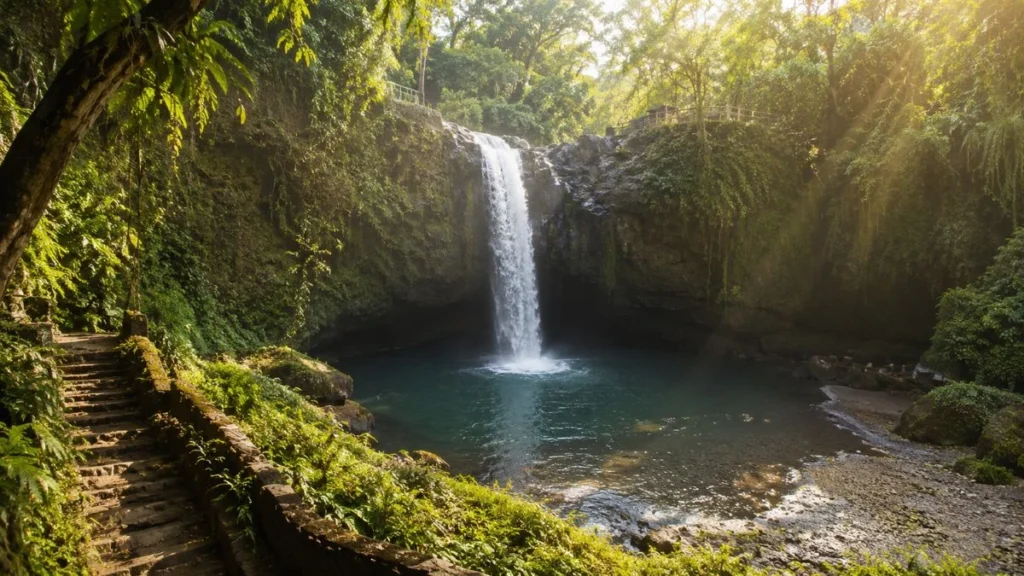
Ubud itself doesn’t have a waterfall in town, and that’s fine — the closest waterfalls near Ubud are all a 20 to 50-minute drive east into Gianyar and Bangli, and every single one of them is worth knowing the trade-offs before you go. Some are stroller-easy with a five-minute walk from the parking lot. Others mean 150 wet stone steps down a canyon and the same 150 steps back up in Bali heat.
This isn’t a “top 10 hidden gems” list. It’s the honest version: which waterfalls near Ubud are actually good for swimming, which ones turn into a queue for a photo by 10am, what you’ll really pay at the gate, and which one is genuinely worth skipping if you’ve only got one morning.
We’re covering four waterfalls you can reasonably combine into a half-day loop from Ubud — Tegenungan, Tibumana, Kanto Lampo, and Tukad Cepung — plus a few quieter alternatives if the first four sound too busy for your taste.
Quick Facts
- Closest waterfall to Ubud: Tegenungan, about 20–30 minutes / 10 km
- Furthest of the four: Tukad Cepung, about 45–50 minutes / 20 km
- Entrance fees: roughly IDR 20,000–30,000 per person, cash only at all four
- Best time to arrive: before 8:30am, especially for Tegenungan and Kanto Lampo
- What to bring: a spare pair of sandals or old sneakers with grip, a dry bag for your phone, small cash notes
- Wheelchair/stroller access: none of the four are fully accessible — all involve stairs
Tegenungan Waterfall — The Easy, Crowded One
Tegenungan is the waterfall most people mean when they say “waterfall near Ubud,” and it’s the closest, roughly 20–30 minutes by scooter or car from central Ubud in the village of Kemenuh, Sukawati. It’s also the biggest of the four, with a wide curtain of water dropping around 15 metres into a swimmable pool.
Entrance runs about IDR 20,000–25,000 per person, and the gate is open from around 6:30am to 6:30pm. Here’s the honest part: it’s split between two entrances, Tegenungan and Blangsinga, run by two different villages, so don’t be surprised if the price or the view feels slightly different depending on which side you walk in from. There’s also a newer glass bridge over the gorge with its own separate ticket, usually around IDR 50,000 — skip it unless you specifically want that photo, because the walk down to the actual pool is the better experience.
Get there before 9am if you want the water to yourself. By 10:30am, tour vans start arriving in numbers and the stairs down (there are well over a hundred of them) get genuinely congested. Swimming is good here, better than at Kanto Lampo or Tukad Cepung, and there are warungs and changing rooms at the top if you don’t want to walk back to your scooter dripping wet.
Tibumana Waterfall — The One to Actually Relax At
If Tegenungan is where everyone goes, Tibumana is where you go if you want to sit by the water for an hour without noise. It’s further out — about 30–45 minutes east of Ubud in Apuan village, Bangli — and that extra distance does a lot of the filtering for you.
The walk in is about 300 metres from the car park, roughly 140 easy stone steps through jungle, taking 10–15 minutes each way. The waterfall itself is a single clean drop of around 20 metres into a calm pool that’s about waist to chest deep near the edges. Entrance is about IDR 25,000 per person, with small parking fees on top (around IDR 10,000 for cars, 5,000 for scooters).
One honest safety note: the current directly under the falling water is stronger than it looks, and the rocks near the pool get slick. Swim off to the side, not directly underneath, and you’ll be fine. This is genuinely one of the better waterfalls near Ubud for families with older kids, since the walk is manageable and the pool is calm enough for actual swimming rather than a quick photo dip.
Kanto Lampo Waterfall — Photogenic, But You’re Sharing It
Kanto Lampo, in Beng village near Gianyar (about 25–30 minutes from Ubud), is the one you’ve probably already seen on Instagram — water sheeting down a wide black rock staircase that people climb on for photos. It’s genuinely striking. It’s also, by a fair margin, the most crowded of the four once a tour group or two shows up, because the whole point of visiting is standing on the rocks under the flow, and there’s only so much rock.
The walk from parking is short, about five to six minutes, mostly stairs, so it’s accessible for most fitness levels. Entrance fees have ranged from IDR 15,000 to 25,000 depending on the source and season — bring small notes and expect it to have crept toward the higher end by the time you visit. It’s not really a swimming spot; the pool is shallow and often packed with people mid-photo rather than mid-swim.
Worth knowing: Kanto Lampo is still an active site for local ceremonies, and you’ll often see offerings near the water. Treat it with the same respect you would a temple, even with the crowd around you.
Tukad Cepung Waterfall — The Furthest, and the Most Dramatic
Tukad Cepung is the outlier of the four: not a waterfall you view from a viewing platform, but one you walk into, inside a narrow canyon where sunbeams cut through an opening in the rock overhead. On a clear late morning — locals say 11am to 1pm is the window — the light through the mist is the reason this waterfall shows up on every “unique Bali” list, and for once, that reputation is earned.
It’s also the most physically demanding: about 45–50 minutes from Ubud to Tembuku, Bangli, then a 15–20 minute hike down steep stone steps (and the same steep steps back up, which is the part people don’t mention). Entrance is around IDR 30,000, open roughly 7am to 6pm. Bring a spare pair of sandals — the final stretch means wading over slick rocks in the streambed, and flip-flops alone won’t cut it.
This one’s the trade-off waterfall: best light, most dramatic setting, but not the one to bring young kids or anyone with knee problems to.
If You Want Fewer People: Quieter Alternatives
None of the four above are secret, and that’s fine — they’re popular because they’re good. But if your priority is quiet over convenience, ask a local driver about Goa Rang Reng (a short walk from Tibumana, far less visited) or Suwat Waterfall, which has a well-maintained path, changing facilities, and a deep swimmable pool without the crowd that gathers at Tegenungan. Neither is “undiscovered” in the true sense — nowhere within an hour of Ubud really is anymore — but both routinely have a fraction of the visitors.
Planning Your Waterfall Day from Ubud
Trying to hit all four in one day is possible but rushed, and you’ll spend more time in the car than at the water. A more honest plan is two waterfalls in a morning: pair Tegenungan with Tibumana if you want variety without too much driving, or Kanto Lampo with Tukad Cepung if photos and drama matter more to you than swimming.
Scooter self-drive works for all four if you’re comfortable on Bali roads, though the last stretch to Tukad Cepung and Tibumana narrows into village lanes. A private driver for around IDR 500,000–600,000 for the day removes that stress entirely and is worth it if you’re combining waterfalls with other stops nearby, like the Tegallalang or Jatiluwih rice terraces.
FAQ
Which waterfall is closest to Ubud?
Tegenungan is the closest of the well-known waterfalls near Ubud, about 20–30 minutes by scooter or car from the town centre.
Can you swim in the waterfalls near Ubud?
Tegenungan and Tibumana both have proper swimmable pools. Kanto Lampo and Tukad Cepung are more for wading and photos than actual swimming — the pools are shallow and usually crowded with people taking pictures rather than swimming.
How much does it cost to visit waterfalls near Ubud?
Expect roughly IDR 20,000 to 30,000 per person at each site, plus a small parking fee. All four take cash only, so carry small notes.
What should I wear to visit these waterfalls?
Quick-dry clothes or a swimsuit, and shoes with actual grip rather than flip-flops, especially for Tukad Cepung where the final approach is over wet rock. Bring a dry bag or waterproof phone case.
Is it safe to swim under the waterfalls?
At Tibumana and Tegenungan, avoid swimming directly under the falling water — the current is stronger than it appears and can carry down small debris. Swim to the side of the main flow instead.
Final Thought
None of these waterfalls near Ubud are hidden, and honestly, the ones that get the most visitors get them for a reason. Pick based on what you actually want out of the morning — a proper swim, a photo, or a bit of both — rather than chasing whichever one looks quietest online. For more on planning the rest of your trip east of Ubud, our guides to things to do in Ubud and Bali road trip through East Bali cover what pairs well with a waterfall morning, and our Ubud hidden villages guide is a good next stop if you want to keep exploring off the main road.