
Ubud has more cooking classes than it has rice paddies, or at least it can feel that way once you start searching. Nearly every hotel front desk has a laminated flyer for one, every tour operator bundles one into a “cultural day,” and the reviews online are almost uniformly glowing — which makes it hard to tell which cooking class in Ubud is genuinely worth your time and which is a rehearsed demo dressed up as a hands-on experience.
The honest answer is that the classes aren’t interchangeable. They fall into three real categories — restaurant-run classes in central Ubud, organic farm schools on the outskirts, and private classes hosted in someone’s actual family compound — and each one gives you a different day, not just a different location. What you’re really choosing between is convenience versus immersion, and it’s worth knowing the trade-off before you book.
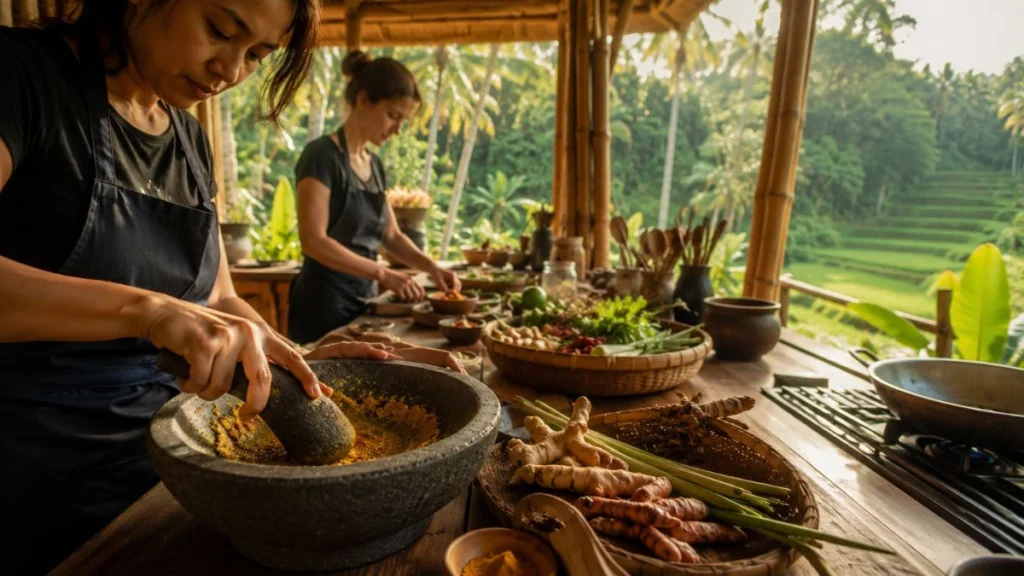
Every decent class teaches you base gede, the spice paste that underlies most Balinese cooking — ground turmeric, galangal, ginger, shallot, garlic, and chilies, worked by hand with a stone mortar (ulekan) rather than a blender. If a class skips this step or hands you a pre-made paste, that’s a fair sign it’s cutting corners.
Quick Facts
- Typical price: IDR 450,000–480,000 (~USD 28–30) per person for standard group farm classes; town/restaurant classes often run similar; private classes start around USD 75 and can run past USD 175 for smaller groups
- Duration: 2.5–6 hours depending on whether a market tour or farm harvest is included
- Group size: Usually 4–10 people for group classes; private classes are just you or your group
- What you actually cook: Typically 6–9 dishes, almost always including base gede, a curry, a salad (gado-gado or sayur urab), satay (sate lilit), and a dessert like pisang goreng or bubur injin
- Included in most bookings: Hotel pickup/drop-off in central Ubud, ingredients, recipe booklet, and the meal itself as lunch or dinner
The Three Real Categories
Restaurant-run classes in central Ubud. These operate out of an actual restaurant kitchen, usually with an outdoor or semi-outdoor cooking area attached. The convenience is real — you’re walking distance from your hotel, the kitchen is polished and clean, and the class runs on a tight, well-rehearsed schedule. What you’re trading for that convenience is atmosphere: it can feel closer to a well-run cooking demo than a cultural immersion, since you’re in a commercial space built for tourists rather than someone’s home. Still a genuinely good option if your schedule is tight or you’re not up for a 30-40 minute drive out of town.
Organic farm schools outside Ubud. A handful of these operate on working farms in villages like Taro, 30–40 minutes north of central Ubud, where you harvest some of your own ingredients before cooking them. The trade-off is time and distance — you’ll lose most of a morning or afternoon to travel and the farm tour before you even start cooking — but the ingredients genuinely come from the ground you’re standing on, and the setting (open-air kitchens, jungle views, cooler highland air) is a different experience from a city-centre kitchen. These usually run a “cook-eat-cook-eat” format, serving dishes in stages as they’re finished rather than making you wait until the end for a lukewarm feast.
Private classes in a family compound. This is the deepest version of the experience, and the reviews for these are consistently the most personal — hosts who walk you through their family temple, explain how a Balinese household compound is laid out, and treat the class as a conversation about culture as much as a cooking lesson. Ingredients often come from the host’s own garden. The catch is availability and consistency: you’re booking a specific person’s time, not a business with backup staff, so read recent reviews closely and confirm details directly rather than assuming every private host runs things the same way.
What a Real Class Actually Looks Like
A genuine Balinese cooking class in Ubud starts with a market visit, usually early — 7 or 8am — before the heat and the tour buses arrive. This isn’t filler; it’s where you learn to recognise the ingredients you’ll be cooking with later: fresh turmeric root versus the powdered version, the difference between the several kinds of chili used in Balinese sambal, and how families select produce for the day rather than the week (refrigeration space in a traditional Balinese kitchen is limited, so daily market runs are still the norm for many households).
Back at the kitchen, the base gede grinding is usually the anchor activity — everyone at a mortar and pestle, working the paste by hand while the instructor explains how the ratio changes for different dishes. From there, classes branch into a rotation of curries, satay, vegetable salads with peanut or coconut dressing, and a dessert, cooked over multiple rounds so you’re eating hot food as you go rather than a single cold buffet at the end.
What to Watch For Before You Book
The clearest sign of a class worth paying for is whether you’re actually doing the work. Reviews that mention “we chopped, mixed, cooked” are describing something different from reviews that describe watching a chef demonstrate while guests observe. Some classes pre-prepare a portion of the ingredients to save time — reasonable for a 2.5-hour session — but if everything arrives pre-chopped and pre-measured, you’re paying for a meal with a cooking show attached, not a cooking class.
It’s also worth checking whether market visits and farm tours are included or sold as add-ons, since the price difference between a bare-bones class and one with a market or farm component is usually modest, but the experience difference is significant. If dietary restrictions matter to you, ask before booking rather than at the door — most schools handle vegetarian and vegan requests well, but gluten-free and severe allergies need advance warning since shared kitchens use nuts, soy, and shellfish products throughout.
FAQ
How much does a cooking class in Ubud cost?
Most group classes run IDR 450,000–480,000 (roughly USD 28–30) per person, which typically includes hotel pickup, all ingredients, the market or farm visit, and the meal. Private classes cost more, usually starting around USD 75 and climbing toward USD 175+ for smaller, more personalised sessions.
Is a cooking class in Ubud worth it if I don’t cook at home?
Yes — most classes are built for complete beginners, with instructors walking you through each step individually rather than assuming prior kitchen experience. The value isn’t really about skill-building; it’s about understanding Balinese food and culture through the ingredients and techniques, which comes through regardless of your cooking background.
Should I choose a farm class or a town class in Ubud?
It depends on how much time you want to spend and how much you value setting versus convenience. A town class saves you 45–60 minutes of driving each way and works well if your schedule is tight. A farm class trades that time for a more immersive setting and ingredients harvested on-site, which suits travellers with a slower-paced day already planned.
Do Ubud cooking classes include a market tour?
Many do, especially morning sessions, but not all — some afternoon and evening classes skip the market and go straight to the farm or kitchen. If the market tour matters to you, confirm it’s included before booking rather than assuming.
What dishes will I actually cook?
Nearly every class includes base gede (the foundational spice paste), plus a rotation of dishes drawn from a fairly consistent regional menu: a curry (often chicken in coconut sauce), satay (sate lilit), a vegetable salad with peanut or coconut dressing (gado-gado or sayur urab), and a dessert like banana fritters or black rice pudding. Exact menus vary by school, but these staples show up almost everywhere.
Final Thought
A cooking class is one of the few Ubud activities that genuinely earns its place on a slow travel itinerary rather than just filling a morning — it’s less about the recipes and more about spending a few hours inside someone’s kitchen and market routine instead of watching it from a car window. If you’re building this into a longer Ubud stay, pair it with a visit to one of the actual markets it draws ingredients from, and read up on the etiquette around visiting family compounds and temples before your host walks you through theirs.