
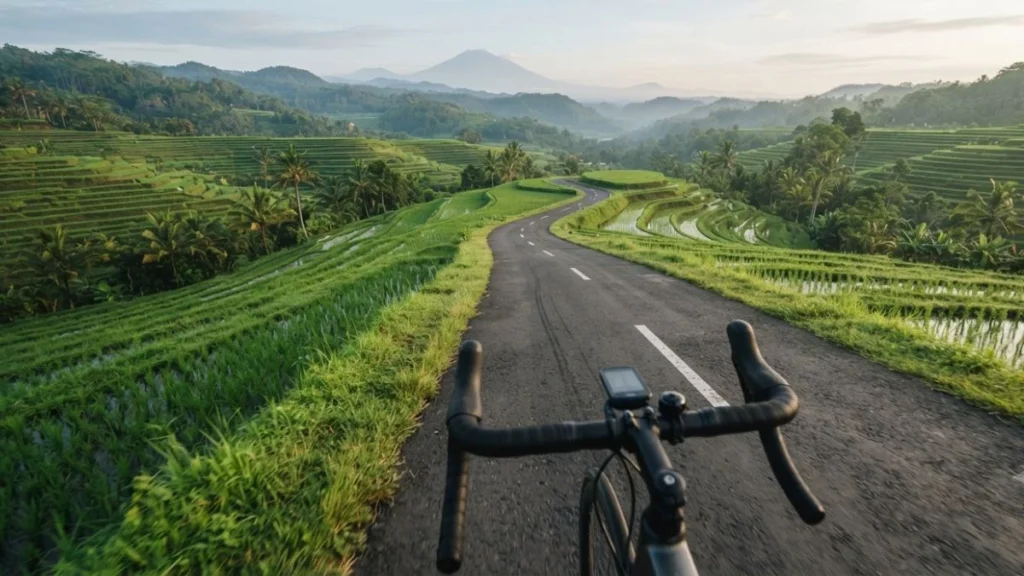
Kintamani downhill cycling is marketed almost everywhere as an easy, no-experience-needed activity — and for the most part, that’s fair. Starting near the crater rim above Lake Batur and coasting roughly 23 to 25 km down through villages, rice terraces, and coffee plantations toward Ubud, the route is genuinely around 90% downhill, genuinely scenic, and genuinely one of the more relaxed adventure activities on offer in the Ubud area. It’s just worth knowing that “downhill” and “effortless” aren’t quite the same thing once you’re actually holding the brakes.
This guide covers what the tour actually involves, realistic pricing, and the honest safety note that gets glossed over in most marketing copy.
Quick Facts
- Route: Kintamani (Penelokan area, near Lake Batur) down to Ubud, roughly 23–25 km
- Downhill ratio: approximately 90% downhill, 10% flat terrain
- Duration: roughly 2 to 3 hours of actual cycling, 5 to 6 hours total including breakfast, stops, and transport
- Price: roughly $36–40 USD (IDR 550,000–650,000) per person for Ubud-area pickup, higher for pickup from Kuta, Seminyak, or Sanur
- Age range: generally suitable for ages 7 to 65
- Fitness level: moderate — no prior cycling or mountain biking experience required, but comfort with brakes matters more than marketing suggests
What the Tour Actually Involves
Most operators follow a similar structure: early morning hotel pickup (typically 7:15–8:30am depending on your location), a drive up to Kintamani, and breakfast or coffee at a spot overlooking Lake Batur and the volcano — a genuinely pleasant way to take in the crater view without doing the sunrise trek. From there, many tours stop at a local coffee plantation before the ride begins, where kopi luwak is often offered as a tasting option; if you’d rather understand what’s actually involved in that before saying yes, our separate guide on kopi luwak ethics covers the civet-cage question in detail.
The ride itself winds down quiet back roads through traditional villages, past rice terraces and the centuries-old Subak irrigation system, with stops for photos, fresh local fruit, and often a chance to talk with farmers working the fields. Some operators include a stop to explain Balinese cremation traditions or visit a village temple along the way, adding a cultural layer beyond just the scenery. Most tours end with a buffet or set lunch, either at a rice-field-view restaurant or a local cafe, before the drive back to your hotel.
The Honest Safety Note
Here’s what the “no experience necessary” marketing tends to undersell: while the route is genuinely mostly downhill and doesn’t require technical mountain biking skills, the speeds you can pick up on a sustained downhill stretch are real, and confidently controlling your brakes matters more than most first-timers expect. More than one visitor account specifically notes that while the ride felt easy overall, the descent moves faster than anticipated if you’re not used to modulating your brakes on a bike, and losing that confidence partway down is more unsettling than dangerous route conditions would suggest. Guides generally ride at the front and set a manageable pace, and reputable operators build in regular rest stops, but it’s worth taking the first few minutes to get a feel for your bike and brakes before relaxing into the ride.
Reputable operators provide insurance, and some include raincoats in case of unexpected weather, since routes at this elevation can shift from clear to misty quickly. Confirm this is included before booking rather than assuming it comes standard.
Pricing Breakdown
Ubud-area pickup typically runs $36–40 USD (IDR 550,000–650,000) per adult, with children under 12 usually discounted to around IDR 450,000. Pickup from further afield — Denpasar, Kuta, Seminyak, Sanur, Nusa Dua — usually adds a separate transport fee, commonly IDR 300,000–450,000 per vehicle (covering up to 6 people) rather than per person, so groups traveling together get better relative value on the transport side. Private tours, rather than joining a shared group, generally run higher, often around IDR 750,000 per person. Most operators require a minimum group size (commonly 2–3 people) to run the tour at standard pricing, so solo travelers should check this before booking.
Separate entrance fees may apply for specific viewpoints along the route, such as the Kintamani/Penelokan viewpoint itself (roughly IDR 50,000), which isn’t always bundled into the base tour price — worth clarifying what’s included before you commit.
FAQ
Do I need cycling experience for Kintamani downhill cycling?
No prior mountain biking experience is required, and the route is genuinely mostly downhill. That said, confidence controlling your brakes at sustained downhill speeds matters more than the “easy for everyone” marketing suggests — take it slow at the start until you’re comfortable.
How long does the Kintamani downhill cycling tour take?
Roughly 2 to 3 hours of actual cycling, with the full experience — including breakfast, coffee plantation stop, and lunch — typically running 5 to 6 hours door to door.
How much does it cost?
Roughly $36–40 USD (IDR 550,000–650,000) per person for Ubud-area pickup. Pickup from further afield (Kuta, Seminyak, Sanur) usually adds a separate per-vehicle transport fee.
Is Kintamani downhill cycling suitable for kids?
Yes, generally suitable for ages 7 to 65, with discounted pricing for children under 12. It’s a genuinely popular family activity given the low physical demand of a mostly-downhill route.
Is the kopi luwak coffee offered on the tour ethical?
Many tours include a stop at a coffee plantation offering kopi luwak tastings, which often means caged civets on-site. See our dedicated guide on kopi luwak ethics in Bali before deciding whether to try it during the stop.
Final Thought
Kintamani downhill cycling delivers on its reputation as one of the more relaxed, scenic adventure activities near Ubud — just don’t mistake “mostly downhill” for “no skill required” once you’re actually rolling. Take the first stretch slow, trust your guide’s pace, and you’ll get one of the better half-day views of rural Bali available from a bike seat. For more on the crater and volcano this tour starts from, our Kintamani volcano guide covers the rest of what the area offers.