
Balinese cremation ceremony guide for tourists: Ngaben is a sacred Hindu Balinese cremation ritual designed to release the soul (atma) from the physical body so it can continue its journey toward reincarnation or moksha — spiritual liberation. It is not a mournful event. It is a duty.
This Balinese cremation ceremony guide for tourists covers what Ngaben actually is, what happens during the ritual, and how to attend as a respectful visitor — because most articles either treat it as a tourist attraction or describe it so clinically that the actual experience makes no sense when you encounter it. The Balinese cremation ceremony is one of the most significant rituals in Balinese Hindu life. Understanding it before you witness it changes everything about what you see.
Ngaben is not on a schedule you can book. It is not performed for visitors. And the way it looks from the outside — loud, colourful, almost festive — contradicts every Western expectation about what a funeral should feel like. That contradiction is the starting point for understanding it.
If you are visiting Bali for the first time and want to understand the cultural foundation beneath the ceremonies, temples, and offerings you will encounter everywhere on the island, the Penglipuran village guide explains the banjar communal system that organises Balinese Hindu life — including who coordinates and funds ceremonies like Ngaben at the village level.
What Is Ngaben? The Spiritual Logic Behind the Ceremony
Ngaben is a Hindu Balinese cremation ritual designed to release the soul — atma — from the physical body so it can continue its journey toward rebirth. Unlike funeral practices in many parts of the world, the ceremony is not mournful.
The word ngaben derives from api, meaning fire — the sacred element used to purify the body and sever its ties to the material world. In Balinese Hinduism, the physical body is considered a temporary vessel composed of five elements: earth, fire, air, water, and ether. Death returns each element to nature. The soul cannot move forward until the body has been properly released through fire. This makes Ngaben not optional or symbolic — it is a religious obligation.
The Balinese believe that both life and death are part of a spiritual cycle that flows without pause. For Balinese families, these rituals are of profound importance. It is believed that if not done properly, the soul might struggle to move forward in its spiritual journey.
No tears are shed, because the deceased is only temporarily not present and will reincarnate or find final rest in Moksha — freeing from the reincarnation and death cycle. This is not emotional suppression. It is a genuine expression of belief that grief is misplaced at a ceremony whose purpose is liberation.
What Actually Happens During a Balinese Cremation Ceremony
Preparation: Days Before the Cremation
The preparation for Ngaben can take days or longer. If the family cannot afford the ceremony immediately — and it is expensive — the body may be temporarily buried until funds are gathered, sometimes months or years later. The day for the ceremonial cremation is chosen by a priest according to the Balinese calendar. As the ceremony costs a lot, some families have to save for a long period of time to afford it.
The family performs the Memukur cleansing ritual — washes the corpse using holy water, dresses it in Balinese attire, and wraps it with white fabric. A clean body can be decorated with flowers, leaves, and gold.
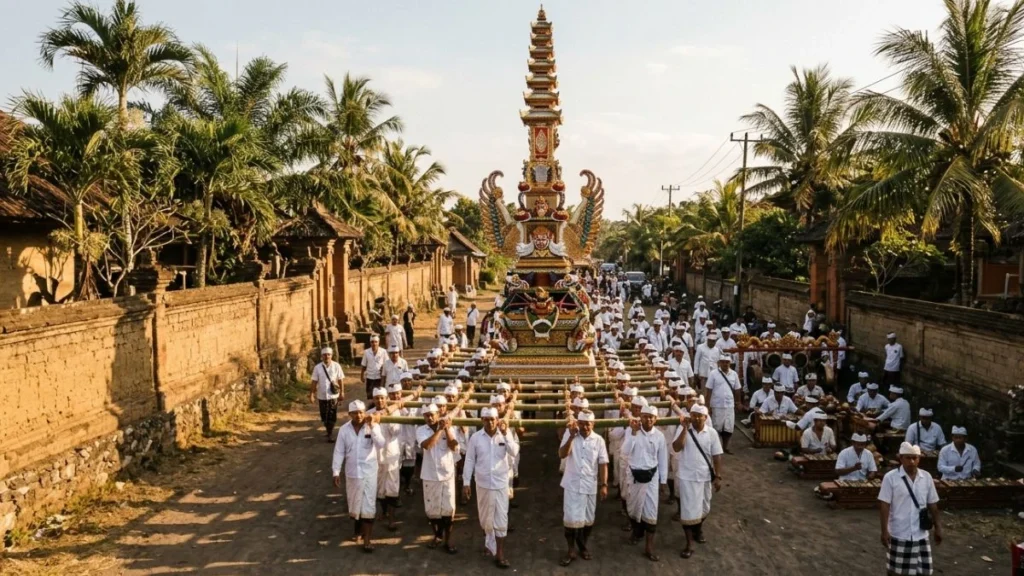
One of the first physical constructions is the bade — a tall, multi-tiered cremation tower in which the deceased will be carried to the cremation site. The bade is often decorated with vibrant colours and intricate detail. For royal or high-priest cremations, the bade can reach 20 metres tall. For community cremations, it is considerably simpler — but the structure and its purpose remain the same.
The Procession
The procession is what most visitors see first and remember longest. The bade is carried through the village on the shoulders of dozens of men — family members, neighbours, banjar members — accompanied by gamelan music, offerings, and the full participation of the community. The procession is deliberately loud and deliberately fast. Moving quickly and changing direction repeatedly is intended to confuse any spirits that might follow the soul and prevent it from moving forward.
The animal-shaped coffin — called lembu (bull) or another animal form depending on caste — waits at the cremation site. The body is transferred from the tower into the coffin. Both are then set alight.
After the Fire: Ngeroras and the Ocean
In some cases, a further ritual known as Ngeroras is performed to purify the soul from any remaining ties to the material world. The ashes and bone fragments are collected, wrapped in white cloth, and taken to the sea — typically the nearest beach or river mouth. The remains are scattered into the water, completing the return of the physical elements to nature and the soul’s release.
The Difference Between a Public Ngaben and a Private One
This is the most important distinction for any visitor to understand.
Ngaben is a family affair. If it’s a private ceremony, you won’t be invited unless you’re personally connected to the family. But in the case of large public or village-wide cremations, tourists can sometimes observe — respectfully — from the sidelines. These ceremonies are not performances, but locals are generally welcoming if you’re curious and behave appropriately.
Private Ngaben — conducted by a single family at their compound or a nearby cremation ground. Do not approach or photograph unless explicitly invited. If you happen to pass one and a family member gestures you in, that is a genuine invitation and should be treated with corresponding seriousness.
Village or mass Ngaben — when multiple families combine their ceremonies to share costs, the event becomes semi-public and often involves the whole banjar. These are the large processions that occasionally stop traffic in Ubud or Denpasar. Observation from the street is generally fine. Entering the immediate ceremonial space without invitation is not.
Royal or priest Ngaben (Pelebon) — the largest and most elaborate. These are effectively public events involving thousands of participants. The royal cremation in Ubud draws visitors from across Bali. These happen rarely and with significant advance notice in the local community.
Balinese Cremation Ceremony Guide for Tourists: How to Attend Respectfully
If you are present at a Ngaben — invited or as a street observer — these are the practical things that matter:
Dress appropriately — For temple or ceremonial space entry: sarong, sash, and covered shoulders are mandatory. For men, a headpiece (udeng) is respectful at formal ceremonies. For street observation of a procession, neat and covered clothing is sufficient. Avoid shorts and sleeveless tops anywhere near the ceremony.
Do not position yourself above the offerings or the body — In Balinese spatial cosmology, height carries spiritual significance. Do not climb walls, stand on vehicles, or use elevated positions to photograph the ceremony.
Photography — Processions on public roads are generally fine to photograph from a respectful distance. Do not photograph the body, the immediate family in grief, or the innermost ritual space. If in doubt, put the camera away entirely.
Do not touch the tower or coffin — The bade and lembu are sacred objects. Keep physical distance.
Follow the family’s lead — If a family member signals you to stay back or move, do so immediately and without discussion. If they invite you closer, accept quietly.
No food or drink — Do not eat or drink during your observation of the ceremony.
Mele had been in Ubud for four days when her driver mentioned, entirely casually, that there was a ngaben procession passing through the centre of town that afternoon. She arrived expecting something solemn. What she found was two hundred people in ceremonial dress, gamelan music loud enough to feel in her chest, a tower so tall it had to tilt to pass under power lines, and a family that laughed and waved at the crowd while carrying their grandfather to his cremation. She stood on the roadside for an hour and understood, by the end of it, something about Bali that no temple visit had given her.
When and How to Find a Ngaben Ceremony
There is no ticket booth or schedule to follow. Ngaben does not appear on tourist event calendars in the way that Kecak performances or temple festivals do. The best ways to find one:
Ask your accommodation — Guesthouses and small hotels with Balinese staff almost always know when a local ceremony is happening. Ask directly: “Is there a cremation ceremony in the area this week?”
Ask your driver — Balinese drivers are connected to local banjar networks and often know about ceremonies days in advance. A trusted driver is the most reliable source.
Large royal cremations — These are announced publicly and covered in local Bali media. Searching “Pelebon Ubud” or “royal cremation Bali 2025” will surface upcoming events when they are scheduled.
Walk slowly in village areas — Gamelan music and processions are audible from a distance. If you hear it, follow the sound respectfully.
What Ngaben Is Not
Most tourist-oriented content about Ngaben describes it as “colourful,” “fascinating,” or “unlike anything you’ve seen.” All of that is true and none of it is useful. Here is what it is not:
It is not a performance. The family is not there for your experience. The ceremony exists entirely for the soul of the deceased and the obligations of the living toward that soul.
It is not always immediately after death. Families sometimes wait years between death and cremation, particularly if coordinating a mass village ceremony to share costs. The body may have been buried and exhumed for the ceremony.
It is not the same everywhere. No single description fits every village or family. Caste, location, family tradition, and financial capacity all shape the ceremony. A royal Pelebon in Ubud and a village Ngaben in a small Bangli compound are both called Ngaben and share the same spiritual purpose — but they look and feel entirely different.
FAQ
Can tourists attend a Balinese cremation ceremony? Yes, with important conditions. Large village or royal cremations are semi-public and observation from a respectful distance is generally welcomed. Private family ceremonies are not open to uninvited visitors. The distinction between the two is not always immediately obvious — when uncertain, observe from the street and do not enter ceremonial space without an explicit invitation.
What should tourists wear to a Balinese cremation ceremony? A sarong and sash are the minimum for entering any temple or ceremonial space. Covered shoulders and closed shoes are expected. For street observation of a procession, neat and covered clothing is sufficient. Avoid shorts, sleeveless tops, or bright colours that draw attention to yourself.
Is it disrespectful for tourists to attend Ngaben? Respectful observation is not considered disrespectful by most Balinese families — particularly at public cremations. What is disrespectful is treating the ceremony as entertainment, photographing the body or grieving family members, entering the inner ceremonial space uninvited, or behaving in ways that signal you view it as a performance. Genuine curiosity and quiet respect are almost always welcomed.
How long does a Ngaben ceremony last? The cremation day itself typically takes several hours from procession to the final fire. The full ritual cycle — including preparation days, the cremation, and the Ngeroras ash-scattering — can span three days or longer. Most visitors observe only the procession and cremation, which can take two to four hours.
How do I find out about upcoming Ngaben ceremonies in Bali? Ask your accommodation staff or driver directly. Balinese staff are connected to local banjar networks and usually know about upcoming ceremonies in the area. Large royal cremations are publicly announced and covered in Bali local media.