
June sits at the start of Bali’s dry season, which runs from roughly April through October. It’s not the cheapest month — that window closed in April and May — and it’s not the busiest, which peaks in July and August. What June actually is: a month where the weather is reliably good, the island is busy but not overwhelmed, and a significant Hindu celebration falls mid-month that most travellers don’t know about until they arrive.
This bali in june guide covers the weather honestly, the Galungan and Kuningan festival cycle that runs through the month, where to be and where to avoid, and the practical details that affect how you plan.
Quick Facts — Bali in June
- Season: Dry season — best weather of the year
- Average temperature: 26–30°C (79–86°F)
- Rainfall: Low — occasional brief showers, rarely disruptive
- Humidity: Moderate — noticeably lower than wet season
- Crowd level: Medium-high, rising toward peak in late June
- Galungan 2026: 17 June
- Kuningan 2026: 27 June
- Price level: Mid-to-high — below peak July/August rates
The Weather in June: What It Actually Feels Like
The dry season in Bali is real — June genuinely delivers the kind of weather that the island’s reputation is built on. Days are sunny, humidity is lower than the wet season months, and the evenings are cool enough in Ubud and the central highlands that a light layer is useful after dark.
Temperatures in the south — Seminyak, Canggu, Kuta, Uluwatu — run 28–32°C through the day. Ubud, sitting at around 200 metres elevation, is typically 2–4 degrees cooler, which matters more than it sounds after a full day of walking. The north coast (Lovina, Singaraja) is similar to the south in temperature but often drier.
Rain in June is possible but rare. When it does come it’s typically a brief afternoon shower of 20–30 minutes, not the sustained multi-hour downpours of the wet season. The surf on the west-facing coasts — Canggu, Echo Beach, Medewi — is at its most consistent through June and July, driven by the same Indian Ocean swells that make this period the favourite for experienced surfers.
The one weather note worth planning around: June can bring strong winds on the Bukit Peninsula (Uluwatu, Padang Padang, Bingin). This is good news for kite surfers at Sanur and Nusa Dua; for beach days on the west-facing Bukit cliffs it can make the water rougher than the photographs suggest.
Galungan and Kuningan: The Festival Most Travellers Miss
This is the most important thing to know about visiting Bali in June 2026.
Galungan falls on 17 June 2026. Kuningan, which closes the festival cycle, falls on 27 June 2026. Together they form the most significant festival in the Balinese Hindu calendar — ten days during which the spirits of deceased ancestors are believed to return to visit their former homes, and the entire island prepares to receive them.
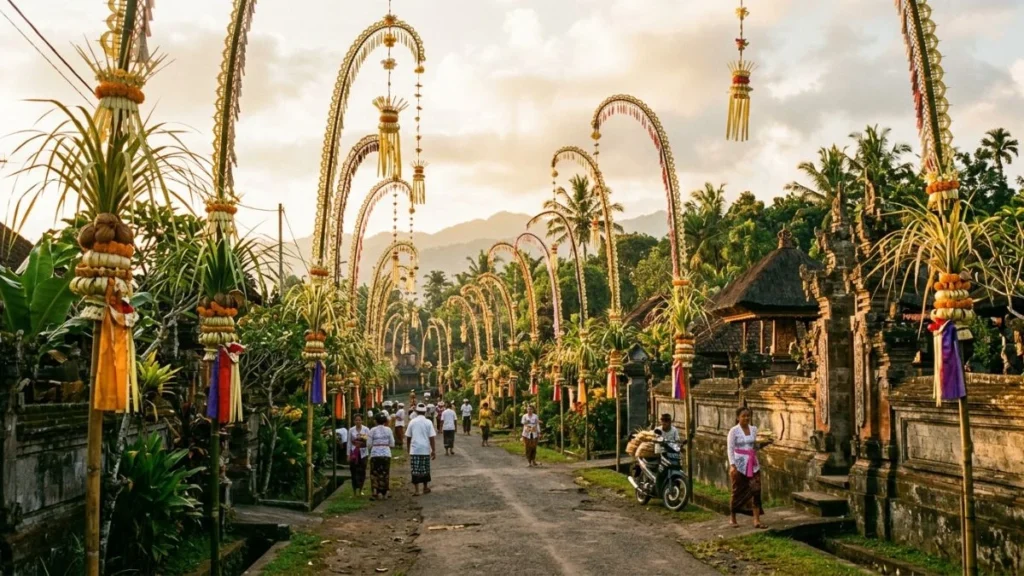
The visible marker of Galungan is everywhere: penjor poles — tall bamboo poles decorated with coconut leaves, fruit, flowers, and woven palm ornaments — are erected outside every family compound and temple in Bali, lining the roads in a way that is genuinely unlike anything else you’ll see in Southeast Asia. Each penjor is made by hand within the compound it stands in front of. The process of making them begins days before Galungan itself.
On Galungan day, families dress in traditional ceremonial clothing and visit temples to make offerings. The streets are quiet in the morning — not because Bali has shut down, but because most of its residents are occupied with something more important than tourism. By afternoon, the processions begin.
For visitors, this creates two distinct experiences depending on how you approach it. If you arrive expecting normal service and open restaurants, some things will be closed or operating on reduced hours. If you treat the festival as the reason to be in Bali in June — positioning yourself in a village or at a temple route rather than a beach club — it becomes one of the more extraordinary things available to a traveller in this part of the world.
Where to See Galungan Well
Ubud and surrounding villages — the density of temples and family compounds in the Ubud area means penjor are on every road. Walking the village lanes of Penestanan, Nyuh Kuning, or Mas on Galungan morning puts you inside the celebration rather than watching it from outside.
Mengwi, Tabanan — the Pura Taman Ayun temple complex (one of Bali’s royal temples, UNESCO-listed) holds major ceremonies during Galungan. About 45 minutes west of Seminyak by scooter.
Besakih — Bali’s mother temple on the slopes of Mount Agung draws the largest ceremonial gatherings during Galungan. Two hours from Seminyak; the drive through East Bali on the festival day is an experience in itself.
Any village road, any part of Bali — the penjor lining every street are the festival. You don’t need to go anywhere specific to see them. They’re the whole island.
Practical Notes for Galungan
Some restaurants, shops, and services run on reduced hours on Galungan day itself (17 June). Accommodation staff may be on reduced teams. This is genuinely fine — plan a lighter day, eat at your hotel or villa, and spend the time walking rather than transacting. The day after Galungan, normal service resumes.
Where to Stay and What to Do in June
The distribution of June visitors across Bali follows a predictable pattern: south Bali (Canggu, Seminyak, Uluwatu) for beach and nightlife; Ubud for culture and rice terraces; Amed and the east coast for diving and a slower pace. All three are valid in June. The weather is good everywhere.
South Bali in June
June is good for surf on the west-facing breaks — Canggu’s Echo Beach, Batu Bolong, and Old Man’s are all working well. The water is clear. Beach clubs are operating at full capacity and the evenings in Seminyak and Canggu are warm enough to sit outside until late.
The Bukit Peninsula — Uluwatu, Bingin, Padang Padang — is worth visiting for the temples and the cliff scenery. Kecak dance at Uluwatu Temple at sunset is at its most dramatic in June’s clear-sky conditions. Note the wind consideration mentioned above: the water below the cliffs can be rougher than it looks from the top.
Ubud in June
June is one of the better months for Ubud. The dry season means the rice terraces are a deep green without the overcast skies of the wet months, and the Campuhan Ridge walk is dry underfoot. The Galungan festival during the third week of June transforms the town in a way that’s worth planning around rather than working around.
For a longer look at how to spend time in Ubud specifically, the things to do in Ubud Bali guide covers the full territory.
East Bali in June
Amed, Candidasa, and the Karangasem coast are at their best in the dry season. The water visibility for diving and snorkelling around the USS Liberty wreck at Tulamben is typically at its clearest June through August. The drive from Ubud to Amed (about 1.5 hours through the rice terraces of Sidemen valley) is one of the better road trips available in Bali and works well as a day trip or overnight.
What to Pack for Bali in June
The dry season is warm and sunny with low rain risk, but a few specifics are worth noting.
Light breathable clothing (linen, cotton) for the days. A light layer for Ubud evenings and air-conditioned restaurants — the temperature gap between outside and heavily air-conditioned interiors can be significant. Sun protection is more important than most visitors expect: UV index in Bali in June regularly reaches 11–12 (extreme), which means serious burn is possible in under 20 minutes without protection.
For Galungan temple visits: a sarong and sash are required at most temple entrances and are available to rent or buy at the gate. If you’re visiting multiple temples during the festival period, carrying your own is more convenient than renting repeatedly.
For the full Bali packing list broken down by activity and area, that guide covers the dry season specifics in more detail.
Crowds and Prices in June
June is mid-high season — busier and more expensive than April and May, less crowded and slightly cheaper than the July–August peak.
Accommodation prices in June run roughly 20–30% below peak July rates. Booking 4–6 weeks in advance secures reasonable availability at most price points. Last-minute availability exists but popular villas and smaller boutique properties in Ubud fill early.
Flight prices from Australia and the UK typically begin rising from late May as the school holiday period approaches. If you’re flexible on dates within June, the first two weeks tend to be cheaper than the last two, with the Galungan period (around 17–27 June) seeing a brief spike in domestic Indonesian visitors.
FAQ
Is June a good time to visit Bali?
Yes — genuinely one of the better months. The weather is reliably good, the wet season is over, and the July–August peak hasn’t arrived. The Galungan festival in mid-June 2026 adds something significant for travellers interested in Balinese culture.
What is Galungan and should I plan my trip around it?
Galungan is the most important festival in the Balinese Hindu calendar, celebrated across the entire island. In 2026 it falls on 17 June. If you’re in Bali around this date, plan to spend the day in a village or near a temple route rather than at a beach club. The penjor-lined roads and ceremonial activity are worth experiencing. Some services run on reduced hours on the day itself.
Is June too hot in Bali?
No. June temperatures (26–30°C in the south, slightly cooler in Ubud) are warm but not oppressive, and the lower humidity of the dry season makes the heat more comfortable than the same temperature during the wet months. UV levels are high — sun protection is genuinely important.
How crowded is Bali in June?
Busier than the shoulder months (April–May) but below the July–August peak. Tourist areas in south Bali are active; Ubud is manageable. If crowd avoidance is a priority, base yourself slightly outside the main tourist centres — Penestanan rather than central Ubud, Pererenan rather than central Canggu.
Is June good for surfing in Bali?
Yes. June marks the beginning of the best surf season on the west-facing breaks (Canggu, Echo Beach, Medewi, Uluwatu). Consistent Indian Ocean swells arrive from the south, and the dry season conditions mean cleaner waves and better visibility. For beginners, Batu Bolong and Old Man’s in Canggu are the standard starting points.
June in Bali is the month where the island is operating at close to its best without operating at maximum capacity. The weather delivers. The festival cycle in the third week turns the island into something that isn’t available at any other time of year. The surf is working. The rice terraces are green.
The bali in june picture is straightforward: if you can travel in the first half of June, you get the dry season conditions and the festival without the late-June price rise that precedes the July peak. If Galungan is the draw, plan to be in Ubud or a village setting rather than a beach resort on 17 June itself. Either way, June is not a month that requires much defending as a choice.
For planning the rest of the itinerary, the Ubud market guide and the things to do in Ubud Bali guide cover the cultural interior. For entry requirements and what’s changed for 2026, the bali travel advisory 2026 has the current picture.