
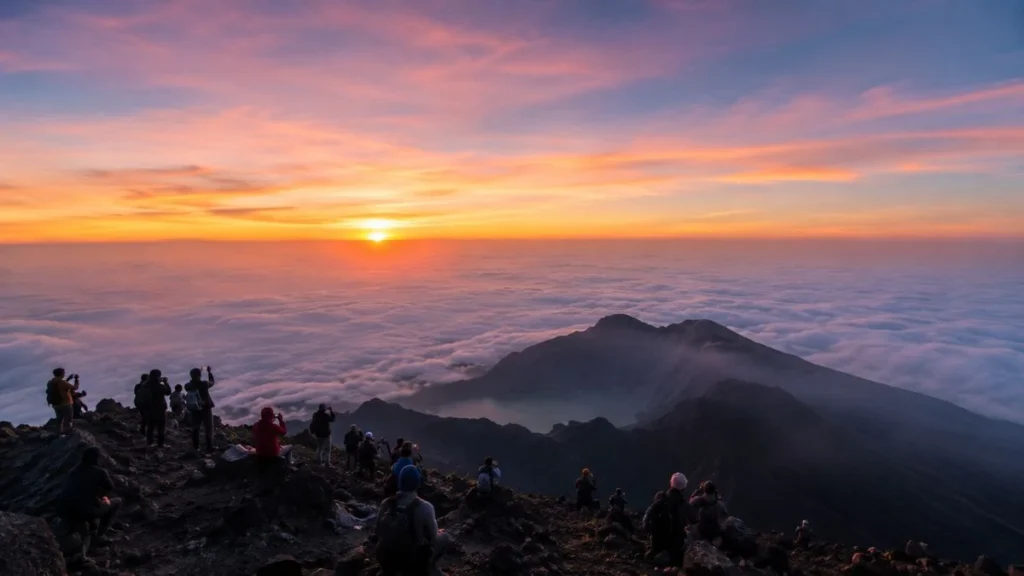
Kintamani Bali sits up in the island’s central highlands, and it’s the one part of Bali that genuinely feels like a different climate zone — cool mornings, coffee farms, and an active volcano rising out of a crater lake. Most people who make the drive from Ubud are here for one thing: the Mount Batur sunrise trek. But Kintamani Bali is worth understanding beyond just the 2am wake-up call, because the region has quietly grown from a quick pit stop into a place people now stay a night or two.
This guide covers what the sunrise trek actually involves (including the guide requirement nobody explains well beforehand), what you’ll pay at the various entrance points, and whether Kintamani Bali deserves more of your itinerary than a single rushed morning.
Kintamani is about 1.5–2 hours from central Ubud by car, roughly 40 km, along winding highland roads that climb steadily from rice terrace elevation into pine forest and volcanic rock.
Quick Facts
- Distance from Ubud: ~1.5–2 hours / 40 km
- Mount Batur elevation: 1,717 metres, an active volcano last erupting in 2000
- Sunrise trek: starts around 2–4am, guide required by local regulation, 1.5–2 hours up, moderate difficulty
- Entrance/viewpoint fees: around IDR 50,000 per adult at official Kintamani Special Tourism Area (KSTP) counters, separate from the volcano trekking fee (~IDR 100,000–150,000)
- Best weather window: mornings, roughly 9am–1pm, before cloud and fog roll in
- Best season: dry season, April–October, for clearer sunrise views
The Mount Batur Sunrise Trek: What Actually Happens
The sunrise trek is the reason most people come to Kintamani Bali, and it’s a genuinely good hike — but it starts absurdly early. Expect pickup from Ubud around 2am, hiking boots on the trail by 3:30–4am, climbing roughly 700 metres of elevation over 4–5 km of loose volcanic gravel and narrow paths to reach the summit before first light. Most people take 1.5–2 hours up and slightly less coming down.
Here’s the part that surprises first-timers: a registered local guide isn’t optional. There are checkpoints at the base, and the local trekking association enforces this firmly — travelers sometimes call it heavy-handed, but that’s how the system works here, and trying to hike solo will get you turned back rather than let through. On the practical side, going with a guide does make the dark trail safer, and most guided treks include a simple breakfast cooked using the volcano’s own steam vents, which is a nice touch.
It gets cold at the top — expect 10–15°C before sunrise — so bring a layer even though you’re in tropical Bali. Trails can also turn muddy and views can get rained out entirely outside the April–October dry season, so if you’re visiting in the wet months, treat the sunrise as a possibility rather than a guarantee.
Skip the Hike: Jeep Tours and Other Options
If the 2am wake-up and steep gravel trail don’t appeal, a 4WD jeep tour takes you up a separate trail to a sunrise viewpoint on the lava fields without the climb. It’s a different experience — less physical, more comfortable, and still genuinely scenic — running roughly IDR 800,000–1,200,000 depending on group size. ATV tours across the lava fields are also available for those who want more activity without a full hike.
If you’re not up before dawn at all, the crater rim viewpoints are worth a mid-morning visit on their own. Penelokan viewpoint is the classic stop — full panorama of Lake Batur and the volcano — and several cafes along Jalan Raya Penelokan let you take in the same view with a slower cup of coffee instead of a headlamp.
Entrance Fees: Where the Confusion Comes From
Be honest with yourself about this before you go: the entrance fee system in Kintamani Bali is confusing, and it’s not just you. The region operates under something called the Kintamani Special Tourism Area (KSTP), which collects entrance fees at multiple separate points — Penelokan viewpoint, the Batur Geopark Museum, and individual attractions like Penglipuran Village if you’re combining stops. Expect around IDR 50,000 per adult and IDR 30,000 per child at these official counters, plus parking (IDR 10,000 cars, IDR 5,000 scooters).
This is separate from the Mount Batur trekking fee, which runs roughly IDR 100,000–150,000 and is usually bundled into your sunrise tour price rather than paid separately. A viral video in early 2026 raised questions about whether these multiple checkpoints were legitimate; local tourism officials confirmed the fees are real and tied to local government policy, not a scam — but the advice still stands to pay only at counters with uniformed staff and to keep your dated ticket. Cash only, everywhere, so bring small notes.
Beyond the Volcano: What Else Is Up Here
After the trek, most people head to the hot springs by the lake — Toya Devasya or the quieter Batur Natural Hot Spring — to soak out the climb, usually for an additional IDR 150,000–200,000. Kintamani is also Bali’s main highland coffee region, and several farms around town let you walk through the process, including the (expensive, divisive) kopi luwak.
If you’re staying overnight rather than doing the rushed day-trip version, the choice comes down to crater rim versus lakeside. Staying up on the rim near Penelokan means waking up to the volcano view directly outside your window. Staying down near Toya Bungkah by the lake feels more remote and rural, and puts you closer to the hot springs and trailhead — worth it specifically if you’re doing the sunrise trek and don’t want a 2am drive up from Ubud.
Is Kintamani Bali Worth It From Ubud?
Honestly, only if you commit to either the early start or an overnight stay. Doing Kintamani Bali as a single rushed midday stop between other East Bali attractions means arriving after the clouds have usually rolled in, which is the least impressive way to see the caldera. If sunrise isn’t your thing, aim to arrive by mid-morning at the latest, before the afternoon fog settles in.
FAQ
How far is Kintamani from Ubud?
About 1.5–2 hours by car, roughly 40 km, mostly uphill on winding highland roads.
Do I need a guide to hike Mount Batur?
Yes. Local regulations require a registered guide, enforced at checkpoints at the trailhead. Solo hiking isn’t permitted in practice, regardless of experience level.
How much does the Mount Batur sunrise trek cost?
Budget group hikes start around IDR 300,000–400,000 (roughly £7–15), while private guided treks with breakfast run higher, up to around IDR 800,000 (£30–40). Jeep tours that skip the hike entirely cost roughly IDR 800,000–1,200,000.
What is the Kintamani entrance fee actually for?
It covers access to official viewpoints and attractions within the Kintamani Special Tourism Area, roughly IDR 50,000 per adult, paid separately from the volcano trekking fee. Multiple checkpoints exist because different sites (viewpoints, museum, villages) each have their own counter.
When is the best time to visit Kintamani Bali?
Dry season (April–October) for the clearest sunrise views. If you’re not trekking, arrive by mid-morning — clouds and fog typically roll in by early afternoon regardless of season.
Final Thought
Kintamani Bali rewards commitment more than most places near Ubud — either get up in the dark for the trek, or plan to arrive early enough to beat the fog. Do it halfway and you’ll leave wondering what the fuss was about. If you’re mapping this into a longer loop, our guide to Bali road trip through East Bali covers how to pair Kintamani with other highland and coastal stops, and if waterfalls are also on your list, best waterfalls near Ubud fits well into the same general direction of travel.