
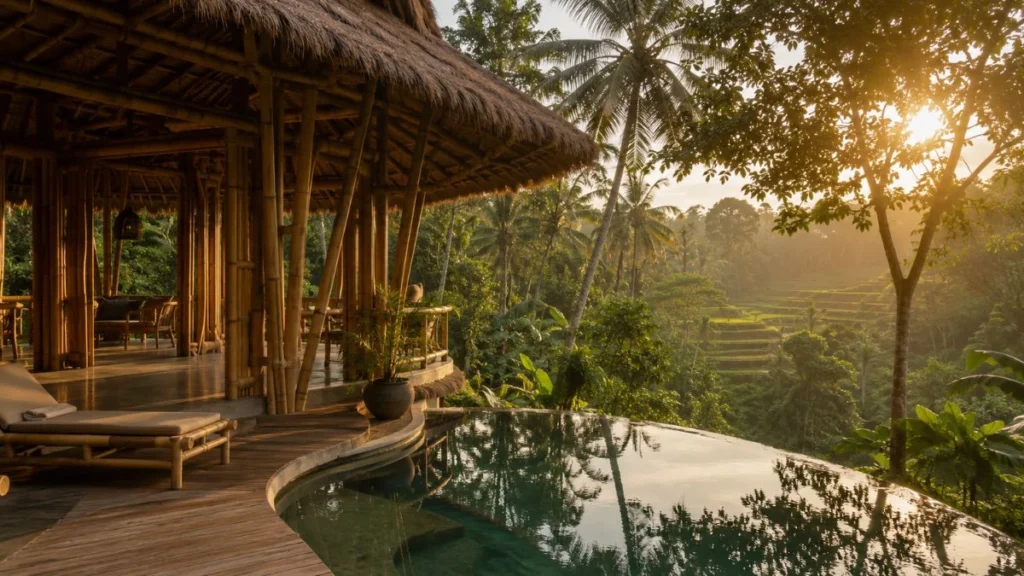
“Eco” gets slapped on a hotel’s homepage in Bali almost as often as “boutique” does. A rattan lampshade and a sign asking you to reuse your towel does not make a resort sustainable — but a genuine handful of properties on this island are doing something real: solar power that actually runs the place, water systems that don’t drain the local water table, architecture built from bamboo and reclaimed wood instead of imported concrete, and kitchens sourcing from farmers a few kilometres away instead of a supplier truck from Denpasar.
If you’re looking for eco resorts in Bali that back up the label with actual practice, the shortlist is smaller than the marketing copy suggests, and it’s worth knowing which ones are genuinely off-grid, which are luxury properties with a sustainability department, and which are simply well-designed and nothing more. Most of the credible ones cluster around Ubud and the hills above it — river valleys, jungle slopes, rice terrace edges — because that terrain lends itself to the building style and because Ubud’s own culture of environmental consciousness (Green School, permaculture farms, the Tri Hita Karana philosophy) gives these places a community to plug into.
This guide focuses on stays that go past the surface: renewable energy that’s structural rather than symbolic, materials sourced within Bali, and some connection to the surrounding community rather than just the surrounding view.
Quick Facts
- Where the real ones cluster: Ayung River valley (Ubud), Mount Batukaru foothills (Tabanan), Sayan, and West Bali National Park
- Price range: From dorm-style budget stays to five-figure-USD-per-night luxury tents — eco doesn’t mean cheap or expensive by default
- Best time to visit: April–October (dry season) if the property emphasizes outdoor pools, open-air bathrooms, or garden dining — these designs feel very different in a downpour
- What “eco” should mean here: renewable energy in daily use, local material sourcing, water/waste management, and community involvement — not just an aesthetic
What Separates Genuine Eco Resorts From Greenwashed Ones
A resort that’s actually sustainable will usually be specific about how. If a property’s website talks in vague terms about “harmony with nature” but can’t tell you their energy source, water treatment method, or where their food comes from, that’s your first flag. The properties worth your money tend to disclose specifics: hydropower from a named waterfall, solar capacity in kilowatts, a named organic farm supplying the kitchen, or certification from bodies like EarthCheck or B Corp.
It also matters whether sustainability shapes the architecture or just sits on top of it. Bamboo construction, thatched roofing, natural cross-ventilation instead of air conditioning, and open-sided common areas aren’t decoration — they’re functional choices that reduce a building’s energy footprint. A concrete resort with solar panels bolted to the roof is doing something, but it’s a different category of effort than a resort that never needed the panels to begin with because the design solved for cooling naturally.
Where the Genuinely Sustainable Stays Are
Ayung River valley, Ubud. This stretch is where Bali’s eco-luxury movement really started. Properties here are built from reclaimed antique timber and custom bamboo, set into permaculture gardens and rice paddies that are still farmed using traditional methods, including duck-based rice paddy fertilisation instead of chemical alternatives. Expect uneven floors, open-air bathrooms, and no air conditioning by design — this is not the stay for someone who wants a sealed, climate-controlled hotel room. It suits travellers who want the eco commitment to be felt in the room itself, not just read about in a brochure.
Mount Batukaru foothills, near Tabanan. Further from Ubud’s centre and considerably quieter, this area has lodges running almost entirely off hydropower from nearby waterfalls, using filtered spring water across the property and composting or recycling all waste on-site. The trade-off is distance — you’re looking at over an hour from Ubud on winding roads, and the isolation means fewer dining options nearby. What you get in return is a property whose sustainability isn’t performative because there’s no tourist foot traffic to perform for.
Sayan and the rice terrace edges outside Ubud. A handful of resorts here are built entirely from locally sourced materials without heavy machinery, and they run genuine waste-minimisation programmes rather than the usual “please reuse your towel” card. Several are B Corp certified, which at least means someone external has checked the sustainability claims rather than the resort grading its own homework. Some of these also run on a tiered pricing model — shared dorm rooms alongside private villas — so the eco-conscious budget traveller and the honeymoon couple can stay at the same property without either compromising.
West Bali National Park. This is the outlier on the list — genuinely far from anything, inside a protected wildlife area most tourists never reach. Properties here run on full solar power, water-efficient fittings, and zero single-use plastic as standard practice, not a marketing add-on. If your Bali trip is Ubud-and-beach focused, this isn’t a convenient add-on stay; it’s a dedicated detour, best paired with a few days of wildlife-watching rather than treated as a base for day trips.
What to Actually Ask Before You Book
Before paying an eco-premium, it’s worth emailing the property directly and asking three things: their energy source and whether it’s the primary or backup power, where their food is sourced from, and what happens to greywater and waste on-site. A resort with a real sustainability programme will answer these specifically and quickly, because they’ve answered them before. A resort that responds with marketing language about “eco-luxury journeys” without naming a single system is telling you something too.
It’s also worth being honest with yourself about comfort trade-offs. Genuine off-grid or near-off-grid properties often mean no air conditioning, intermittent hot water depending on solar load, and slower Wi-Fi than a five-star chain hotel. None of that is a flaw — it’s the actual cost of lower energy consumption — but it’s not what everyone wants on a two-week trip, especially travelling with young kids or during Bali’s hottest stretch from August to October.
FAQ
Are eco resorts in Bali more expensive than regular hotels?
Not inherently. Some of the most committed properties — particularly the B Corp–certified ones near Sayan — run tiered pricing with dorm or shared-room options specifically so budget travellers aren’t priced out of a sustainable stay. The luxury tented and jungle-villa properties near Ubud’s river valleys are expensive, but that reflects their five-star positioning more than their sustainability practices.
Do eco resorts in Bali have air conditioning?
Many genuinely sustainable properties don’t, by design — natural ventilation and shade are part of what keeps their energy use low. If air conditioning is non-negotiable for you, check specifically before booking, since it varies room to room even within the same resort depending on the building style.
Is Bambu Indah worth staying at, or just worth visiting for the day?
Both, depending on your priorities. It’s one of the more established names in Bali’s eco-luxury space, built from reclaimed antique houses and bamboo structures set in permaculture gardens along the Ayung River. Day passes exist if you just want to see the grounds and eat at the riverside restaurant without the overnight price tag — a reasonable option if you’re staying elsewhere in Ubud and curious rather than committed.
How do I know a “sustainable resort” isn’t just greenwashing?
Look for specifics, not adjectives. A credible property names its energy source, water system, and food sourcing rather than describing itself only in terms like “eco-luxury” or “in harmony with nature.” Third-party certification (B Corp, EarthCheck) is a useful but not perfect signal — it means someone outside the resort has checked the claims.
Are eco resorts near Ubud walkable to town, or do I need transport?
It varies a lot. Some river-valley properties are a short scooter or car ride from Ubud centre; the Batukaru and West Bali properties are considerably further and require a private driver or rental car, since there’s no practical way to reach them on foot or by regular transport.
Final Thought
Bali’s tourism boom has made “eco” one of the most overused words on the island’s hotel listings, but the genuine article still exists if you know what to check for — energy source, materials, water management, and who’s benefiting from your stay beyond the resort’s own bottom line. If you’re building out a slower, more intentional Bali itinerary, pairing a stay like this with time in Ubud’s markets and rice terrace villages rounds out the trip in a way a beach resort alone won’t. For the practical groundwork — what to pack, what a realistic budget looks like, and how to structure a slower trip around Ubud — it’s worth reading through our Ubud market guide and Bali slow travel itinerary before you lock in where to stay.