
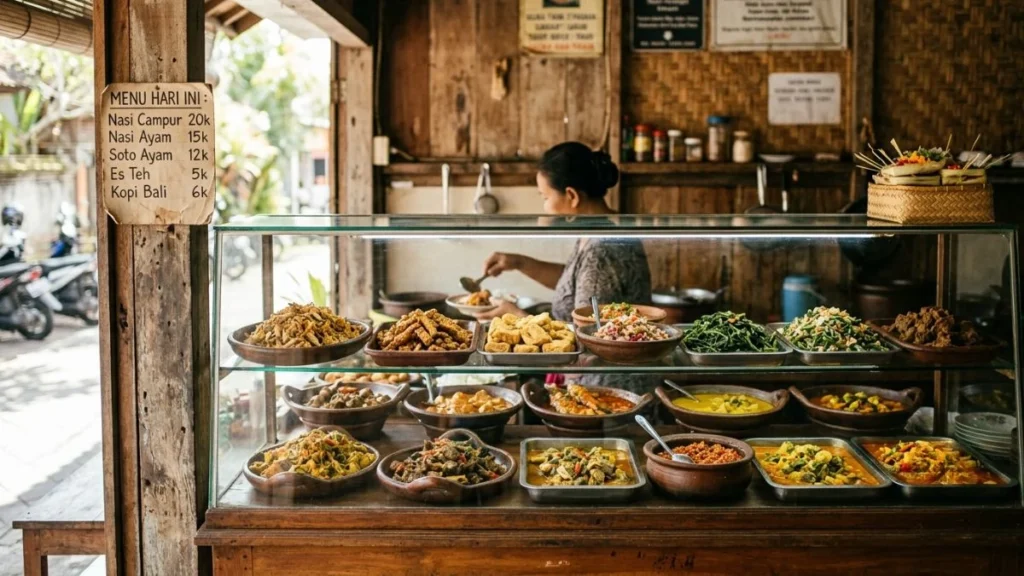
Best warung Ubud honest guide: Ubud’s warung scene has two distinct layers — the back-lane family operations that have been cooking the same food for the same community for decades, and the warung-branded tourist restaurants that use the word as a pricing and atmosphere strategy. Both exist on the same streets, often within fifty metres of each other. Knowing which is which before you sit down saves both money and expectation.
This best warung Ubud honest guide covers the family-run eating operations worth seeking out, organised by what each one does best, alongside the context that makes each recommendation meaningful rather than just a name and an address. Ubud has more warungs per square kilometre than any other area of Bali, partly because it has the cultural density that produces food culture and partly because the expat and long-stay visitor community that lives here has sustained a demand for genuine local cooking at local prices for long enough to keep real warungs viable alongside the tourist economy.
For the broader picture of Balinese food — what the dishes are, how the spice paste works, and why some versions are better than others — the Bali food guide local eating covers the foundational knowledge that makes any warung visit more rewarding. This guide assumes you have that context and want specific Ubud recommendations.
The Ubud Warung Landscape in 2026
Ubud’s main streets — Jalan Monkey Forest, Jalan Hanoman, Jalan Dewi Sita — are lined with establishments that use “warung” in their name or describe themselves as warungs while charging restaurant prices and serving tourist-adjusted food. This is not dishonest — the word has genuinely expanded in meaning to cover a broad range of informal eating establishments. But the original meaning — a family-run counter operation where the family cooks what they eat, charges what it costs, and serves on plastic chairs — is still present in Ubud on the back lanes and village streets that run alongside the tourist infrastructure.
The distinction worth maintaining: a genuine Ubud warung costs IDR 25,000–50,000 for a full meal. A tourist-facing warung in the same area costs IDR 80,000–180,000 for the same format. The food at the genuinely local version is, with very few exceptions, better.
Warung Ibu Oka — The Babi Guling Benchmark
Warung Ibu Oka is the most famous warung in Ubud and occupies an unusual position — genuinely excellent food that has been operating long enough and consistently enough that its fame has not degraded its quality. The primary branch on Jalan Tegal Sari is the most locally oriented; branches at Jalan Suweta and elsewhere have moved slightly toward tourist-facing operations, but the food at all three reflects the same daily fresh-roasted standard.
The pig is roasted each morning and sold until gone — typically by early afternoon. The babi guling plate includes crispy skin, seasoned meat, lawar, blood sausage (urutan), and rice. The crispy skin is the marker: properly roasted and correctly seasoned babi guling has skin that shatters rather than bends. If the skin is soft, it was roasted too long ago or at the wrong temperature.
Arrive before 11am for the full selection. The blood sausage (urutan) is an optional addition that most visitors skip — it is worth trying once for the specifically Balinese flavour profile it represents.
Location: Jalan Tegal Sari No. 2, central Ubud. Hours: From 9am until sold out (typically 1–2pm). Price: IDR 50,000–80,000 for a full plate. Cash only.
Nasi Ayam Kedewatan — For the Most Genuinely Local Nasi Campur
Nasi Ayam Kedewatan is the warung most consistently recommended by Ubud’s long-term expat and local resident community as the most genuinely un-touristified nasi campur operation in the area. It sits on Jalan Raya Kedewatan in Kedewatan village, 3km northwest of central Ubud — far enough from the tourist centre to have maintained a predominantly local clientele.
The format is standard nasi campur counter service: a selection of daily dishes including chicken preparations, spiced vegetables, tempeh and tofu, sambal in several heat levels, and whatever the kitchen made that morning. The difference from the tourist-facing version of the same format is the spice paste — more shrimp paste, less palm sugar, more galangal than the adjusted version most tourists encounter on the main streets.
Getting here requires a scooter or a 30-minute walk from central Ubud. The walk along the Campuhan ridge path connects to the Kedewatan road through Penestanan — a route worth doing independently of the food destination.
Location: Jalan Raya Kedewatan No. 18, Kedewatan. Hours: 7am–3pm, until sold out. Price: IDR 25,000–45,000. Cash only.
Warung Babi Guling Pak Malen — The Less-Famous Alternative
Pak Malen operates a babi guling counter on the outskirts of Ubud without the fame or the queue of Ibu Oka. The pig is roasted to the same daily-fresh standard; the preparation has a slightly different spice balance — more turmeric, less lemongrass than the Ibu Oka version — that reflects the specific family recipe rather than a generic Ubud babi guling standard.
This is the warung to visit when Ibu Oka is sold out, when the queue at the main branch is longer than you want to wait, or when you want to compare two daily-fresh preparations side by side across two mornings. The differences between the two are small but specific — turmeric weight in the skin, chilli heat in the lawar — and worth noticing if the ceremonial food culture of Bali is what you came to understand.
Location: Back streets of Ubud, best found via Google Maps or local recommendation. Hours: 9am–2pm. Price: IDR 45,000–70,000. Cash only.
Siboghana Warung — The Best Vegetarian Option
Siboghana is a family-run operation in a garden compound on Jalan Made Lebah — a lane behind the main Ubud streets that most visitors do not walk. The entire menu is vegan. The cooking uses Balinese spice logic — basa gede, fresh galangal, kencur, coconut milk — applied to plant-based ingredients rather than meat.
The nasi campur plate here is one of the most consistently praised dishes by long-term Ubud residents who eat plant-based. The garlic satay mushroom skewers are the specific item most worth ordering. The setting — a family garden with small shrines visible from the eating area — is as close to eating inside a Balinese compound as a visitor-facing operation gets in Ubud.
Prices are genuinely low: nasi campur at IDR 35,000 is the most expensive item on the menu. This is not a wellness café with warung branding — it is a family operation that runs on the same economics as any genuine warung.
Location: Jalan Made Lebah No. 36, Ubud. Hours: Lunch and dinner, variable — check recent Google reviews for current hours. Price: IDR 5,000–35,000. Cash only.
Compound Warung — The Best Mid-Range Option
Compound Warung sits in a different category from the others on this list — it has a longer queue than most tourist restaurants, appears in international travel guides, and charges slightly more than a genuine family warung (IDR 60,000–120,000 per meal). It is included because it represents the category of Ubud eating that bridges genuine food quality and visitor-accessible atmosphere without the full tourist-restaurant price adjustment.
The food is freshly cooked to order rather than from a pre-prepared counter. The Balinese dishes are made with stone-ground spice paste. The setting is an actual compound — open air, high ceiling, garden — rather than a designed tourist-restaurant interior.
The queue at dinner is real — 15 minutes is normal during peak season evenings. Arriving at 6pm rather than 7:30pm avoids most of it.
Location: Jalan Bisma area, Ubud — confirm current address via Google Maps as the exact location has had minor changes. Hours: Lunch and dinner. Price: IDR 60,000–120,000. Cash preferred; cards sometimes accepted.
Warung Teges — Rice Field Setting Without Rice Field Prices
Warung Teges is the warung that appears on the list of visitors who have already done the main-street options and want to eat in a genuinely rural setting. It sits on the eastern outskirts of Ubud near the Teges village area, surrounded by rice fields with views across the paddies from the eating area.
The food is standard warung format — nasi campur counter, daily fresh dishes, IDR 30,000–50,000. The setting is what makes it unusual: the rice field surroundings without the rice field view premium that Jalan Bisma accommodation charges. Long-stay expats who know Ubud’s food landscape recommend it consistently as the best combination of setting and price available within the Ubud area.
Getting here without a scooter requires a 30-minute walk east from central Ubud through the village lanes — a walk worth doing for its own sake.
Location: Teges area, east of central Ubud. Hours: 8am–4pm. Price: IDR 30,000–50,000. Cash only.
The Back-Lane Strategy: Finding Warungs Not on This List
The best warung discovery strategy in Ubud is not a list — it is a method. Walk the lanes that run parallel to the main tourist streets: Jalan Kajeng, Jalan Goutama, Jalan Sukma Kesuma, the Nyuh Kuning village lanes south of the monkey forest, and the Penestanan lanes west of the Campuhan bridge. On each of these lanes, warungs are visible from the street by the counter display of dishes behind glass and the plastic chairs on a concrete floor.
The indicators that a warung is genuine rather than tourist-facing:
- Cash only signage
- Price board in Indonesian only
- Counter display of pre-cooked dishes rather than a printed menu
- Family members of different ages present
- Predominantly local clientele at lunchtime
Any warung meeting three or more of these criteria in the back lanes of Ubud is worth sitting down at. The food will be made with the same daily-fresh ingredients and stone-ground spice paste as the named establishments above — without the name recognition and without the queue.
Pita had been in Ubud for ten days when she walked into a lane she had not noticed despite passing the junction every morning. The warung she found — no sign in English, two plastic tables, a glass counter with twelve dishes — charged her IDR 35,000 for nasi campur with five dishes and a cup of sweet black coffee. She came back every morning for the remaining four days of her stay. She does not know the warung’s name. She described it as being on a lane going east from the junction near the bridge. It is not on any list. It does not need to be.
FAQ
What is the best warung in Ubud for nasi campur?
Nasi Ayam Kedewatan in Kedewatan village, 3km from central Ubud, is the most consistently recommended by Ubud’s long-term resident community for genuinely local nasi campur — spice paste made in the traditional way, prices calibrated for local incomes, and a clientele that is predominantly Balinese. For visitors who want a nasi campur warung walkable from central Ubud, the back lanes around Jalan Goutama and Jalan Kajeng have several family operations with rotating daily menus.
Where is the best babi guling in Ubud?
Warung Ibu Oka on Jalan Tegal Sari is the most famous and most consistent — pig roasted fresh daily, sold until gone, with the crispy skin and seasoned lawar that define the dish. Arrive before 11am for the full selection. Warung Babi Guling Pak Malen is the less-famous alternative with a different spice balance worth visiting for comparison.
Are there good vegetarian warungs in Ubud?
Yes. Siboghana Warung on Jalan Made Lebah is the most consistently recommended fully vegan warung in Ubud — Balinese spice-logic applied to plant-based cooking at genuine warung prices (IDR 5,000–35,000). The 9 Angels and 9 Bamboo community warung operates on an honesty-box payment system and is worth experiencing once for its community model alongside the food.
How do I find a genuine warung in Ubud rather than a tourist restaurant using the word warung?
Walk the back lanes parallel to the main tourist streets — Jalan Goutama, Jalan Kajeng, Nyuh Kuning village lanes, Penestanan lanes. Look for: cash-only signage, counter display of pre-cooked dishes, Indonesian-only price board, family members of different ages present, and predominantly local clientele at lunchtime. Any warung meeting these criteria is genuine. The named establishments on this list are verified starting points; the unnamed ones on the back lanes are often equally good.
How much should I pay at a genuine warung in Ubud?
IDR 25,000–50,000 for a full nasi campur plate with drink at a genuine Ubud warung. Babi guling speciality operations charge IDR 50,000–80,000. Any warung in Ubud charging IDR 80,000+ for a basic nasi campur plate is tourist-facing regardless of its name or aesthetic.