
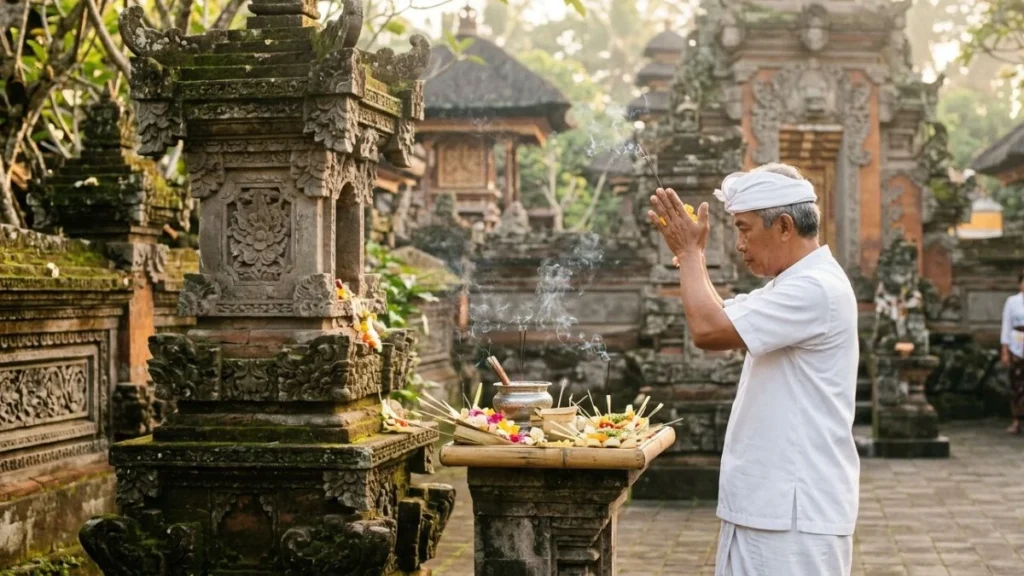
Balinese Hindu beliefs explained: Balinese Hinduism — formally called Agama Hindu Dharma — is a distinct form of Hinduism that integrates Indian Hindu theology with Balinese animism and Buddhist philosophy. The result is a belief system that is simultaneously ancient and specific to this island, and that shapes every visible aspect of Balinese life from the daily offering on the pavement to the orientation of a family compound gate.
The balinese hindu beliefs explained clearly start with one clarification: Balinese Hinduism is not a simplified or corrupted version of Indian Hinduism. It is a distinct tradition that developed over approximately a thousand years through the layering of Indian Hindu theology, Mahayana Buddhist influence, and an indigenous animist worldview that predated both. The result is a living religion that operates at the level of daily practice rather than weekly attendance — present in the canang sari placed before 8am every morning, in the direction a house gate faces, in the specific day chosen for a cremation, and in the communal structure that gathers hundreds of people to carry a cremation tower through the streets.
Understanding these beliefs does not require becoming a scholar of comparative religion. It requires knowing five foundational ideas that explain almost everything a visitor sees in Bali. This article covers all five, plus the philosophical framework that ties them together.
For the physical expression of these beliefs in architecture and spatial design, the Balinese family compound guide shows how the cosmological system described here is literally built into every home on the island.
The Supreme Deity: Sang Hyang Widhi Wasa
Indonesian law requires all recognised religions to be monotheistic — a legal framework that shapes how Balinese Hinduism formally presents itself. Balinese Hindus describe Sang Hyang Widhi Wasa as the supreme divine reality — the single source of all creation, from which all other deities are understood as manifestations.
In practice, Balinese Hindu worship addresses a large number of deities, ancestral spirits, nature spirits, and divine forces simultaneously. The formal monotheistic framing and the lived polytheistic practice coexist without contradiction in Balinese understanding — a feature of the tradition that Western frameworks of religious classification tend to find difficult and that Balinese Hindus themselves tend to find unremarkable.
The most important deities in the Balinese Hindu pantheon are the Trimurti in their Balinese forms: Brahma (creator, associated with the south direction and the colour red), Wisnu (preserver, associated with the north and black or dark green), and Siwa (transformer, associated with the centre and white). All three are present simultaneously in the porosan at the heart of every canang sari offering — betel, lime, and areca nut together representing the three in a single gesture of daily acknowledgment.
The Five Core Beliefs: Panca Sraddha
Balinese Hinduism is structured around five foundational beliefs called Panca Sraddha — the five articles of faith:
Widhi Tattwa — faith in Sang Hyang Widhi Wasa as the supreme divine reality. The foundation from which all other beliefs extend.
Atma Tattwa — belief in the eternal soul (atma). Every human being possesses an atma that does not perish with the physical body. The atma is the continuity of a person across lifetimes — distinct from the body, the personality, and the accumulated memory of a single life.
Karma Phala Tattwa — the law of cause and effect. Every action produces consequences that shape future experience, either in this life or in subsequent ones. The Balinese understanding of karma is not a moral accounting system managed by an external judge — it is understood as a natural law of consequence, as impersonal as physics.
Punarbhawa Tattwa — reincarnation. The atma is reborn across multiple lifetimes, carrying the accumulated karma of previous existences. In Balinese belief, reincarnation can occur within the same family line — a grandchild may carry the atma of a grandparent, which is why the relationship between the living and the ancestral dead is maintained through daily offering practice at the family compound shrine.
Moksa Tattwa — liberation. The ultimate goal of spiritual practice is moksa — freedom from the cycle of rebirth and reunion with the divine source. Moksa is achieved through the cumulative refinement of karma across lifetimes, the correct performance of religious duties (dharma), and devotion (bhakti). It is not a destination reached in a single lifetime for most people — it is the horizon toward which the entire cycle of birth, death, and rebirth moves.
These five beliefs are not abstract theology confined to priests and temples. They are the operating framework within which cremation ceremonies make sense (the atma needs to be released to continue its journey), within which daily offerings make sense (the divine is present and deserves daily acknowledgment), and within which the Balinese relationship to death makes sense (grief is understood as misplaced sentiment when the atma has simply moved to its next state).
Tri Hita Karana: The Philosophy That Governs Everything Spatial
Tri Hita Karana — literally “three causes of well-being” — is the philosophical framework that governs the relationship between the three realms that Balinese Hinduism considers essential to balance:
Parahyangan — harmony between humans and the divine. Expressed through temple building, daily offerings, ceremony, and prayer. The thousands of temples across Bali are the physical infrastructure of parahyangan — each one a maintained point of communication between the human community and the divine forces associated with that location.
Pawongan — harmony between humans and other humans. Expressed through the banjar communal system, gotong royong (mutual assistance), and the social obligations of community membership. The collective labour that carries a cremation tower, prepares offerings for an odalan, or maintains a village road is pawongan in practice.
Palemahan — harmony between humans and nature. Expressed through the subak cooperative irrigation system that has governed Balinese rice cultivation for over a thousand years, through the maintenance of forest reserves at temples and villages, and through the cosmological understanding that mountains, rivers, and the sea are not landscape features but inhabited by specific divine presences that require relationship.
Tri Hita Karana was recognised by UNESCO in 2012 as part of the inscription of the Bali Cultural Landscape — specifically the subak system that makes Jatiluwih’s rice terraces a World Heritage site. The recognition acknowledges that the landscape itself is an expression of a philosophical system, not merely an agricultural technique.
The spatial expression of Tri Hita Karana is visible everywhere in Bali: in the kaja-kelod orientation of compounds and temples toward Mount Agung, in the three-temple structure of every traditional village, and in the position of the family temple at the most sacred corner of every pekarangan.
The Caste System: What It Is and What It Is Not
Balinese society has a caste system derived from the Indian varna system but adapted significantly over centuries. The four warna in Balinese context:
Brahmana — the priestly caste. High priests (pedanda) who conduct the most elaborate rituals come from Brahmana families. The title Ida Bagus (male) or Ida Ayu (female) in a person’s name indicates Brahmana origin.
Ksatria — the warrior and noble caste. Historical Balinese royalty was predominantly Ksatria. Names including Anak Agung, Cokorda, or Dewa indicate Ksatria origin.
Wesia — the merchant and administrative caste.
Sudra — the largest group, encompassing most of the Balinese population including farmers, craftspeople, and service workers. Sudra names include Wayan/Putu (firstborn), Made/Kadek (secondborn), Nyoman/Komang (thirdborn), Ketut (fourthborn) — the cycle repeating for fifth, sixth, and subsequent children.
The practical significance of caste in daily Balinese life is less rigid than Indian equivalents and has been formally reduced by Indonesian national law. What remains is the ceremonial register — the specific titles used in formal address, the specific high priests (pedanda) who can conduct certain ceremonies that lower-caste priests (pemangku) cannot, and the social memory of family lineage encoded in names and titles.
For visitors, the most immediately relevant aspect of caste is the naming system: understanding that Wayan, Made, Nyoman, and Ketut are birth-order names used by Sudra families (the majority) explains why so many Balinese people appear to share the same first name — and why a driver named Wayan and a guesthouse owner named Wayan are not related.
The Relationship with the Dead: Ancestors as Active Participants
The Balinese understanding of death differs from most Western frameworks in a specific and practically important way: the dead are not absent. They are present in the family compound, at the family shrine, and in the daily offering practice that acknowledges them.
Balinese Hinduism holds that ancestral spirits (pitara) remain in communication with the living family between death and cremation, and that after a properly performed cremation and subsequent purification ceremonies, the atma may reincarnate within the same family line. The daily offerings at the family temple shrine maintain this relationship — they are addressed partly to the divine and partly to the ancestors, who are understood as watching over the family from their current state.
This explains several things that visitors find puzzling: why a Ngaben cremation ceremony is not sorrowful but purposeful (the family is performing their duty to release the atma), why the family compound temple shrines continue to receive offerings long after a household member has died, and why Balinese people often speak of deceased relatives in the present tense — not metaphorically but as a genuine reflection of their cosmological position.
Animism Within Balinese Hinduism: The Spirit World
Alongside the formal Hindu theological structure, Balinese Hinduism incorporates an animist understanding of the world that assigns spiritual presence to specific locations, objects, and natural features. Mountains, rivers, large trees, and crossroads are not neutral physical features — each has an associated spirit or deity that requires acknowledgment through the correct ceremony or offering.
The practical expression of this for visitors: the small shrines at the base of large trees in Bali (wrapped in black and white poleng cloth) are not decorative. They mark acknowledged spiritual presences. The offerings placed at crossroads during Tawur Kesanga before Nyepi are addressed to the spirit of the intersection. The temple at the summit of Mount Agung — Pura Besakih — is positioned there because Agung is understood as the physical abode of the divine, not merely because the view is impressive.
The animist dimension of Balinese Hinduism also explains the bhuta kala — demonic forces associated with lower realms of existence — whose appeasing and containment is the purpose of certain offerings (caru), certain ceremonies, and the logic of Nyepi itself.
How These Beliefs Connect to What You See in Bali
The framework above is not theoretical context — it is the direct explanation for specific visible things:
The canang sari on every pavement is Panca Sraddha in daily practice — an acknowledgment of Sang Hyang Widhi Wasa, the ancestors, and the animist presences of specific locations, compressed into a palm-leaf tray.
The orientation of compound gates toward kaja (Mount Agung) is Tri Hita Karana expressed spatially — the compound is positioned in relationship to the divine rather than to the road.
The three temples of every village (Kahyangan Tiga) are the structural expression of the three relationships of Tri Hita Karana at the community scale — one temple for the origin, one for the living community, one for the dead.
The cremation ceremony is Punarbhawa Tattwa in practice — the fire releases the atma from the physical body so it can continue its journey toward eventual moksa.
The daily offering circuit of a Balinese household is not religious observance in the Western sense of a weekly appointment. It is the active maintenance of all three relationships — with the divine, with the ancestors, and with the spiritual presences of the compound and its surroundings — that Tri Hita Karana requires to keep the household in balance.
FAQ
What religion do most Balinese people practise?
The majority of Balinese people practise Agama Hindu Dharma — Balinese Hinduism — which is Indonesia’s officially recognised form of Hinduism. Approximately 84% of Bali’s population is Hindu, making Bali the only majority-Hindu province in Indonesia. The religion is a synthesis of Indian Hindu theology, Mahayana Buddhist influence, and indigenous Balinese animism.
What is Tri Hita Karana in Balinese belief?
Tri Hita Karana translates as “three causes of well-being” and describes the three essential harmonious relationships in Balinese Hindu philosophy: harmony between humans and the divine (parahyangan), harmony between humans and other humans (pawongan), and harmony between humans and nature (palemahan). The principle governs Balinese architecture, agriculture, social organisation, and daily ritual practice. UNESCO recognised it in 2012 as part of the Bali Cultural Landscape World Heritage inscription.
What is karma in Balinese Hinduism?
In Balinese Hinduism, karma (karma phala) is understood as the natural law of cause and effect — every action produces consequences that shape future experience in this or subsequent lifetimes. It is not managed by an external judge but operates as an impersonal law of the universe. Accumulated karma across multiple lifetimes determines the conditions of each rebirth, with the ultimate goal being the refinement of karma over many lives until moksa — liberation from the cycle — is achieved.
What are Balinese Hindu names and what do they mean?
Most Balinese names encode birth order and caste. In Sudra families (the majority), the first child is named Wayan or Putu, the second Made or Kadek, the third Nyoman or Komang, and the fourth Ketut — the cycle repeating for subsequent children. High-caste families use different naming conventions: Brahmana families use Ida Bagus or Ida Ayu; Ksatria families use titles like Anak Agung, Cokorda, or Dewa. A Balinese person’s full name typically encodes both their birth order and their caste lineage.
What is moksa in Balinese belief?
Moksa is the ultimate spiritual goal in Balinese Hinduism — liberation from the cycle of death and rebirth (samsara) and reunion with the divine source, Sang Hyang Widhi Wasa. It is achieved through the cumulative refinement of karma across multiple lifetimes, devotion, and the correct performance of religious duties. For most Balinese Hindus, moksa is understood as a horizon toward which spiritual practice points rather than a destination reachable within a single lifetime.