
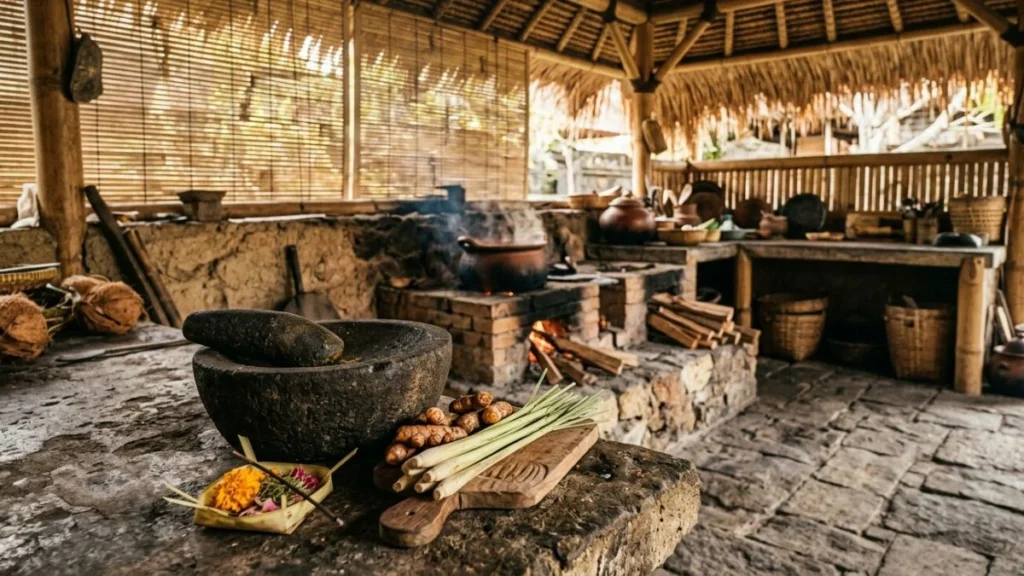
Balinese cooking class Ubud honest review: Ubud cooking classes range from hotel demonstrations with 30 participants to intimate family compound sessions where you cook in someone’s actual kitchen. The difference between the two is not price — it is what you actually learn and whether the experience has anything to do with how Balinese people cook at home.
This balinese cooking class ubud honest review covers the three main formats available, what each one delivers, the specific classes worth booking in 2026, and the one question to ask before you commit to any of them. Cooking classes in Ubud are one of the most reviewed activities in Bali — which means the bad ones are easy to avoid if you know what to look for, and the good ones are genuinely among the best cultural experiences the island offers.
The honest framing: a cooking class in Bali is not primarily about the cooking. It is about access — to a Balinese family compound, to a morning market before the tourist traffic arrives, to the specific flavour logic of a cuisine that uses ingredients most Western visitors have never handled. The cooking is the vehicle. The access is the value.
For visitors who have already learned about the structure of a Balinese family compound — the pekarangan layout, the family temple, the kitchen’s position in the kelod-kauh corner — a cooking class that takes place inside a real compound adds a physical dimension to that understanding. The Balinese family compound guide covers the spatial and cosmological logic you will literally be standing inside during the class.
The Three Formats: What They Are and What They Actually Deliver
Format 1: Hotel and Restaurant Classes
The most widely booked format — partly because they are the most visible on booking platforms and partly because the logistics are easy. You are collected from your hotel, taken to a restaurant’s kitchen or a hotel’s dedicated cooking classroom, and guided through three to five dishes with a professional chef.
What you get: A clean, organised cooking space, reliable equipment, a professional recipe handout to take home, and a meal at the end that tastes good.
What you do not get: Any connection to how Balinese people actually cook. Hotel kitchens and restaurant facilities are not family kitchens. The spice paste (basa gede) may be pre-measured. The fire may be gas rather than wood. The context — why these ingredients are combined this way, what ceremony this dish appears at, how the recipe changes between a north and south Balinese village — is typically absent.
Who it suits: Visitors who want a cooking activity rather than a cultural experience, or who have never cooked Asian food and want a structured introduction before attempting it at home.
Price range: IDR 350,000–600,000 per person including transport and meal.
Representative example: Paon Bali Cooking Class — one of the most consistently reviewed hotel-adjacent classes in Ubud. The market visit before the class is the strongest part; the cooking session itself is large (up to 20 people) but professionally run.
Format 2: Farm-Based Classes
A mid-point between hotel classes and family compound sessions. You visit an organic farm outside central Ubud — typically 20–40 minutes from town — harvest some of the ingredients you will cook, and prepare a meal in an open-air kitchen overlooking the farm or rice fields.
What you get: A more sensory and contextual experience than a hotel class — you handle fresh turmeric, lemongrass, and galangal as living plants before you cut them. The farm setting explains the agricultural side of Balinese cooking in a way that a restaurant kitchen cannot.
What you do not get: Entry into a family home or a family compound. The farm is a business, not a domestic space. The class is still designed for visitors.
Who it suits: Visitors who want more than a hotel class but are not specifically seeking a family compound experience.
Price range: IDR 400,000–750,000 per person including transport, farm tour, and meal.
Representative example: Pemulan Farm Cooking Class — located in a village outside Ubud, well-regarded for its vegetarian and vegan menu options, and strong on the agricultural context that other formats skip.
Format 3: Family Compound Classes
The format most directly aligned with what a Balinese cooking class can be at its best. You are hosted by a Balinese family in their own compound — cooking in their actual kitchen (paon), using ingredients from their garden or the local morning market, and eating in their courtyard.
What you get: Direct access to a working Balinese household. The host is not a professional instructor — she is a woman who cooks this way every day for her family. The knowledge she shares is not standardised for a visitor curriculum. It is specific to her family, her village, and her own practice.
What you do not get: The polish and organisation of a hotel class. Equipment is domestic rather than professional. Group sizes are small — typically 2 to 8 people — which means the experience is intimate but the logistics depend on your host’s availability.
Who it suits: Slow travellers specifically seeking cultural access and genuine household experience over a curated activity.
Price range: IDR 250,000–500,000 per person — often cheaper than hotel classes despite delivering a significantly richer experience.
Representative examples:
Putu’s class (bookable through Travelingspoon) — widely reviewed as one of the most authentic compound classes available in Ubud. Putu runs the class from her family’s multi-generational compound, includes a market visit, and teaches using her own recipes rather than a standardised tourist curriculum. Recent reviews from 2025 and early 2026 consistently describe it as the best meal of the trip.
Dewa’s class (bookable through Travelingspoon) — based in a village in north Ubud, includes a walk through the family compound and surrounding village community before cooking. Particularly strong for visitors interested in the cultural and ceremonial context of food alongside the cooking itself.
The One Question to Ask Before Booking Any Class
“Is this class held in a family home or a commercial kitchen?”
The answer determines almost everything else about the experience. A family home means a working kitchen in a pekarangan, ingredients from the family’s own garden or market, and a host who cooks this food because it is her family’s food. A commercial kitchen means a clean and reliable facility designed for visitors, where the cooking is the same every time because the same recipe is taught to the same group format.
Neither is dishonest. But the difference is the difference between an activity and an experience, and most visitors who have done both say they wish they had done the family compound format first.
What a Good Balinese Cooking Class Teaches
The dishes vary by class — nasi goreng, mie goreng, sate, lawar, be tutu (slow-cooked duck), tipat cantok (rice cake salad), jukut urab (spiced vegetable salad) — but the underlying lesson across all of them is the same: Balinese cooking is spice paste cooking. Every significant dish begins with basa gede — the great spice paste — or one of its variants, made fresh by grinding shallots, garlic, ginger, galangal, turmeric, lemongrass, candlenut, chilli, shrimp paste, and palm sugar together on a stone grinder (batu giling).
The stone grinder is not replaceable by a blender for this purpose. The grinding produces a different texture and a different oil release from the spices — which is why Balinese food cooked with a blended paste does not taste the same as Balinese food cooked with a ground paste. Learning to use the batu giling is the single most transferable skill a cooking class can teach.
A class that skips the batu giling and provides pre-made spice paste is teaching you to assemble Balinese food, not cook it.
Dishes Most Commonly Taught — and What They Mean
Nasi goreng — fried rice, the daily staple that uses leftover rice from the previous day. Its simplicity is deceptive — the spice paste version made with basa gede and fresh kaffir lime leaves is substantially different from the tourist restaurant version.
Lawar — a ceremonial dish of finely chopped vegetables, coconut, and spiced meat or tofu. In traditional practice, lawar is made in large quantities by groups of men for temple ceremonies. The version taught in cooking classes is a simplified household version.
Be tutu — duck rubbed with a complex spice paste and slow-cooked in banana leaves, traditionally prepared for major ceremonies. Making it properly takes several hours; most classes teach an accelerated version that captures the spice logic without the full ceremonial timing.
Jamu — traditional herbal drinks including turmeric, ginger, and tamarind preparations. Several Ubud cooking classes have added a jamu-making component to their programmes in the past two years, reflecting growing international interest in Balinese herbal medicine traditions.
Practical Booking Notes
Group size matters: A class with 8 or fewer people allows hands-on time at the stone grinder. A class with 20 people means observation more than participation. Ask about group size before booking.
Morning classes include a market visit: The Ubud morning market operates from approximately 4am to 9am — most cooking class market visits target the 6–8am window. This is the most useful part of many classes, because the market context — seeing the full spice inventory, understanding what is seasonal, watching vendors and buyers interact — is not replicable in a cooking space.
Transport is usually included for classes based in Ubud or within 30 minutes of the centre. Confirm before booking if your accommodation is outside the standard pickup radius.
Vegetarian and vegan options are available at most Ubud cooking classes — confirm at booking if this is a requirement. Pemulan Farm and several family compound classes are particularly strong on plant-based menus.
Booking platforms: Travelingspoon for family compound classes. Klook and GetYourGuide for hotel and restaurant format classes, with review filtering available. Airbnb Experiences for a middle category — often family-run but with platform verification.
Miriam had done a hotel cooking class in Thailand the year before and found it technically useful but culturally thin. In Ubud, a fellow guest at her guesthouse mentioned Putu’s class. Miriam arrived at the compound gate at 7am for the market visit, spent an hour at the Ubud morning market with Putu choosing ingredients she did not recognise, and spent the following three hours in Putu’s kitchen learning to use a stone grinder and discovering that the basa gede she had been trying to replicate from restaurant food for two years required galangal, not ginger, and a specific ratio of shallots to garlic that she had been consistently getting wrong. She said afterward that the class was the most immediately useful thing she had done in Bali, and that the food she cooked in Putu’s kitchen was better than anything she had eaten in a restaurant.
FAQ
Are Balinese cooking classes in Ubud worth it?
Yes, if you choose the right format. Family compound classes hosted by Balinese women in their own kitchens deliver genuine cultural access alongside the cooking skills — the experience is consistently described by recent visitors as one of the highlights of their Bali trip. Hotel and restaurant classes are worth it for visitors who want a structured activity; they are less valuable for visitors specifically seeking cultural depth.
What dishes do you learn in a Balinese cooking class in Ubud?
The core dishes taught across most Ubud cooking classes include nasi goreng (fried rice), sate ayam (chicken satay), lawar (ceremonial vegetable and meat salad), jukut urab (spiced coconut vegetable salad), and various sambal chilli pastes. The most important skill taught is making basa gede — the foundational Balinese spice paste — using a stone grinder rather than a blender.
How much does a cooking class in Ubud cost?
Hotel and restaurant classes cost IDR 350,000–600,000 per person including transport and meal. Farm-based classes cost IDR 400,000–750,000. Family compound classes cost IDR 250,000–500,000 — often the most affordable format despite being the most culturally substantive. All prices include the meal you cook.
How long does a Balinese cooking class in Ubud take?
Most classes run three to four hours including the market visit. The market portion takes one to one and a half hours; the cooking and eating portion takes two to three hours. Classes that skip the market visit run approximately two hours. Morning sessions starting at 7–8am are standard; some operators offer afternoon sessions without the market component.
Where can I book a Balinese cooking class in Ubud?
For family compound classes, Travelingspoon is the most reliable platform with verified reviews. Klook and GetYourGuide list hotel and restaurant format classes with user reviews. Airbnb Experiences covers a middle category of family-run classes with platform verification. Booking direct through accommodation is also reliable for guesthouses with local connections.