
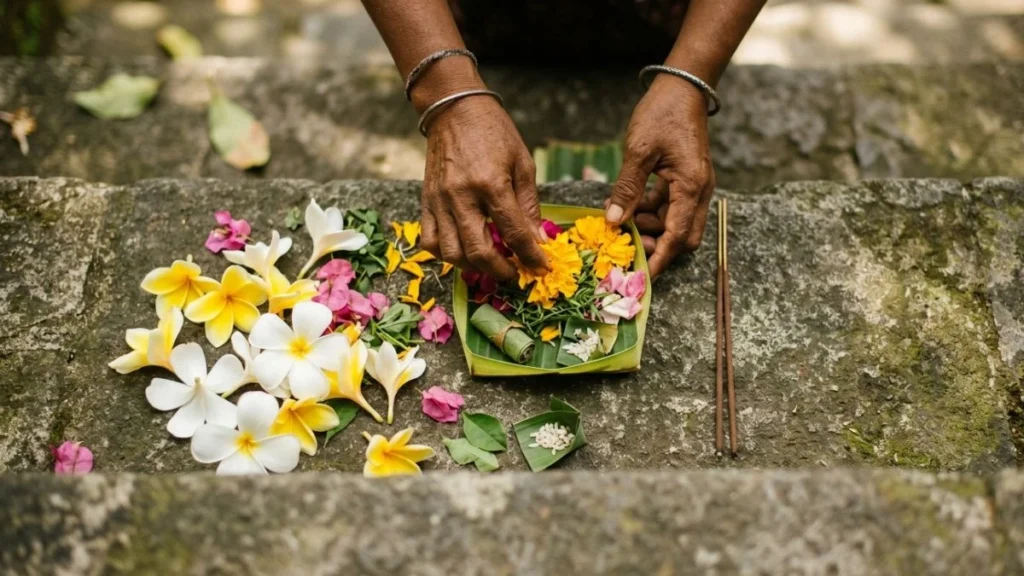
How to make canang sari Bali: Canang sari is a small woven palm leaf tray containing betel leaf, lime paste, areca nut, flowers in four directional colours, and incense — assembled daily by Balinese Hindu women as an offering of gratitude to the divine. The making is as much the practice as the placing.
Learning how to make canang sari Bali is the most direct entry point into understanding why Balinese Hindu life looks the way it does from the outside — why every shop entrance, temple gate, motorbike seat, and roadside shrine has a small flower arrangement sitting on it by 8am every morning, and why those arrangements are gone or scattered by evening, replaced fresh the following day.
Canang sari is not decoration. It is a daily act of communication between the household and the divine — an expression of gratitude for life, compressed into a palm-leaf tray small enough to hold in one hand. Balinese women make them every morning after bathing and before the household day begins. The process takes five to fifteen minutes depending on skill. The materials cost almost nothing. The practice has not changed in its essentials for centuries.
Understanding what you are looking at when you step around a canang sari on a Bali pavement changes the entire experience of the island. Understanding how to make one yourself — which any visitor can learn in a ninety-minute workshop — changes it further. For the broader context of how offerings function within the temple ceremony cycle, the odalan ceremony guide shows where canang sari sit within the larger structure of Balinese ritual practice.
What Canang Sari Is and What It Means
The word canang is Balinese in origin — ca means beautiful, nang means purpose. Sari means essence. The full phrase translates roughly as “the essence of a beautiful purpose.” The offering expresses gratitude to Sang Hyang Widhi Wasa — the Balinese Hindu concept of the supreme divine — and to the three principal deities of the Hindu Trimurti in their Balinese forms: Brahma (creator), Wisnu (preserver), and Siwa (transformer).
Every canang sari contains a physical representation of the Trimurti in its base layer: betel leaf, lime paste, and areca nut placed together in the centre of the tray. These three elements together are not arbitrary — they are a specific cosmological reference embedded in the most basic offering a Balinese Hindu can make.
The flower arrangement on top adds the directional cosmology: white flowers facing east (kangin), red facing south (kelod), yellow facing west (kauh), and blue or green facing north (kaja). The four directions and their associated deities are represented simultaneously in the colour arrangement of a single small tray.
Canang sari is placed accompanied by incense and a brief prayer. The smoke of the incense carries the essence of the offering upward. Once placed, the offering has served its purpose. It will disintegrate naturally, be taken by birds or insects, or be swept away — none of which diminishes or cancels the offering. The act of making and placing is the practice. The object is its vehicle, not its substance.
What You Need
Materials for canang sari are available at every traditional market in Bali — pasar in Ubud, Sukawati, and Denpasar all have dedicated offering sections. A day’s supply of materials for a single household costs IDR 5,000–15,000. Pre-made ceper (woven leaf trays) are widely available for those who do not weave their own.
For the tray base (ceper): Young coconut leaves (janur) or banana leaves, cut into strips approximately 20cm long and 3–4cm wide. Thin bamboo pins or toothpicks for securing the folded corners.
For the inner base layer: A small piece of betel leaf (daun sirih), a small dab of white lime paste (kapur sirih), a thin slice of areca nut (buah pinang), and a small piece of gambier (gambir). These four elements together form the porosan — the symbolic core representing the Trimurti.
For the flower layer: Fresh flowers in four colours: white (bunga putih — jasmine or frangipani work well), red (bunga merah — hibiscus or red frangipani), yellow (bunga kuning — marigold or yellow frangipani), and blue or green (bunga biru/hijau — blue hydrangea or pandan leaves folded as a base). The flowers should be fresh — using wilted flowers is considered disrespectful.
For placing: One stick of incense (dupa) per offering. A small amount of holy water (tirta) if available — sprinkled over the completed offering before placing.
How to Make Canang Sari: Step by Step
Step 1 — Weave the ceper Take a strip of young coconut leaf and fold it into a small square tray shape approximately 8–10cm across. The four corners are folded up to form low walls and pinned with bamboo pins or toothpicks. The tray should be sturdy enough to hold the flower arrangement without collapsing. This step requires practice — beginners typically find their first few trays unstable. Pre-made ceper from the market are a practical alternative while learning.
Step 2 — Place the porosan In the centre of the tray, place the small piece of betel leaf first. Add the dab of lime paste on top of it, then the thin slice of areca nut, then the gambier. This three-element combination — betel, lime, areca nut — is the porosan, representing the Trimurti. It sits at the foundation of every canang sari regardless of what is placed above it.
Step 3 — Arrange the flowers by direction Working outward from the porosan, arrange the flowers in four sections according to direction. The arrangement faces outward from the maker’s perspective: white to the east, red to the south, yellow to the west, blue or green to the north. If you are uncertain of actual compass direction, approximate. The intention of the arrangement is understood in the making.
In practice, Balinese women work quickly and by feel — years of daily practice mean the colour arrangement and the tray shape are produced almost without conscious thought. A first attempt by a visitor will be slower and less precise. That imprecision does not undermine the learning.
Step 4 — Add the final elements A small additional element — a piece of food, a coin, a few grains of cooked rice — is sometimes placed on top of the flower arrangement as an extra expression of generosity. This is optional and varies by family tradition.
Step 5 — Place and light incense When placing the canang sari, light the incense stick and hold it briefly between your palms in a prayer gesture before planting it into the offering or beside it. The prayer (puja) that accompanies the placement is spoken quietly — in Balinese, in Sanskrit, or simply as a held intention of gratitude. The words are less fixed than the gesture and the sincerity behind it.
Step 6 — Sprinkle holy water if available A few drops of tirta — holy water from a temple or blessed spring — sprinkled over the completed offering purifies it before it is placed. In a home setting, water that has been blessed by a pemangku at the family temple serves this purpose. For visitors making canang sari in a workshop context, the teacher typically provides appropriately blessed water.
Where to Learn: Canang Sari Workshops in Bali
Several Balinese families and cultural centres in Ubud offer canang sari making workshops, typically 90 minutes to two hours, for IDR 150,000–250,000 per person. The most substantive workshops are run by Balinese women in their own family compounds — the teaching context matters. Learning to make canang sari in a family pekarangan from a woman who makes them daily is a different experience from a hotel class.
When looking for a workshop:
Ask your accommodation for family-run options rather than hotel-organised activities. The difference in authenticity and quality of explanation is significant. Guesthouses in Penestanan, Sayan, and the northern Ubud outskirts have regular contact with local families who host visitors.
A good workshop includes not just the making but the meaning — why the colours are directionally arranged, what the porosan represents, where the finished offering will be placed and why. If the class focuses only on the craft without explaining the cosmological and daily-life context, it is a palm-weaving class, not a canang sari workshop.
What to Know Before Your First Attempt
The ceper weaving is the hardest part for beginners. Most visitors find folding the coconut leaf tray more difficult than expected. The palm is flexible but requires specific fold angles to hold its shape without pins at every corner. Allow for multiple failed attempts before the tray is stable enough to hold flowers.
Pre-made ceper are completely acceptable. Every Balinese household has the option to buy pre-made trays from the morning market. Many women do, particularly on busy mornings. There is no cultural hierarchy between hand-woven and market-bought ceper — the practice is the making of the whole offering, not the weaving of the tray.
The flowers must be fresh. Used flowers, wilted flowers, or plastic flowers are not appropriate. The standard at every Balinese market is that the offering section opens early with fresh-cut flowers. Shop in the morning.
The offering should not be stepped on. Once placed, canang sari should be walked around, not over. This is a basic marker of respect that every Balinese person will notice and appreciate without commenting on.
You can make a canang sari as a visitor. The practice is not restricted to Balinese Hindus. Making one with correct intention and placing it respectfully — not at a major public temple without a Balinese host, but at a private location or within a workshop context at a family compound — is considered an act of respect rather than appropriation. The key is sincerity of intention, not cultural gatekeeping.
Yuki had been watching women place canang sari every morning outside her guesthouse for four days before she asked her host if she could learn. Her host called her mother, who arrived the next morning with fresh flowers and coconut leaves and sat with Yuki on the compound steps for an hour. The weaving was harder than Yuki expected. Her first three trays collapsed. The fourth held. Her host’s mother arranged the flowers from behind Yuki’s hands, guiding the colour placement without words. When the canang sari was finished, they walked to the family temple together and Yuki placed it at the base of the ancestor shrine. She said later that the four days of watching had not prepared her for the hour of making — that the making was a different kind of understanding entirely.
FAQ
What is canang sari in Bali?
Canang sari is a small daily offering made by Balinese Hindu women consisting of a woven palm leaf tray (ceper) containing betel leaf, lime paste, and areca nut at the base, with fresh flowers arranged in four directional colours on top. It is placed at shrines, doorways, temples, and significant locations every morning as an expression of gratitude to the divine. The word means roughly “the essence of a beautiful purpose.”
What do the flower colours in canang sari mean?
The four flower colours represent the four cardinal directions and their associated deities in Balinese Hindu cosmology: white for east (kangin), red for south (kelod), yellow for west (kauh), and blue or green for north (kaja). The arrangement places the directional deities around the central porosan — the betel, lime, and areca nut that represent the Hindu Trimurti — simultaneously in every offering.
Can tourists make canang sari in Bali?
Yes. Several family-run workshops in Ubud and surrounding villages offer canang sari making sessions led by Balinese women in their own compounds. Making an offering with correct intention and placing it respectfully is considered a gesture of respect by most Balinese. The appropriate context for a visitor’s first canang sari is a workshop setting with a Balinese host rather than independently at a major public temple.
How long does it take to make canang sari?
An experienced Balinese woman makes a canang sari in five to ten minutes, including the ceper weaving. For a first-time learner, allow thirty to forty-five minutes for the full process. The ceper weaving is the most technically demanding part — most visitors find it takes several attempts before the tray holds its shape.
Where are canang sari placed in Bali?
At family compound shrines, temple entrances, shop doorways, vehicle dashboards, street corners, market stalls, and anywhere considered significant or inhabited by a spirit that deserves acknowledgment. In a traditional Balinese household, daily placement covers the family temple shrines, the house entrance, the kitchen hearth, and often the family vehicle. The placement circuit of a single household can involve fifteen to twenty individual offerings placed every morning.