
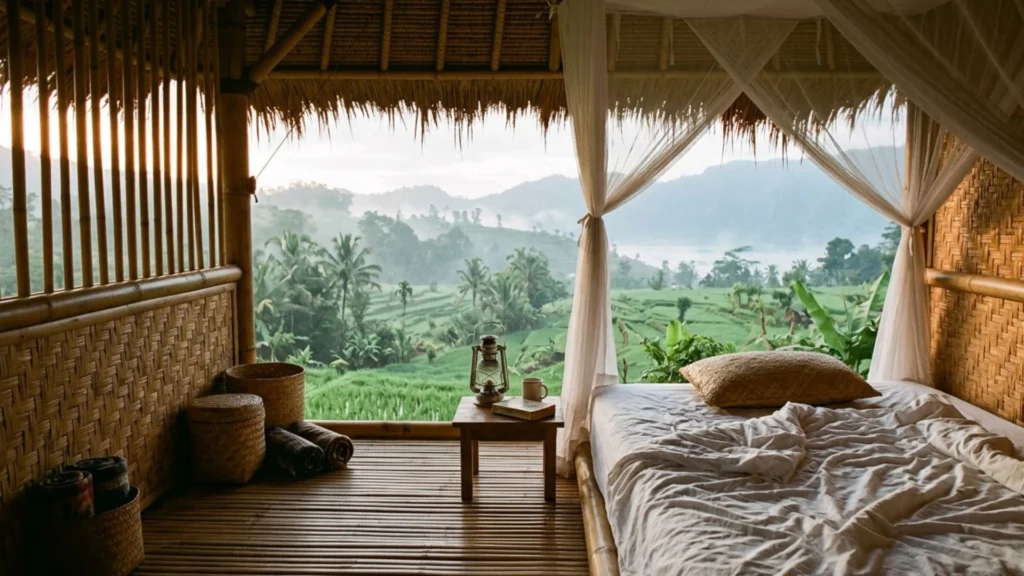
Eco stays Bali honest guide: Eco accommodation in Bali ranges from genuinely off-grid operations running on river hydro and spring water to resorts that removed their plastic straws and called it sustainability. Knowing the difference before you book saves both money and disappointment.
This eco stays Bali honest guide covers what sustainable accommodation in Bali actually looks like, how to tell the real thing from the marketing, and which properties across different regions and budgets have earned the label through practice rather than brochure language. The market for eco-friendly accommodation in Bali has grown considerably over the past decade. So has the number of properties that describe themselves as eco without substantiating the claim.
The honest version of this guide starts with a straightforward admission: most accommodation in Bali that uses the word “eco” is doing something — but very few are doing everything. The properties worth staying at are the ones where the sustainability practices are specific, verifiable, and structurally integrated into how the place operates — not added on top as a marketing layer.
What “Eco” Actually Means in a Bali Context
Genuine sustainable accommodation in Bali typically operates across five areas: construction materials, energy source, water management, waste systems, and community investment. A property doing all five with documented practice is rare. A property doing three or four consistently is worth considering. A property that mentions bamboo furniture and refillable soap dispensers and calls itself eco is not the same thing.
Construction — Bamboo, reclaimed wood, natural stone, and earthen materials built by local craftspeople. Not imported materials with a tropical veneer.
Energy — Solar panels, micro-hydro from on-site rivers or springs, or grid-tied renewables. Properties powered entirely by diesel generators and describing themselves as eco are not.
Water — Rainwater harvesting, greywater recycling, and on-site spring or river sources. Bali’s groundwater is under significant pressure in the south; properties that pump groundwater without recycling systems are contributing to a real problem regardless of other credentials.
Waste — Active composting, zero single-use plastic as a structural policy, and organic waste going back into the land. Not “we reduced our straws.”
Community — Staff hired locally, produce sourced from nearby farms, and a meaningful percentage of revenue staying within the local economy. This is the criterion most frequently absent from eco claims that focus only on the environmental side.
The Tri Hita Karana award — given by the Balinese foundation of the same name — is one of the more credible local certifications, recognising properties that demonstrate alignment with the Balinese principle of harmony between people, nature, and the spiritual. Properties holding this award have been assessed by an independent body rather than self-certified.
Eco Stays by Region
Ubud and Central Bali
Ubud has the densest concentration of genuinely sustainable accommodation in Bali, partly because the cultural and environmental values of the region attract properties that mean it, and partly because proximity to Bali’s most active conservation and wellness communities creates accountability.
Bambu Indah (Ubud) — Built by John and Cynthia Hardy, the founders of Green School Bali, Bambu Indah sits on the Ayung River gorge with accommodation in restored antique Javanese houses and bamboo structures. The property runs on spring water, composts extensively, and operates a farm supplying much of the kitchen. It is not cheap — rates start around USD 300 per night — but the sustainability credentials are substantive rather than decorative.
Sarinbuana Eco Lodge (Mount Batukaru, Tabanan) — On the slopes of Mount Batukaru in central Bali, Sarinbuana offers six bungalows in a permaculture garden setting with guided rainforest trekking and food grown almost entirely on site. Rates are considerably more accessible than Bambu Indah — roughly USD 80–120 per night including breakfast. This is the property most consistently recommended by travellers who specifically want a working eco stay rather than an eco-branded luxury experience.
Ulaman Eco Luxury Resort (Canggu) — Bamboo architecture at the luxury end of the market, built from sustainably harvested local bamboo with a strong commitment to low-impact construction. Located near Canggu, which is not inherently a slow travel destination, but the property itself operates on genuinely sustainable principles. Rates from USD 250 per night.
East Bali
The Seed Bali (Candidasa) — A private estate in Candidasa, East Bali, built from reclaimed wood and local materials with a closed-loop waste system and solar energy. The Seed must be booked as an entire property (sleeps up to 21) rather than room by room, which makes it suitable for groups. It is located within the same Karangasem region as Sidemen and Amed, making it a natural base for East Bali exploration.
Village homestays in Sidemen — The most straightforward form of eco stay in East Bali requires no certification: family-run guesthouses where your money goes directly to the household, food comes from the local market and family garden, and the environmental footprint of your stay is minimal by default rather than design. The Sidemen Valley trekking guide includes accommodation notes for the area.
North Bali
Munduk Moding Plantation (Munduk) — A working coffee plantation converted to small resort accommodation. The plantation character is genuine — cloves and coffee are harvested, processed, and served. Local hiring is extensive. The setting is one of the most beautiful on the island. Rates are mid-to-high range.
Sumberkima Hill (West Bali coast) — A private villa retreat in northwest Bali near Pemuteran, involved in coral reef restoration in the adjacent marine park and committed to regenerating the surrounding land. One of the more serious environmental operations on the island for guests who want their stay to contribute to active conservation work.
How to Identify Greenwashing Before You Book
Greenwashing in Bali accommodation is common enough that it warrants a practical checklist. Before booking any property claiming eco credentials, look for:
Specific claims, not general language — “We use solar panels for 60% of our energy and composted all organic waste from our kitchen last year” is specific. “We care about the environment” is not.
Staff nationality and sourcing — A property with all local Balinese staff and a kitchen sourcing from nearby farms is doing more for sustainable community impact than a resort with international management and imported produce and a bamboo lobby.
What they do with water — Ask directly. Properties with genuine water management systems can answer specifically. Properties that cannot answer have no system worth mentioning.
Third-party recognition — Tri Hita Karana award, Green Globe certification, or mention in credible sustainability-focused travel media is more meaningful than self-applied labels.
Price point versus claims — A property charging USD 30 per night and claiming comprehensive sustainability practices is almost certainly not delivering on the waste management and community investment side. Real eco operations have real costs.
| Claim | What to check |
|---|---|
| “Eco-friendly construction” | What materials specifically? Built by local craftspeople? |
| “Sustainable energy” | Solar, hydro, or wind? What percentage of total energy? |
| “Organic food” | Grown where? On site, or from a certified local supplier? |
| “Zero plastic” | Does this extend to the kitchen and housekeeping, not just guest amenities? |
| “Community support” | What percentage of staff are local? Where does produce come from? |
Budget Eco Stays: What’s Actually Possible Under USD 50
The honest answer is that comprehensive sustainability costs money to operate, and budget accommodation under USD 50 per night in Bali is unlikely to have invested in solar systems, greywater recycling, or permaculture gardens. What is achievable at budget level is the community investment side: staying in a family-run guesthouse where your money goes directly to the household, eating at local warung, and hiring local guides rather than booking through international platforms.
This approach — call it community-focused rather than infrastructure-eco — has a legitimate claim to sustainable travel practice. It keeps money in the local economy, avoids the extractive dynamic of large resort chains, and creates a closer connection between visitor and place. It is worth stating plainly rather than dismissing because it doesn’t involve bamboo architecture.
Nara had spent a week comparing eco certifications online before her Bali trip. She booked Sarinbuana eventually — the permaculture garden and the trekking were what tipped it. What she didn’t anticipate was spending most of her stay talking to the kitchen staff about what was growing in the garden that week and eating dishes she couldn’t have named before she arrived. The sustainability infrastructure mattered less, she said afterward, than the fact that the people running the place were genuinely invested in where it was located.
A Practical Note on Booking Direct
Booking directly with eco properties rather than through major platforms (Booking.com, Expat, Airbnb) has a concrete sustainability benefit: the commission that platforms charge — typically 15–25% — stays with the property rather than a multinational intermediary. For small eco operations where margins are already tight, direct bookings make a meaningful difference to what can be invested in sustainability infrastructure. Most properties of the kind described in this guide have direct booking options on their own websites.
FAQ
What makes an eco stay in Bali genuinely sustainable? Genuine sustainability in Bali accommodation involves specific, verifiable practices across construction materials, energy source, water management, waste systems, and community investment. Properties that can answer specific questions about each of these areas are more credible than those using general language about caring for the environment.
Are eco stays in Bali expensive? The most comprehensive eco operations — Bambu Indah, Ulaman, Sumberkima Hill — are in the USD 200–400 per night range. Mid-range genuinely sustainable properties like Sarinbuana Eco Lodge operate in the USD 80–120 range. Community-focused budget stays in local guesthouses are available from USD 20–50 per night and deliver a different but legitimate form of sustainable travel.
What is the Tri Hita Karana award in Bali? The Tri Hita Karana award is given by a Balinese foundation to properties that demonstrate alignment with the Balinese principle of harmony between humans, nature, and the spiritual. It is an independent assessment rather than self-certification and is one of the more credible local sustainability recognitions available in Bali.
Is it better to stay in a local homestay or a certified eco resort? They serve different purposes. A certified eco resort with strong infrastructure makes a direct contribution to renewable energy adoption and waste reduction in Bali. A local homestay makes a direct contribution to community economic sustainability and cultural continuity. Both are valid approaches to responsible travel; the right choice depends on what matters most to the individual traveller and their budget.
How do I avoid greenwashing when booking eco accommodation in Bali? Ask specific questions before booking: what percentage of energy comes from renewable sources, where does the food come from, what happens to organic waste, what percentage of staff are local. Properties with genuine practices can answer these specifically. Those that cannot have something less than they claim.