
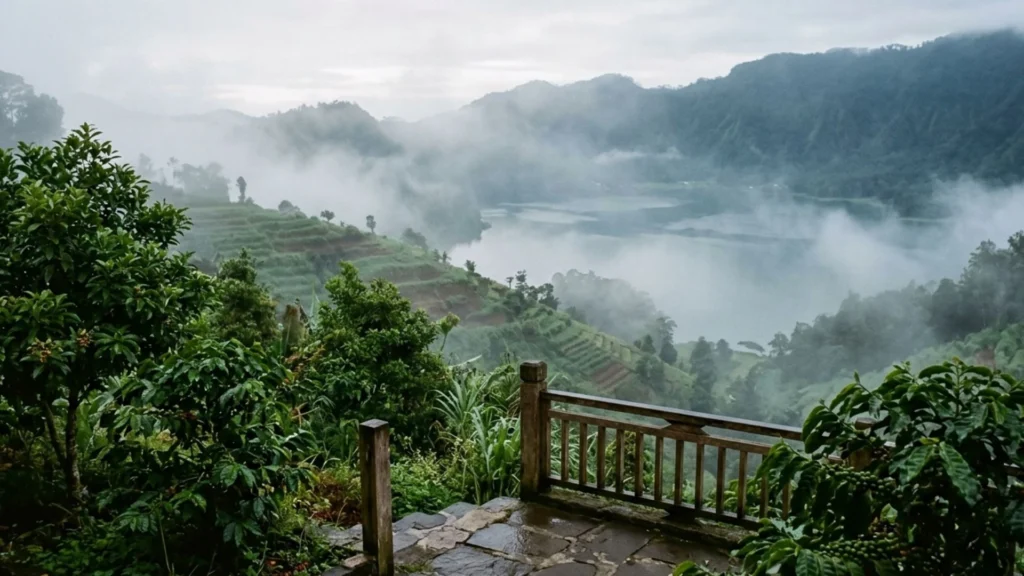
Munduk Bali travel guide: Munduk is a small highland village in Buleleng regency, North Bali, at around 900 metres elevation — surrounded by clove and coffee plantations, crater lakes, and a waterfall trail that takes most of a day to complete properly.
This Munduk Bali travel guide covers the waterfall trek, the twin lakes, where to stay, and how long to spend — because Munduk is one of those places that most visitors do as a rushed day trip when it works considerably better as a two or three night stay. The village sits at the end of a winding mountain road above Bedugul, cooler and quieter than anywhere in South Bali, and its character is almost entirely intact. The accommodation is mostly local homestays. The restaurants are mostly warung. There are no beach clubs.
Most two-week Bali itineraries slot Munduk in as a stop on the drive between Ubud and the north coast — which works, but shortchanges the place considerably. If you have built a Bali slow travel itinerary around depth rather than coverage, Munduk deserves two nights minimum and ideally three.
What Munduk Actually Is
Munduk is a working agricultural village. The surrounding land produces cloves, coffee, vanilla, and cacao — crops that have shaped the local economy for generations. Walking the paths around the village, you move through working plantations, not scenic reconstructions. The smell of drying cloves on roadside racks is one of the more immediate sensory markers that you are somewhere genuinely different from the tourist circuit.
The village itself is small — a main road with a handful of warung, a few shops, and guesthouses set back on the hillside. There is no ATM in the village; the nearest is in Seririt, about 20 minutes north. Bring cash before you arrive.
The landscape differs from central Bali in every respect. No rice terraces in the Ubud sense — the terrain here is too steep and the agriculture too mixed. The views instead are of forested ridges, lake surfaces through the trees, and on clear days the north coast and the Bali Sea visible far below. The temperature is noticeably cooler — mornings in Munduk often require a light jacket, which feels extraordinary after days on the coast.
The Munduk Waterfall Trek
The most popular activity in Munduk is the waterfall trail that connects five waterfalls on a 4 to 6 hour loop starting from the village centre. The five are: Red Coral Waterfall (also called Munduk Waterfall), Golden Valley Waterfall, Belong Waterfall, Labuhan Kebo Waterfall, and Melanting Waterfall.
The trail starts on Jalan E Taman near the centre of Munduk and is walkable from most accommodation without transport. Entrance fees at the trail head run IDR 20,000–25,000 per person depending on the specific access point.
Red Coral Waterfall is the closest to the village and the most visited — a wide cascade into a pool suitable for swimming, surrounded by jungle. It is typically the first stop and takes about 20 minutes to reach on foot.
Golden Valley Waterfall is about 15 minutes further along the trail and has an eco café at the top where you can eat lunch with the waterfall visible from the table. This is a reasonable midpoint rest stop on the full circuit.
Melanting Waterfall is the furthest and involves roughly 450 stairs — steep, uneven in places, and demanding after several hours of trekking. It is also the least visited, which means on a weekday morning you may have it entirely to yourself. The descent is worth the effort; most visitors who quit before reaching it say afterward that they regret it.
Practical notes for the full circuit: Start no later than 8am. The trail takes 4 to 6 hours at a thorough pace including swimming stops. Bring water (minimum 2 litres), snacks, and footwear with grip. Flip flops are not suitable — the paths involve steep stairs, wet rocks, and mud after rain. The trail is self-guided and reasonably well-marked, but a local guide (bookable through accommodation, IDR 100,000–200,000) adds context and ensures you do not miss the less obvious junctions.
The Twin Lakes: Tamblingan and Buyan
Two crater lakes sit directly below the ridge road that leads into Munduk from the south — Danau Tamblingan to the west and Danau Buyan to the east. Both are visible from the road and from several viewpoints along the descent into the village. On a clear morning, the surface of the lakes reflects the surrounding forest and the early light in a way that earns the frequent superlative descriptions.
Tamblingan is the more interesting of the two for visitors. The lake sits inside an ancient caldera and has no outlet — its water level is maintained entirely by rainfall and the surrounding forest. Pura Ulun Danu Tamblingan, a Hindu temple complex on the lake’s western shore, is considered one of the island’s most spiritually significant water temples. A canoe ride with a local paddler across the lake to the temple — IDR 150,000–250,000 per boat — is the most direct way to approach it. The lake’s stillness and the temple’s position at the forest edge make the approach by water more effective than the road access.
Buyan is larger and more easily visible from the main road viewpoint. It has a lakeside walking path and several cafés along the ridge above with views across the water. The viewpoint above the twin lakes is one of the most-photographed spots in North Bali — arrive before 8am to have the view without crowds and without vendors.
What Else Is Worth Doing in Munduk
Banjar Hot Springs — 30 minutes northwest of Munduk, a series of sulphurous hot spring pools set in a garden. The water is genuinely hot — around 38–40 degrees — and the pools are tiered, with carved dragon spouts feeding each level. It is neither secluded nor uncrowded, but it is a legitimate hot spring, not a resort spa, and the surrounding garden is well-maintained. Entry IDR 40,000.
Brahmavihara Arama Monastery — 5 minutes from Banjar Hot Springs, the only Buddhist monastery on Bali. The grounds are immaculately maintained and the architecture is a striking departure from the Hindu temple aesthetic that dominates the island. The monastery is active — monks are present, prayer schedules are observed — and visitors are welcome during daylight hours. Free entry, donations appreciated.
Banyumala Twin Waterfalls — 15 minutes east of Munduk, technically in Wanagiri rather than Munduk itself, but easily combined with a Munduk stay. Two parallel cascades fall into a cold, clear pool. The hike down involves steep stairs and takes about 20 minutes from the car park. Entrance IDR 30,000. The pool is swimmable and the waterfall is significantly less visited than anything in South Bali.
Coffee plantation walk — Several plantations in the Munduk area allow informal visits. Ask at your accommodation for the nearest one. Seeing cloves, coffee, cacao, and vanilla growing together in the same slope puts the agricultural character of the area into direct context.
Where to Stay in Munduk
Munduk has no large hotels. Accommodation is almost entirely homestays, small guesthouses, and a handful of boutique lodges on the hillside.
Budget — Local homestays charge IDR 150,000–300,000 per night for a clean room with breakfast. The family-run places near the village centre are the most practical base for the waterfall trail.
Mid-range — Several guesthouses with valley or lake views charge IDR 400,000–800,000. Rooms with a private terrace overlooking the forest below are worth the small premium, particularly for early morning coffee with the mist still in the valley.
Boutique — Munduk Moding Plantation is the most well-known upmarket option — a working coffee plantation turned small resort with cottages set among the trees. Rates are considerably higher than the local guesthouses but the setting is genuinely exceptional. Worth considering if Munduk is a focal point of the trip rather than a stop.
Getting to Munduk
Munduk is approximately 1.5 to 2 hours from Ubud by scooter or car via Bedugul. The road from Bedugul climbs sharply to the ridge above the twin lakes before descending into the village — the views from this ridge section on a clear morning are among the best driving scenery on the island.
From Ubud: take the road north through Kintamani or via Bedugul depending on route preference. The Bedugul route passes Ulun Danu Beratan temple on Lake Beratan — a worthwhile stop en route if you have not visited.
From the north coast (Lovina, Singaraja): Munduk is approximately 45 minutes south. This makes it a natural base if you are moving between the north coast and central Bali.
A scooter is the most practical transport once in Munduk — the waterfalls, lakes, and surrounding attractions are spread across 15 to 20km of mountain road. Walking between them is possible but time-consuming. A driver for a day (IDR 300,000–450,000 from within Munduk) makes sense if you want to cover the twin lakes, a waterfall, and Banjar Hot Springs in a single day without managing parking.
Munduk works best when you give it more time than your itinerary initially allocates. The waterfall trail alone fills a full day. The twin lakes fill a morning. The coffee plantation, the monastery, and the Banyumala waterfalls fill another. Three nights in Munduk is not excess — it is the point at which the village starts to feel like somewhere you are staying rather than visiting.
For travellers building a North and East Bali circuit, Munduk connects naturally with Amed on the east coast — a half-day drive through the interior via Singaraja and the north coast road, stopping at Sekumpul Waterfall along the way if the schedule allows.
FAQ
How long should I spend in Munduk Bali? Two nights is the minimum to complete the waterfall trek properly and visit the twin lakes. Three nights allows you to add Banjar Hot Springs, Banyumala Twin Waterfalls, and a coffee plantation walk without rushing any of them. Day trips from Ubud are possible but cover only a fraction of what Munduk offers.
Is the Munduk waterfall trek suitable for beginners? The full five-waterfall circuit involves steep stairs — particularly the 450 steps to Melanting Waterfall — and takes 4 to 6 hours. It is manageable for most fitness levels with appropriate footwear and an early start. Visitors who want a shorter option can do just Red Coral and Golden Valley waterfalls in about two hours.
Do I need a guide for trekking in Munduk? The main waterfall trail is self-guided and reasonably well-marked. A local guide adds context about the plantations, the local community, and the less-visible junctions on longer routes. For the twin lakes and Tamblingan temple canoe visit, a guide is useful for arranging the boat and explaining the temple. Bookable through most accommodation for IDR 100,000–200,000.
Is there an ATM in Munduk? No. The nearest ATM is in Seririt, approximately 20 minutes north. Bring enough cash from your previous base — Ubud, Bedugul, or Lovina — to cover your full stay including accommodation, food, entrances, and transport.
What is the best time to visit Munduk Bali? The dry season from April to October offers the most reliable conditions for trekking. The wet season brings daily rain — usually in the afternoons — which can make the waterfall trail slippery and raise the risk of river crossings. Munduk is worth visiting year-round; the wet season makes the waterfalls more dramatic and the plantations greener. Start all activities before noon regardless of season.