
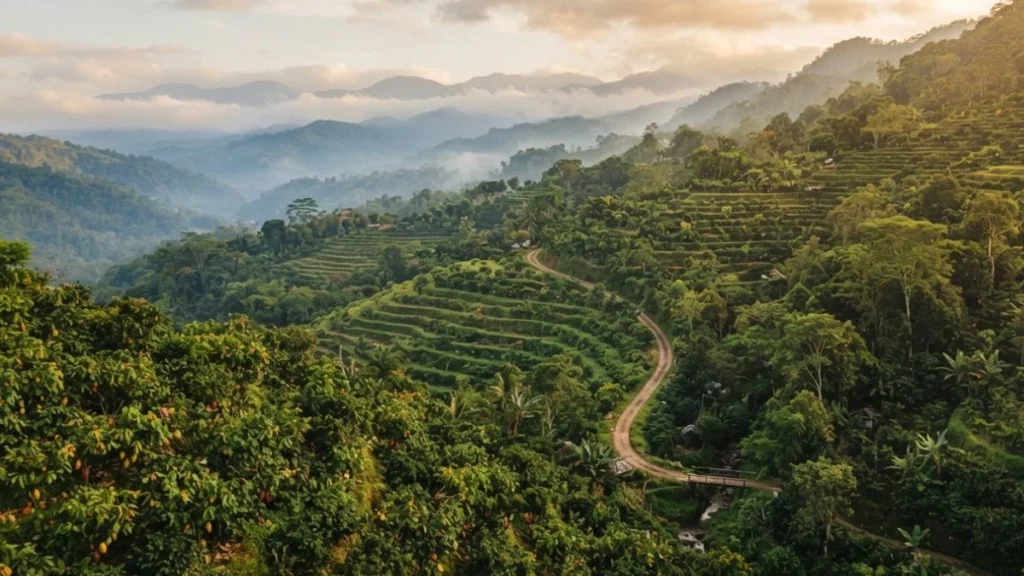
Ask ten travelers where Bali’s chocolate comes from and most will point you toward a roadside “chocolate farm” outside Ubud with a gift shop bigger than the plantation. Pupuan, tucked into the hills of west Tabanan, is where the actual work happens. This is robusta and cacao country — steep terraces of coffee and cocoa trees planted between clove and durian, worked by families who’ve been farming this ridge for generations, with almost none of the polish (or the crowds) of the tourist-facing “chocolate villages” closer to the south.
It’s not a detour you make on a whim. Pupuan sits roughly two to two and a half hours from Ubud on a road that climbs, drops, and switches back through some of the greenest scenery on the island — which is exactly why the honest pitch here isn’t “quick stop,” it’s “make the drive the point.” You go for the road as much as the destination, and you go knowing this is farm country, not a curated attraction.
Quick Facts
- Location: Pupuan district, west Tabanan Regency, roughly 700m elevation
- Distance from Ubud: ~68km road distance, around 2–2.5 hours by car (mountain roads, not a straight shot)
- What grows here: Robusta coffee and cacao, interplanted with cloves, durian, and vanilla on smallholder plots
- Best for: Slow travelers with a car and a full day, coffee/cacao enthusiasts, anyone doing the Tanah Lot–Antosari–Pupuan–Munduk route
- Not for: Anyone on a scooter, short on time, or expecting a polished visitor center
- Cost: Farm visits are typically informal — a small tip or produce purchase goes further than a ticket price
Why Pupuan and Not the Chocolate Village Near Ubud
The chocolate farms clustered around central Bali and the Denpasar–Bedugul road do real agrotourism work, and they’re a fine option if time is tight. But they’re built for volume: set tour packages, a restaurant menu, chocolate-themed desserts, a gift shop. What you’re buying there is an experience about cacao.
Pupuan is where the beans for a lot of Bali’s robusta actually grow. Farmers here work small plots — often under a hectare — and cacao is usually just one crop among several on the same land, alongside coffee, cloves, and fruit trees. There’s no single “Pupuan Chocolate Village” gate to walk through. Visiting means connecting with a local guide, a homestay, or a smallholder cooperative that can walk you through an actual working farm rather than a demonstration one.
What You’ll Actually See
Terraced hillsides thick with coffee shrubs and cacao trees, their pods ripening from green to yellow-orange to deep red depending on the season, planted alongside durian, mangosteen, and rambutan groves that most visitors to Bali never see outside a market stall. Early morning is when the region actually shows itself: farmers laying out cloves to dry on roadside mats, the air carrying that sharp, warm clove smell before you’ve even parked. Simple family compounds with drying racks out front, not staged for tourists but because that’s where the beans and buds dry every day regardless of who’s watching.
If you connect with a farming family or a small cooperative, you’ll typically get shown the difference between a ripe and unripe cacao pod, how beans are split and fermented before drying, and — if you’re lucky and it’s the season — a chance to try roasting or grinding cacao the way it’s done at home rather than in a factory.
The Cooperative Behind the Chocolate
Pupuan’s cacao doesn’t stay local — some of it has ended up in genuinely well-regarded chocolate. Nearby in the Jembrana side of West Bali, a farmers’ cooperative called Koperasi Kerta Semaya Samaniya (KSS) has spent over a decade working with the Kalimajari Foundation to shift smallholders away from old-tradition methods toward proper fermentation and sustainable farming practices. The payoff is real: French chocolate maker Valrhona now sources from this cooperative for a single-origin bar called Sakanti Bali, and has brought international visitors out to see the plantations firsthand.
That’s the honest context worth knowing before you go: this isn’t a region play-acting at cacao tourism for Instagram. It’s a working supply chain that happens to also be one of the most scenic drives in Bali, and a handful of farms and cooperatives around Pupuan and Jembrana are open to visitors who reach out ahead of time rather than just showing up.
Blahmantung Waterfall (Pupuan Waterfall)
If you’re already making the drive, build in time for Blahmantung Waterfall, locally known as Pupuan Waterfall, dropping more than 100 meters through cliffs surrounded by coffee and clove plantations. It’s roughly an 800-meter walk in from the parking area — manageable, but the path gets slippery in the rainy season, so decent shoes matter more than they would at a paved attraction. It’s not signposted the way south Bali waterfalls are, so ask locally or arrange it through wherever you’re staying rather than relying on a map pin alone.
The Robusta Story
Bali’s coffee identity outside the country is almost entirely Kintamani arabica — high-altitude, volcanic soil, citrus notes, the stuff that ends up in specialty cafes worldwide. Robusta rarely gets mentioned, but it’s what most Balinese actually drink day to day: stronger, more bitter, higher caffeine, earthier. Pupuan and neighboring Munduk are the heartland of it, grown at lower elevation than Kintamani’s arabica belt and processed with far less ceremony.
If your only frame of reference is specialty arabica, Pupuan robusta will taste different — heavier, less bright. That’s not a flaw to explain away; it’s the point. This is working coffee, not competition-grade coffee, and treating it as such is the honest way to enjoy it.
Getting There and Making It Worth the Trip
The drive itself is the main event on the way in. The classic route runs Tanah Lot → Antosari → Pupuan, climbing through rice terraces that shift growth stage from field to field, then into denser plantation country as the road gains altitude. Coming from Ubud, plan on the Angsri–Apuan road through small villages rather than the main highway — slower, but it’s the scenic version and matches the slow-travel point of going at all.
Because the drive eats most of a day round-trip, the honest move is to combine it rather than treat it as a standalone outing. Pupuan sits naturally on the way to or from Munduk, so a west Bali loop — Tanah Lot, Pupuan, Munduk, and back — makes far better use of the drive than a there-and-back day trip. Renting a car with driver or doing this on a self-drive road trip both work; a scooter does not, given the road length and mountain switchbacks.
If you want to stay overnight instead of rushing back, Temuku Pupuan is a working organic farmstay at the foot of Mount Batukaru with views over the plantations and coastline below — the kind of place built for slow mornings and a farm workshop rather than sightseeing checklists. It’s a fair marker of what this whole region is actually for.
What to Skip and What to Manage
Don’t expect a formal booking system or a set tour price — this is closer to arranging a visit through a homestay owner or a small cooperative than clicking “book now.” Build in flexibility, and be ready for a visit that runs on the farmer’s schedule, not a tour operator’s.
Don’t come expecting the chocolate-dessert experience of the bigger agrotourism farms — no cacao pizza, no ice cream parlor. What you get instead is a genuine look at where the crop comes from, which is a fair trade if that’s what you’re actually after.
FAQ
Is Pupuan worth visiting if I only have a few days in Bali?
Probably not on its own. The drive alone takes half a day round-trip, so it makes far more sense as part of a longer west Bali loop with Munduk or Tanah Lot than as an isolated stop for a short trip.
Can I visit a cacao farm in Pupuan without a pre-arranged guide?
It’s possible but harder — this isn’t a ticketed attraction with a gate and a schedule. Most travelers arrange a visit through a local homestay, driver, or small cooperative rather than showing up unannounced.
Is Pupuan coffee the same as Kintamani coffee?
No. Kintamani is Bali’s arabica region, grown at higher volcanic altitude with a lighter, fruitier profile. Pupuan grows mostly robusta at lower elevation — stronger, earthier, and much more likely to be what a local household actually drinks.
What’s the best way to get to Pupuan from Ubud?
By car, ideally self-drive or with a hired driver, via the Angsri–Apuan road or the Tanah Lot–Antosari route. Expect roughly two to two and a half hours of winding mountain road each way — not a trip for a scooter.
Is there somewhere to stay overnight in Pupuan itself?
Yes, though options are limited and simple compared to Ubud or Munduk — small homestays and working farmstays like Temuku Pupuan, near Mount Batukaru. Many travelers instead base themselves in Munduk, a short drive further north, and treat Pupuan as a stop along the way.
Is there anything to see in Pupuan besides plantations?
Blahmantung Waterfall (also called Pupuan Waterfall), an 100-metre-plus drop reached by an 800-metre walk from the parking area, is the main non-agricultural stop. It’s unmarked compared to south Bali’s tourist waterfalls, so it’s worth confirming directions locally rather than relying only on a map app.
Pupuan won’t show up on a “top things to do in Bali” list, and that’s the honest appeal of it — it’s farm country that happens to grow the beans in your morning coffee, not a destination built for visitors. If you’re already planning the drive out to Munduk or working West Bali into a longer Bali road trip, routing through Pupuan is the one that actually earns its place on the map.