
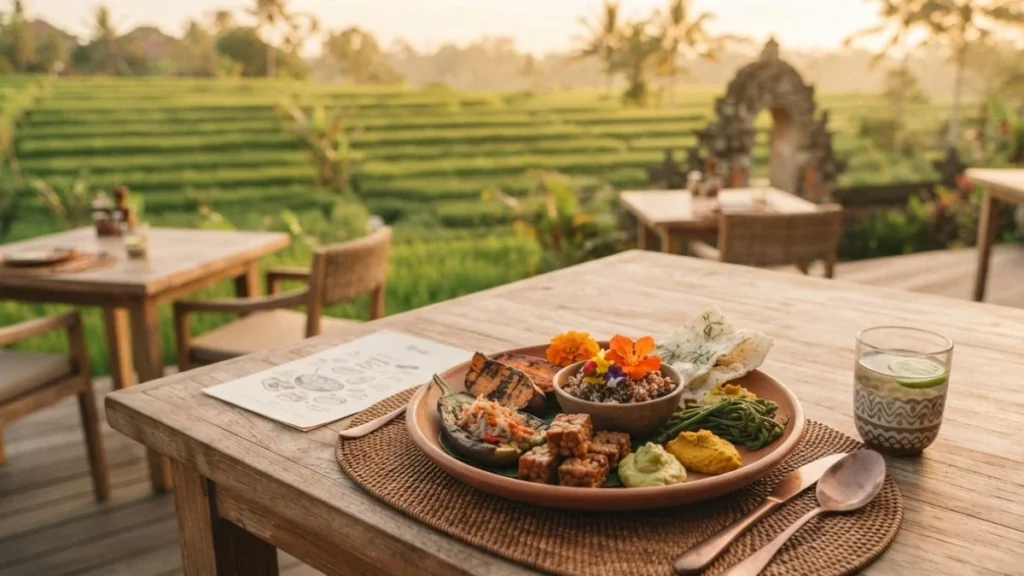
“Farm-to-table” gets printed on menus all over Bali now, usually next to a photo of a rice field the kitchen may or may not actually source from. Ubud is the one place on the island where the phrase mostly holds up. This is a town surrounded by working farms, with chefs who’ve spent years mapping which grower has the best kale this week, and a permaculture garden or two attached directly to the dining room. It’s also, as of 2026, becoming Bali’s most serious culinary address — not because of beach-club energy, but because of exactly this: produce-driven kitchens that treat a farmer relationship as the actual product, not the marketing.
That said, the label still gets stretched. Some places genuinely grow a meaningful share of what’s on your plate. Others buy from the same wholesale market as everywhere else and lean on the aesthetic. Knowing which is which — and picking the tier that matches your budget and time — makes the difference between a forgettable dinner and the meal you talk about after the trip.
Quick Facts
- Where: Concentrated in and around central Ubud, with several standouts a short drive into the rice fields (Sayan, Nyuh Kuning)
- Price range: Rice-field warungs from ~100–200k IDR/person; mid-range farm-driven spots 300–600k; tasting-menu fine dining 1–3 million+ per person
- Booking: Reserve fine dining at least a week ahead in peak season (July–August, December)
- Extra costs: Most fine-dining bills carry a 15–21% service charge and tax on top of menu prices — always ask
- Dress code: Casual across most of Ubud; smart-casual expected at the top-tier tasting-menu restaurants
- Best for: Travelers who want to understand Bali’s agriculture through food, not just eat scenery
The Places Actually Doing the Work
Locavore NXT is the benchmark — a hyper-local tasting menu that landed on Asia’s 50 Best Restaurants list, built on relationships with named farmers rather than an anonymous supply chain. It’s the least “warung-adjacent” option on this list and priced accordingly, but it’s the clearest example of what farm-to-table means when a kitchen takes it seriously.
Moksa does the opposite end of the same idea at a gentler price point: a plant-based restaurant with its own permaculture garden growing more than 60 species of edible plants on-site, so a meaningful share of what you eat that night was picked from soil visible through the dining room.
Tembaga, at the eco-retreat Bambu Indah, has built its entire concept around “longevity” ingredients — mushrooms and nutrient-dense produce sourced locally, organized around growing, transforming, and sharing food as three connected stages rather than just a menu.
Terra Verte, one of Ubud’s newer openings, applies the same farm-sourcing logic to Italian-Mediterranean cooking, with rice-field views and ingredients harvested within hours of service — proof the trend isn’t limited to Indonesian tasting menus.
For something closer to daily life than fine dining, Sweet Orange Warung sits out in the rice fields at warung prices and is the honest answer for travelers who want the setting and the local-ingredient ethos without a three-hour tasting menu and a service charge.
Why This Is Concentrated in Ubud Specifically
Coastal Bali competes on beach clubs and Instagram backdrops. Ubud doesn’t have that option, so its restaurant scene grew around what it does have: proximity to farmland, a wellness-and-slow-living identity that draws chefs who want to cook that way, and a customer base that’s already primed to care where food comes from. That’s not a coincidence — it’s the same demand that built Ubud’s yoga and coworking scenes. Gastronomy tourism here isn’t a bolt-on trend; it’s downstream of the town’s whole positioning.
That also means the “farm-to-table” claim is easier to verify in Ubud than almost anywhere else on the island. A kitchen twenty minutes from an actual cacao or coffee smallholding has a real supply chain available to it. A beach-club restaurant in Canggu or Uluwatu is working with the same wholesale distributors as everyone else, whatever the menu says.
How to Tell the Real Ones From the Marketing
A few honest signals worth checking before you book:
- A named garden or grower relationship, not just “locally sourced” as a blanket phrase — Moksa’s on-site garden or Locavore NXT’s farmer partnerships are concrete; vague language usually means less concrete sourcing
- A menu that changes with the season, since real dependence on a farm means real dependence on what’s actually ready to harvest
- Staff who can answer where a specific ingredient came from when you ask — a fair test at any price point, and one that filters out the places using the term loosely
None of this means the marketing-heavy places are bad meals. It just means “farm-to-table” on a menu isn’t a guarantee, and it’s worth a five-second gut check before assuming the phrase is doing real work.
Booking and Budgeting Realistically
Peak season (July–August and December) fills the top-tier tasting menus fast — book Locavore NXT and similarly ranked spots at least a week out if those dates matter to you. Expect a 15–21% bump on top of the printed menu price at fine-dining restaurants once service charge and tax are added; it’s rarely broken out clearly on the menu itself, so budget for it rather than being surprised at the bill. Warung-tier farm-to-table spots don’t carry this markup, which is part of why they’re the better fit for a casual lunch rather than a special-occasion dinner.
FAQ
Is farm-to-table dining in Ubud actually more expensive than regular restaurants?
It depends entirely on the tier. A rice-field warung with a genuine local-ingredient ethos can cost about the same as any other Ubud warung. The gap opens up at the tasting-menu level, where a farm-driven fine-dining experience runs well into seven figures (IDR) per person once service and tax are added.
Do I need to book Locavore NXT or Mozaic in advance?
Yes, especially during peak season (July–August and December), when a week’s notice is the safe minimum for the most in-demand tasting menus. Shoulder-season bookings a few days out are usually fine.
Is Moksa suitable if I’m not vegetarian or vegan?
Yes — it’s built for plant-based dining but is popular with omnivores specifically because the permaculture garden and seasonal menu make the food genuinely craveable rather than a compromise option.
What’s the difference between farm-to-table and just “organic” on a Bali menu?
Organic refers to how something was grown; farm-to-table refers to how directly it reached the kitchen. A restaurant can serve organic produce sourced through a distributor, which isn’t the same as a direct farmer relationship or an on-site garden — worth distinguishing if that connection is the reason you’re choosing the restaurant.
Are there farm-to-table options outside central Ubud, like near Sayan or Nyuh Kuning?
Yes — several standouts, including riverside and rice-field settings, sit a short drive from the town center rather than in it. If you’re staying outside central Ubud already, it’s worth checking a restaurant’s exact location before assuming a walk is possible.
If food is part of why you’re slowing down in Ubud rather than island-hopping, pair a farm-to-table meal with a morning at Ubud Market or a proper sit-down at Best Warung Ubud — seeing where the ordinary version of this food culture happens makes the tasting menu land differently.